A familiar National Day song still needs work
For Singapore listeners who know Where I Belong, meaning a place of belonging, the melody provides a close-to-home entry into Tanya Chua’s work. She wrote and sang the 2001 National Day song. For its twentieth anniversary in 2021, the Singapore Symphony Orchestra collaborated with her on a new version. Arranger Avik Chari had to make room for vocalists, choir, solo violin and orchestra inside a song many listeners already knew.
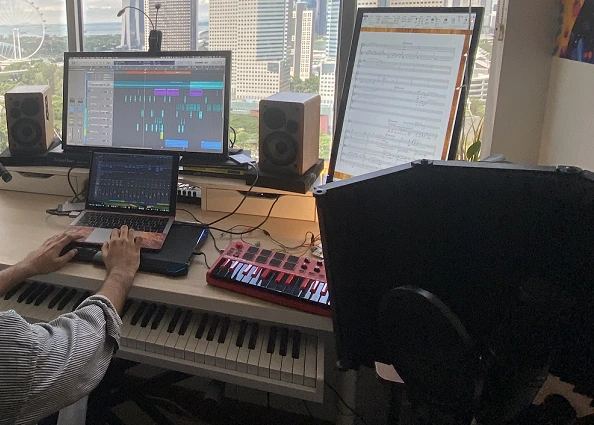
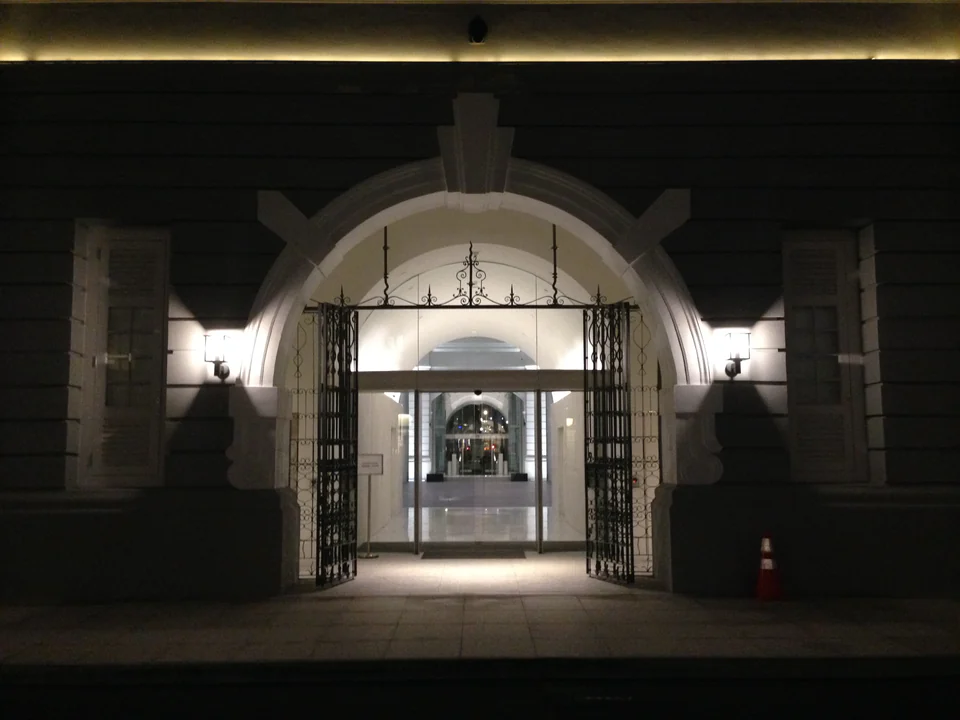
Chari received the assignment in May 2021 and described the pressure in SSO’s July interview: the understated song had to become symphonic while meeting listeners’ expectations. His other job, preparing the orchestra’s scores and parts, placed him in its music library at Victoria Concert Hall. Both tasks turn written music into something other people can perform. A familiar melody reaches an audience again because somebody has worked through those details.
An award does not decide what a songwriter can make
Chua’s recording career began with the English-language album Bored in 1997. Years later, a first Golden Melody award did not resolve the question of what she could make. Recalling this period on Bowie Tsang’s Let’s Go Home in 2025, she described pressure at her former Singapore label and agency to sing other people’s songs, including material intended for karaoke. Writing had drawn her into music; being asked to set it aside threatened the reason she wanted to stay.
She recalled choosing between giving up music and moving to Taiwan. In 2006 she arrived in Taipei with a guitar, a suitcase and enough money for three months’ rent, without a management company or label waiting for her. The move required starting again with the conditions of daily work. Her account makes the cross-sea connection concrete: Taipei became a place in which she could rebuild a life around continuing to write.
Home recording opens onto other people’s work
For DEPART, released on 13 August 2021, Chua brought composition, acoustic-guitar arrangement, her own playing and singing, and recording work into her home studio. The album materials also identify other contributions, including Ricky Ho’s string arrangements. The ten-song record included collaborations with Ayanga and Carla Bruni. Taking more of the recording into her own hands gave her a working centre from which different voices and instruments could join.
For Photographs, Chua recorded Mandarin pronunciation so that Bruni could learn the words, then took part in producing the recording by video connection. Taiwanese production coordinator and lyricist David Ke connected her idea for Into the Wild with Hong Kong writer Chow Yiu-fai. Sandee Chan directed the Bluebirds video after Chua explained the song’s intention. The connections involved practical exchanges: explaining an idea, teaching a pronunciation and finding an image that could carry a song.
The score begins before the camera starts
Taiwan’s 2024 series Imperfect Us, written and directed by Hsu Yu-ting, changed the task again. In a June 2025 account, Chua recalled reading the script with Hsu before filming began. They imagined scenes and discussed the points at which music should enter; Hsu affirmed her choices. The composer was therefore working with a story still on the page. Decisions about music were being made alongside the director’s thinking, before there was a finished scene to accompany.
This became Chua’s first complete score for a television series. At the October 2024 Asia Contents Awards and Global OTT Awards, she received the original-song award and thanked Hsu for inviting her into the production, as well as David Ke for writing the lyrics of 善良的我們, a song about learning kindness. The completed work carried a clear division of labour: the director developed the characters, the composer found musical responses, and a lyricist supplied words for one of those responses.
Rebecca gives that working relationship a precise example. Hsu asked for a song that included the character’s name, and Chua approached it through Yu Hsiang-li’s feelings for Rebecca. For its later video, actor Tiffany Hsu returned to the role under director Birdy’s guidance. Tiffany Hsu recalled finding Rebecca again as the song played repeatedly during the work. A song had moved from a script discussion to a character’s viewpoint, and then into another actor’s performance.
Keep choosing what reaches an audience
In a 2026 interview, Chua looked back on Into the B-Sides, a smaller tour featuring less recognised songs. She described criticism when it was announced and her decision to continue, explaining that a label can put promotional resources behind only a few tracks. The question from 2006 had taken a new form: which parts of her work would receive a place onstage? Listeners can follow this choice by pairing a familiar song with one they have rarely heard and checking who helped make each.
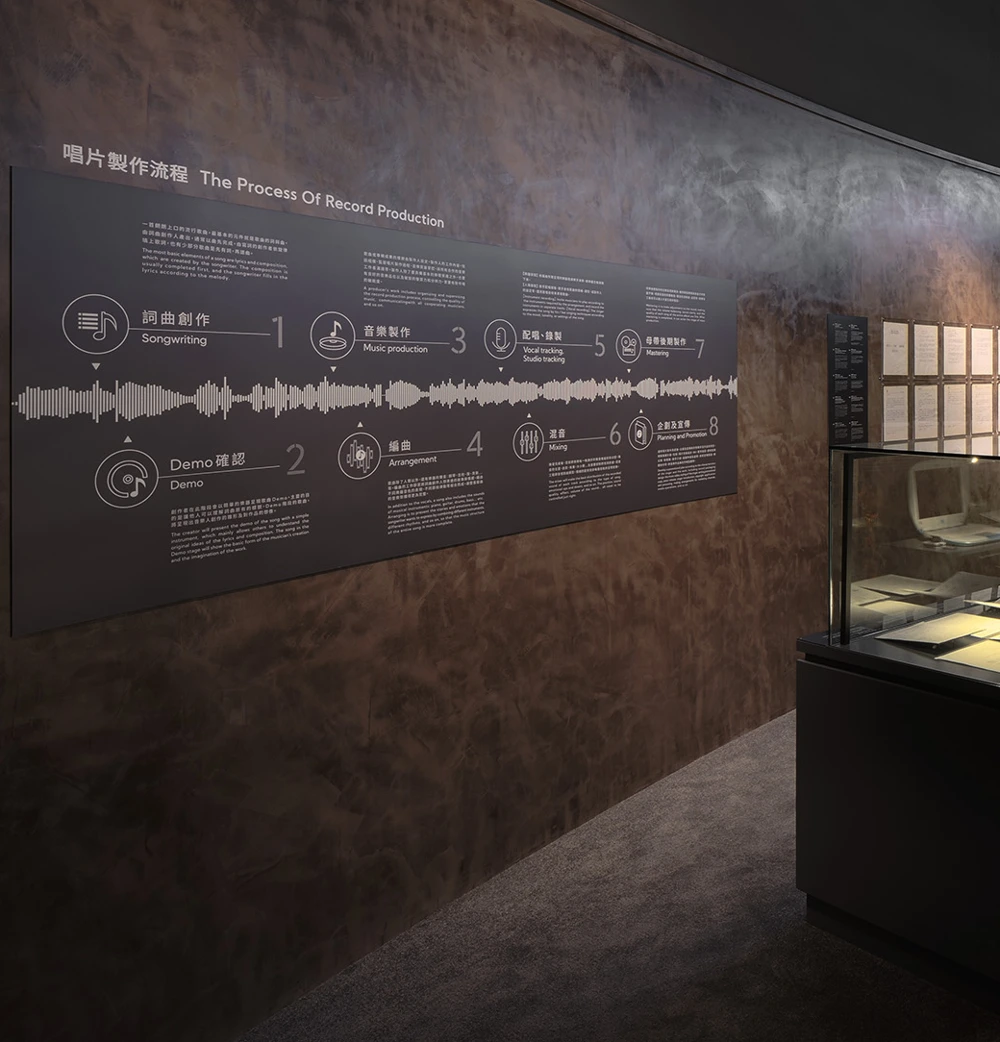
Taipei Music Center provides a public setting for following that work. In version 1.0 of Music, Island, Stories, a record-production panel and equipment display made songwriting, demos, arrangement, recording and mixing visible. The photograph here preserves that earlier exhibition. It offers a way to connect the choices in Chua’s story with the steps involved in making a record, in a space designed for visitors.
The permanent exhibition is closed from 1 October to 4 December 2026, with its 2.0 reopening announced for 5 December. During the changeover, plan around a currently listed performance elsewhere in the grounds; choose the venue and admission time shown for that event. Reach the centre from Kunyang or Nangang MRT station and return to the same station afterwards. A future exhibition or a live performance can continue the question raised at the script table: what must happen before music reaches another person?