
A familiar light, a different calendar
In Seoul in April 2025, young people gathered through Fo Guang Shan’s Asian youth meeting. On 26 April, Seoul youth-group member Gu Fengyin (古峰印) taught lotus-lantern making; the group then carried its lamps to the procession at Dongguk University. The account also records participant Lin Peijin (林佩瑾) recalling her encounter with Buddhist groups from several countries while walking with her lantern.
Yeondeunghoe is linked to Buddha’s birthday. Taiwan’s Yuanxiao observances fall around the fifteenth day of the first lunar month. Seeing lanterns in both places does not put them in the same festival or give them the same maker.
The useful connection is a question rather than a claim of sameness. Who makes the lantern, what is written on it, and where is it used? Those questions lead away from the temporary spectacle and towards an individual maker’s work in Taiwan.
A Korean camera came to Lukang
A Korean encounter with Taiwanese lantern craft is documented more directly in Lukang. Changhua County’s account of Wu Dun-hou’s life records that a KBS reporter (named as 李孝善 in that account) visited his shop in February 2012 to film his work. The visit brought a Korean camera to an existing Taiwanese workshop; it did not begin the craft or establish that Wu taught lantern making in Korea.
The surviving account identifies an interview visit. It does not describe a joint project, an audience response or lantern techniques being taught in Korea. The recorded encounter can introduce Wu’s workshop, but the work itself still needs to be understood: a rounded body to support, a brush to control and an intended use that guides the painted design.
Learning from the doorway
Wu Dun-hou (吳敦厚) grew up in Lukang, a historic town on Taiwan’s west coast. As a teenager he watched a local lantern maker, Wang Yugui (王玉圭), at work from the doorway; the craft was kept within the family, so observation became his way of learning. He later made toys and established his lantern shop in 1957.
A lantern brought several skills together. Bamboo gave it a frame, a covering received the written and painted surface, and the chosen words connected the object to a household or a deity. Making the structure and making its message legible belonged to the same craft.
The work also had a physical difficulty. In an agricultural documentary, Wu’s son Wu Yi-de explains that the curved lantern cannot be laid on a table like a sheet of paper. The maker supports it against the body, plans the composition and paints with the brush held clear of a flat support. Too much or too little pressure changes the result. The hands, not just the finished image, make the skill visible.
After Wu Dun-hou died in 2017, both the county account and Public Television’s report identified his youngest son, Wu Yi-de, as continuing the lantern shop and its craft. This is a family succession recorded at that time, not a promise that a visitor today will meet the late master or find a particular workshop demonstration taking place.
The words have a place to go
The National Center for Traditional Arts records a set of Wu Dun-hou’s lanterns made in 1990. They include the hall name Yanling and the deity Baosheng Dadi, alongside auspicious imagery. A lantern could therefore identify a particular relationship, not simply illuminate an anonymous space. In the agricultural documentary, Wu’s son explains that the lantern is painted according to the customer’s needs and intended use. Its finished examples make that concrete: dragon motifs are associated with temple celebrations, while a peony carries a wish for prosperity. The documentary also shows the flower’s centre painted by hand. These are examples from the workshop record, not an identification of the pictured lamps as the 1990 collection set.
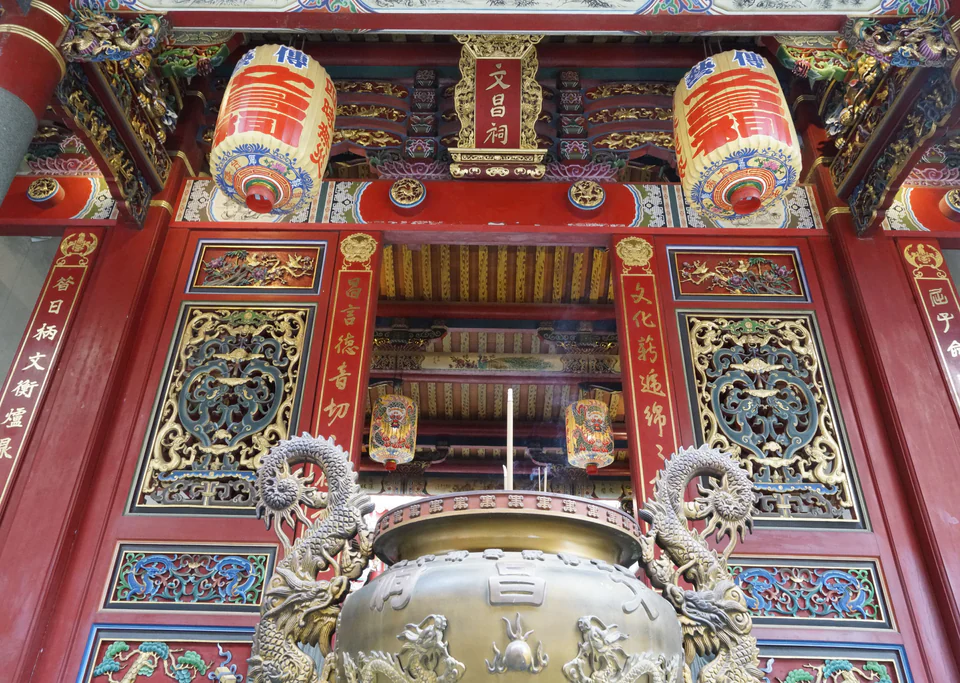
His work can also be encountered at Wenchang Shrine in Yilan, on Taiwan’s northeast coast. The park identifies his lanterns in the front and main halls and above the incense burner. The main hall also contains black-gauze lanterns by another artisan, Xie Zongze (謝宗澤); the hanging lanterns are not all the work of one maker. Here they belong to a temple setting dedicated to Wenchang, associated with learning, among works by other named traditional artisans. The writing is part of the place’s use, while the painted forms sit within a larger built ensemble.
A visit that does not wait for a festival
At the Yilan park, allow time at the shrine rather than expecting a lantern parade. From the visitor area, compare the characters and painted motifs on the hanging lanterns with the other crafted surfaces around them. The park’s shrine guide identifies the makers and helps separate their contributions.
Seoul’s procession supplied the starting question. In Yilan, the answer takes the scale of a single object placed where people continue to read and use it.