
01
A familiar name beside a different river
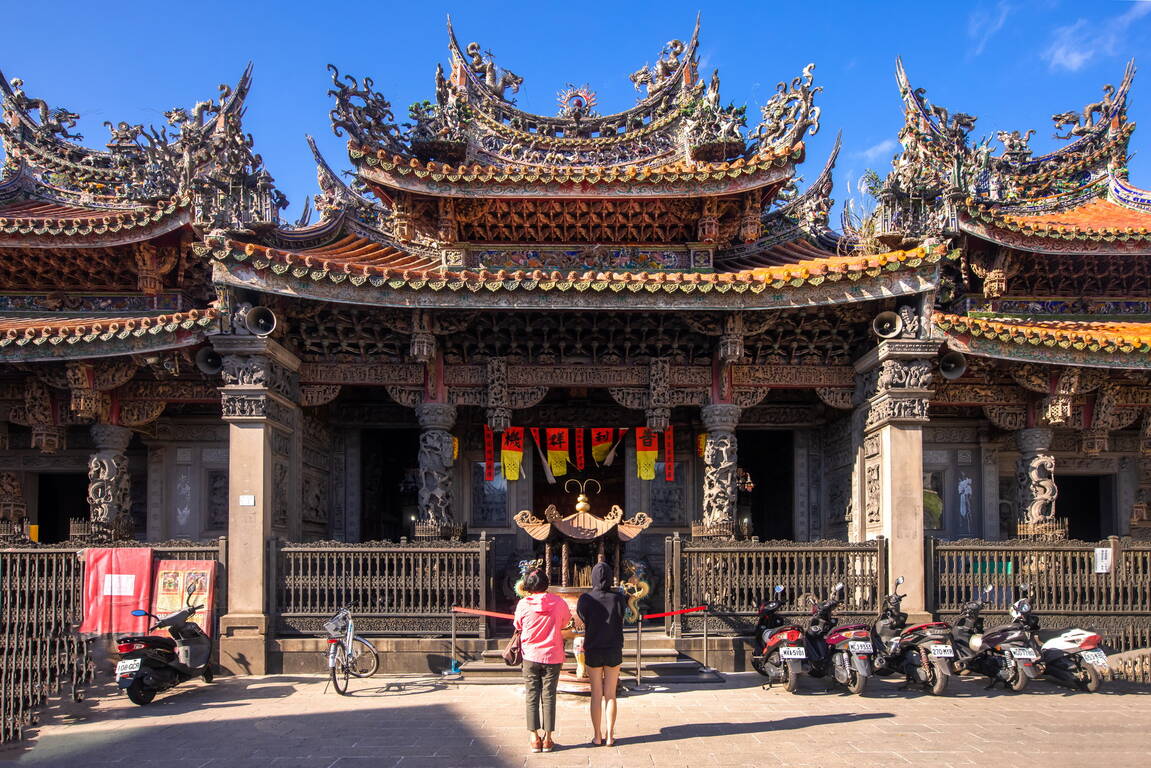
For a visitor who knows Anxi in Quanzhou, the name Qingshui Zushi is a point of recognition in Sanxia, northern Taiwan. Migrants carried the worship across the sea, and the temple founded in 1769 gave it a place in their new settlement. But recognition only starts the story. The building now standing there is the result of later residents repeatedly deciding to rebuild and maintain it.
The congregation organised temple responsibilities through seven surname groups. This gave the shared belief a practical structure: worship required people to contribute and take turns, not just a founding date. The temple’s repeated rebuilding after damage belongs within that history of local organisation. A tradition could cross the sea; keeping a place for it required work after arrival.
02
Rebuilding meant more than commissioning a picture
In 1947 Li Mei-shu took a leading role in the third reconstruction. He was a painter from Sanxia, working on a building that people still needed for worship. The task joined artistic decisions to a community’s material commitments. The memorial gallery’s chronology records committees, fundraising and donations, including timber from a Sanxia native who had moved to Fengyuan. The work depended on more than one person’s vision.
Drawings then had to become stone, wood and cast metal. Li and other painters supplied designs; artisans translated them into carved surfaces and structures, while sculpture students also contributed bronze work. These roles are connected but not interchangeable. A design sets a direction, while making it in a resistant material demands another body of knowledge. Calling the whole temple one painter’s artwork hides that collaboration.
The rebuilding continued over decades. That duration changes how a visitor reads the finished-looking surface: the stonework is also accumulated labour, maintained alongside the rhythms of worship. The belief from Anxi did not dictate every later artistic decision. Sanxia’s people made a particular place from it, with forms shaped by their own resources and expertise.
03
Follow a bird from drawing to stone
The bird-carved pillars offer a manageable starting point. The official temple guide describes Li and artisans consulting bird illustrations for the pair known as the Hundred Birds and Plum Blossom pillars. Rather than trying to identify every bird at once, look at how a body, wing or branch projects from the stone, and how adjacent forms leave space around one another. A flat design had to become something readable from several angles.
Then step back and compare the detail with the column’s place in the hall. The building must also hold people, movement and ritual. Keep worshippers’ paths clear and look without touching the carving. The artist’s decisions become easier to understand when the temple remains a place in use rather than an empty gallery arranged for visitors.
A visit to the old street and temple can stand on its own; a mountain route requires separate planning. Before leaving, return to the detail you first chose. Its overseas connection lies in the worship brought from Anxi, while its particular form belongs to later work in Taiwan. Both histories are needed to explain what is in front of you.