
A broom in the Forum
The Forum was the setting for Lee Mingwei’s Our Labyrinth in the Centre Pompidou’s Move programme, from 2 to 26 June 2017. Its materials were modest: a performer, a broom and rice tracing paths across a floor. The centre’s description makes participation part of the work’s changing form. A visitor was encountering something sustained by people and time, rather than an object waiting unchanged for the next person.
The programme names eleven performers and a partnership with Paris Marais Dance School. Among those credited are French performer Jean-Gabriel Manolis and Cheng-Lung Wu. Those names are a useful way into the Taiwan connection. The work had been created in Taipei two years earlier, and one of the people performing in Paris had already performed it there.
A new work required people in Taipei
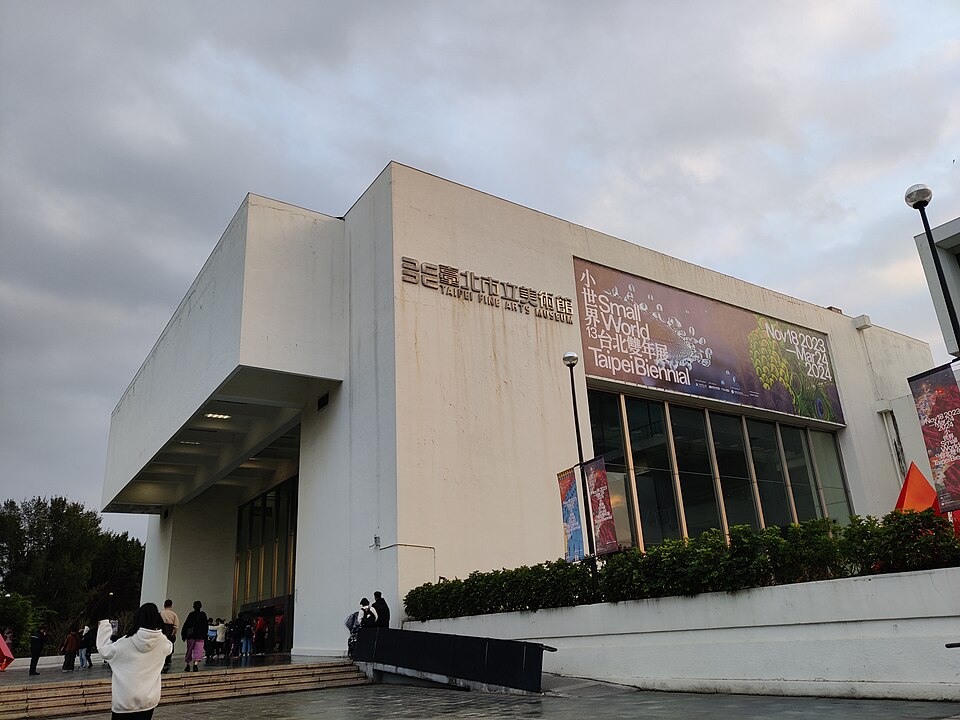
Taipei Fine Arts Museum’s 2015 annual report places the new work within Lee Mingwei and His Relations, co-organised with Mori Art Museum from 30 May to 6 September. Mami Kataoka was the touring curator; Lei Yi-ting and Su Tzu-hsiu were the Taipei curators. Director Lin Ping’s preface identifies Our Labyrinth as a work made especially for the museum. Taipei was therefore a place where something began, not only a stop receiving a finished exhibition.
The same report records the selection of performers for Our Labyrinth and Sonic Blossom. It also describes a wider exhibition in which staff, volunteers and members of the public took on different roles. These were distinct projects, but together they show the museum’s practical challenge: participation had to be arranged. For Our Labyrinth, the rice and floor alone could not make the work appear; someone had to enter and perform.
The instruction was to listen
On performer Lucas Damiani’s account of the work, Lee asks dancers to slow down and attend to the rice instead of planning the next movement. The page also traces the idea to Lee’s observation of volunteers sweeping sacred spaces in Myanmar for barefoot visitors. An ordinary act of care became a performance practice. That origin keeps the broom from being read simply as a symbol standing for Taiwan.
There is room for individual experience within that instruction. Wu’s published biography lists training in tai chi, martial arts, drumming and several movement practices, and records Our Labyrinth performances at Taipei Fine Arts Museum in 2015, MoNTUE in 2016 and the Centre Pompidou in 2017. The documented continuity is a person learning and performing across settings. It does not tell us what Wu privately felt in any one performance.
A French performer became a guide
Manolis’s biography adds another direction. After performing the work at the Centre Pompidou, he gave artistic advice and supported new performers in Jakarta in 2018, Berlin in 2020 and London in 2022. The French connection continued beyond hosting an event. A participant in Paris later helped others take up the practice, carrying knowledge that could not travel as a crated object.
Read together, the Taipei recruitment record, the Paris credits and the performers’ biographies describe a chain of work. The artwork does not remain identical merely because its title and materials travel. A museum commissions and organises, performers attend and respond, and experienced participants support the next group. The changing paths of the rice make that dependence visible without requiring us to invent an audience’s reaction.
Return to the museum that made room
A visit to Taipei Fine Arts Museum today can begin from its current exhibitions, with this history in mind. The museum’s current visitor page lists Tuesday–Friday and Sunday opening from 09:30 to 17:30, and Saturday until 20:30, with Monday closure. It also says the first and third floors are temporarily closed, while the second floor, basement and Children’s Art Education Center continue to open. Check the latest notice when choosing an exhibition.
Our Labyrinth is not promised as a current exhibit. What a visitor can carry from Paris to Taipei is a more specific question: when art asks people to participate, who makes that possible? The 2015 museum team and the named performers offer a documented answer from one work’s history. In today’s museum, the people welcoming visitors and interpreting the present programme are doing their own work in another moment.