
A field on a London stage
British Theatre Guide’s record places Cloud Gate’s Rice at Sadler’s Wells on 26–27 February 2014. Reviewer Vera Liber singled out the filmed rice-growing cycle as an anchor for the production. For a London audience, fields from eastern Taiwan became part of the theatre’s scale and rhythm, seen alongside moving bodies rather than as a travel film between dances.
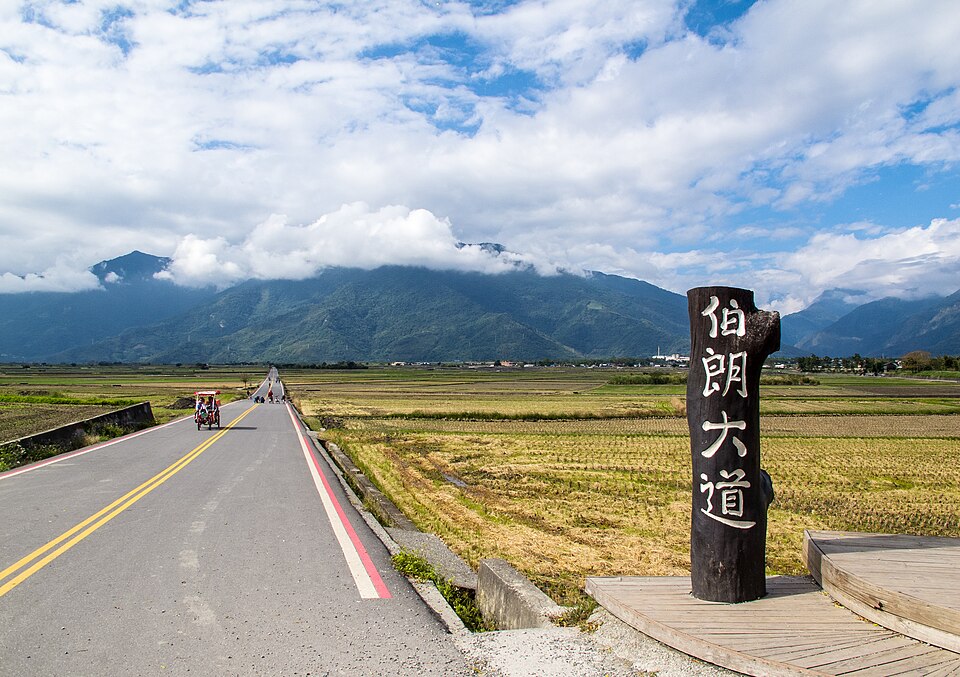
Cloud Gate’s own account identifies the source as Chishang in Taitung’s East Rift Valley. Lin Hwai-min created the work for the company’s fortieth anniversary in 2013, and it premiered in Taipei that November. The London dates establish one point on its journey; the more revealing route runs backward to the people who made those fields and images available.
Two years behind the images
Photographer Chang Hao-jan spent two years recording a rice field through planting, growth, harvest and water returning to the land. Projection designer Ethan Wang worked with that material for the stage. Cloud Gate’s description also credits recorded sounds from Chishang alongside Hakka songs and other music. The production assembled different forms of attention to one place.
The dancers also went to Chishang and harvested rice with farmers. That experience need not mean that each gesture is a literal farming demonstration. Lin explicitly described the choreography as moving beyond realism. The useful connection is between labour encountered and artistic choices made afterward: the body learns something, then chooses a different language with which to express it.
Rain changed the programme
Before the full theatre premiere, excerpts were presented at the 2013 Chishang Autumn Harvest festival. A report preserved by the organiser describes rain, a slippery uncovered stage and a changed programme that included excerpts from Moon Water and Songs of the Wanderers. It records how an outdoor performance could require the artists to alter what they had prepared.
The same report quotes Lin on his pleasure in sharing Hakka songs, noting Chishang’s Hakka presence as a source of inspiration. Landscape and sound therefore had people behind them. Following the music toward its local context avoids treating the valley as an empty natural stage. A performance arrived in a place where residents already had language, work and memories of their own.
A farmer’s calendar includes a stage
A later interview in Mirror Media makes the local work more concrete. Rice-mill operator and community arts organiser Liang Cheng-hsien explained how festival dates were used to work backward to planting dates and rice varieties. Farmer Chang Tien-chu helped coordinate the event. Their account shows that making a field available for performance was an agricultural decision as well as an artistic one.
The article also records Liang offering an old granary for the Chishang Granary Art Museum, which opened in 2017. This does not make the museum a permanent Rice exhibition. It shows the community’s cultural work continuing in another form, with a building where visits need not depend on the short annual window of a field performance.
Visit the work that continues
The museum’s current site lists opening from 10:30 to 17:30, with Mondays and Tuesdays closed. Start with the present exhibition and the granary’s relationship with the town. If you continue toward Chishang’s fields, stay on public roads and keep clear of cultivated plots and working machinery. The landscape that travelled to London is still someone’s workplace.
Rice offers a connection from a London theatre to Taiwan that remains legible after the touring dates have passed. Look again at a filmed field and it becomes possible to notice duration, sound recording and farm work within the image. In Chishang, the next encounter can be with a current exhibition or an ordinary working day. Neither needs to recreate the old performance to continue its story.