
A city needs water
On Kobe’s Nunobiki Dam, a stone plaque names engineers including Sano Tojiro. The structure was completed in 1900, after Sano helped replace an earlier earth-dam proposal with a concrete design. Clean water had become an urgent concern in a city facing disease and rapid growth.
Sano’s work also reached Taipei. Its existing water supply could no longer keep pace with expansion. Introducing metered consumption in 1925 was not enough; the colonial administration turned to springs in the Datun mountains. In 1927, Taipei engaged Sano to investigate and help design the new source and waterworks. Construction began in 1929, and the Caoshan system opened in 1932.
One flow, several uses
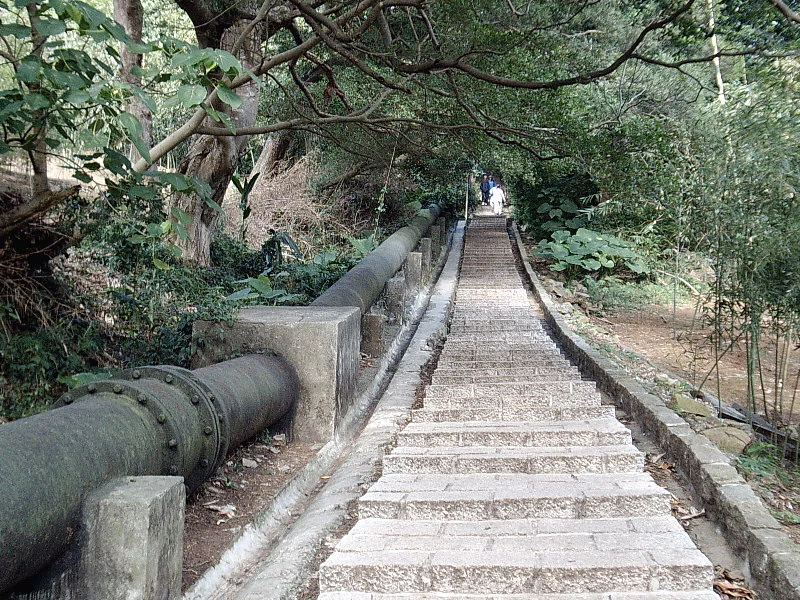
The large black pipe beside the Tianmu trail belongs to that system. Water descended toward the city under gravity. At Sanjiaopu, the design put its descent to work again, generating electricity before sending the water onward to Yuanshan’s reservoir.
The design could also supply electricity to irrigation pumps in Shilin and the central market’s ice-making. A mountain spring could therefore support several parts of daily life before its water reached a city tap. Sanjiaopu’s power generation later ceased, and the plant was retained as heritage. The pipe visible from the trail is one piece of a much larger network.
What construction left behind
Construction also cost lives. In 1938, a water shrine was built beside the Yuanshan reservoir to commemorate workers who died and to pray for the system’s operation. The engineer’s name and the shrine preserve different parts of the same undertaking: its design and the human cost of carrying it out.
At Tianmu, the pipe’s descent gives this history a visible form. Kobe held water behind a dam; Taipei carried spring water down a mountain. Sano’s career joins the two, while the slope beside the footpath shows how Taipei’s solution took shape.