
Bronze in name, clay in material
The catalogue for Clay Affection, Pottery Expressions at Wanawani Art Center in Johor Bahru places a green, angular teapot beside a photograph of Taiwanese maker Lee Hsieh-chih at work. Its title is 青銅壺, Bronze Teapot, but the listed material is clay. The following page presents porcelain alongside several clay teapots: a student’s work could take more than one form.
Announced for 1–28 December 2024, the exhibition gathered Peter Low Hwee Min and forty-five of his students from Malaysia, Singapore and Taiwan. It was also Wanawani’s debut exhibition in Johor Bahru. The catalogue lets readers follow a particular teacher–student connection after the temporary show has ended.
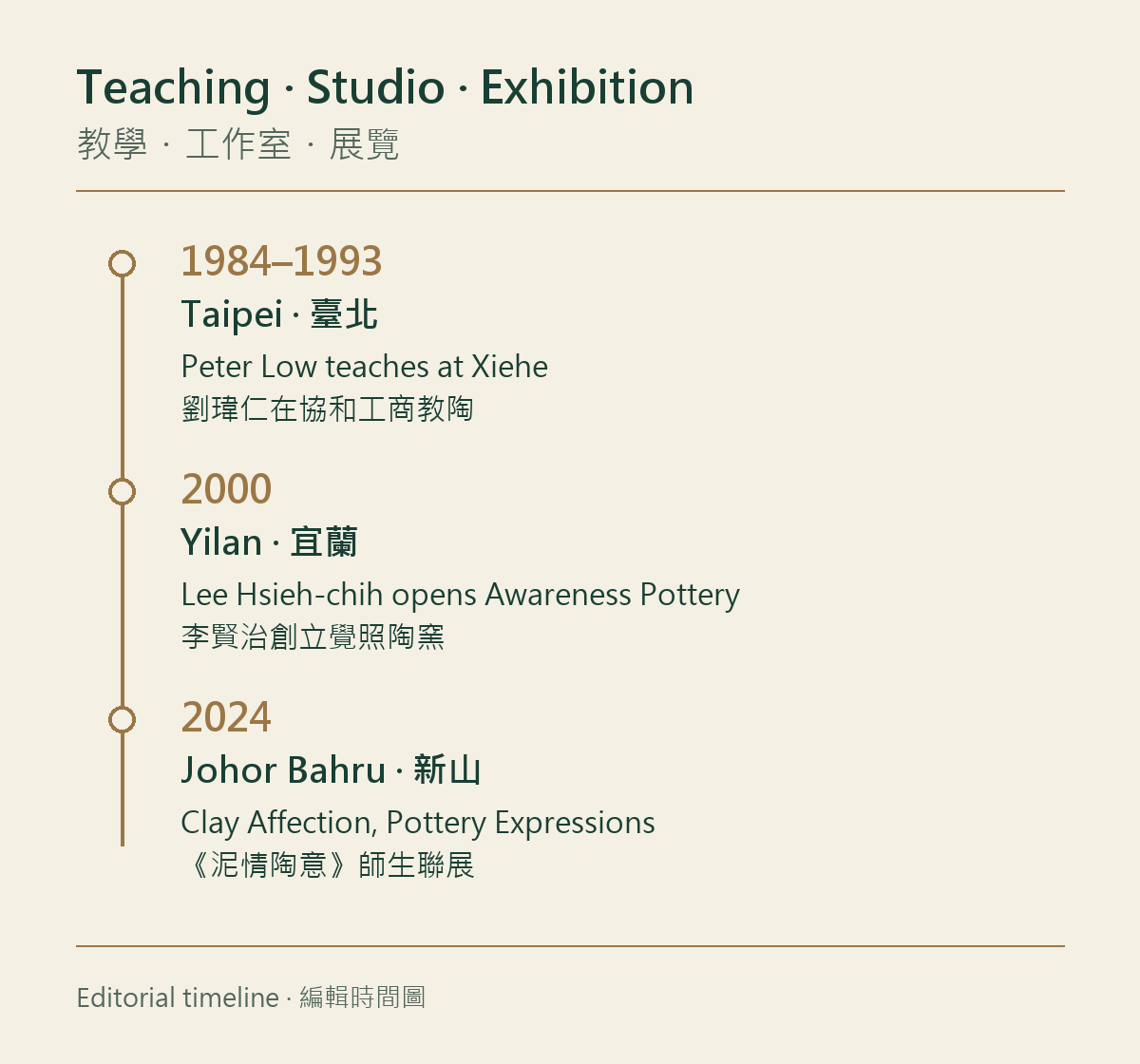
Teaching crossed the sea before the pots did
Low was born in Muar, Johor, in 1943. He studied in Singapore and Britain, and his career included years teaching in Taiwan. His catalogue biography records teaching ceramics at Taipei’s Xiehe vocational school from 1984 to 1993. A future Taiwanese potter’s encounter with him therefore began in a classroom, rather than at an overseas exhibition.
Learning continued after graduation
Lee encountered clay while studying art at Xiehe. His own studio account names Low as a formative teacher and describes continuing journeys between Taiwan, Malaysia and Singapore. The learning involved kiln construction, firing, glazes and sculptural techniques. He chose to keep travelling for practical experience after graduating, carrying questions about how ceramics were made as well as how they looked.
A teacher’s handwriting stayed in Yilan
In 2000 Lee founded Awareness Pottery in Yilan. Low wrote the four Chinese characters 覺照陶窯 for the new studio. The teacher’s contribution thus remained in an ordinary working place, in a name that Lee uses as a reminder to notice his own state of mind. The studio now describes his focus as tea utensils and everyday ceramics, with individual teaching in Yilan.
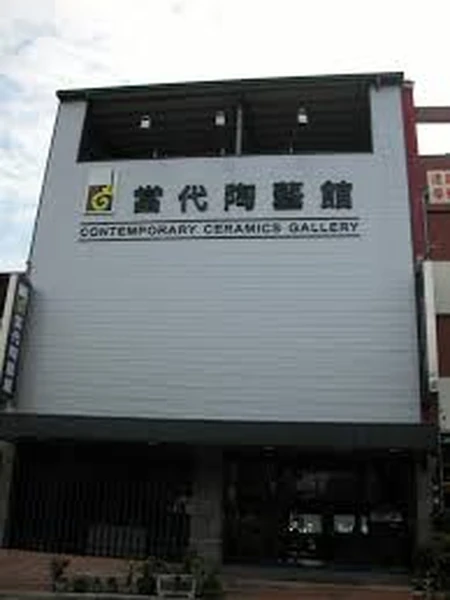
The relationship did not require every student to make identical work. Low, Chen Yuan-chieh and Lee exhibited together at Sanyi’s Contemporary Ceramics Gallery in 2013. In the 2024 catalogue, Lee’s bronze-coloured clay pot and incised porcelain box make the diversity concrete. Compare the mottled surface of the pot with the fine lines on the pale box: clay, porcelain, surface colour and incised marks offer different ways to read a maker’s work.
A working studio requires a different kind of visit
Lee’s published account places him in Sanxing, Yilan, and lists individual instruction at Awareness Pottery. It does not publish a reliable visitor address, fixed opening hours or a walk-in programme. A visit therefore begins by asking the studio whether it can receive you, which pieces are available to see and what language a lesson would use.
If a visit is agreed, begin with the material: clay or porcelain, the join between handle and body, and the difference between a glaze and a carved line. These are useful questions to bring from Johor Bahru’s catalogue to a Taiwanese worktable. The lesson that crossed the sea was a set of skills; its later life depends on how another maker keeps using and teaching them.