
01
A tea wrapper speaks to more than one market
For readers familiar with Singapore and Java, a Chinese tea business may belong to the history of a neighbourhood as much as to a distant tea-growing region. A wrapper preserved in Taiwan makes the journey visible. Academia Sinica’s archival exhibition identifies packaging and trademarks of Kwik Hoo Tong, whose Taipei branch was Jinmao Tea Company in Dadaocheng. Chinese, Malay and Dutch appear in the designs: the tea had to be recognised within more than one commercial world.
Guo Chunyang, known in Java as Kwik Djoen Eng, built his career across these places. Research drawing on family records and business documents connects his Java enterprise with the tea trade in Taiwan. Dadaocheng was a working part of that business, not simply a romantic port of departure. The surviving company names and packaging let us follow an enterprise more precisely than a general claim that Taiwanese tea travelled south.
02
The market could change after the tea was ready
Buying leaves and arranging shipment did not settle whether tea could be sold abroad. The 1918–1919 import dispute in Java exposed that vulnerability. Taiwanese tea interests needed negotiation as well as stock and ships. Research records Guo’s role in helping restore access to that market; it is more accurate to describe a dispute and resolution across those years than to compress everything into a successful conversation in 1918.
This was commerce across colonial jurisdictions, not a direct exchange between two modern nation-states. Taiwan was under Japanese rule and Java under Dutch rule. A merchant’s connections and ability to approach authorities mattered alongside the product. The tea trade therefore gives a concrete way to see how political arrangements entered the daily prospects of a Taiwanese industry.
Nor was the overseas customer a passive endpoint. Competition and changes in local production could alter demand. The scented pouchong of this trade should also be distinguished from the lightly oxidised Wenshan pouchong familiar to many tea drinkers today. Keeping the product and period clear prevents a current tea name from flattening an older manufacturing and trading history.
03
The journey continued in Singapore’s tea shops
Singapore’s National Library Board describes a later chapter: after 1949, merchants adjusted their sources of supply, including purchases from Taiwan, and carried out blending, processing and packing locally. This is not evidence for the itinerary of Guo’s earlier shipments. It does show why an export story cannot end when cargo reaches a port: businesses at the receiving end could continue changing the product before selling it.
Read the earlier wrapper alongside that later work and the connection becomes less one-directional. Taiwan supplied tea, while merchants elsewhere selected, presented and sold it within their own markets. Each stage required decisions. A cup associated with one place could depend on work in several others, without those places losing their different histories.
Pek Sin Choon offers a later example of that local work. Its tea is blended for Singapore's customers and folded by hand into pink paper packets: an imported leaf becomes a product people recognise through local craft.
04
Return to the workrooms, not an imagined original shop
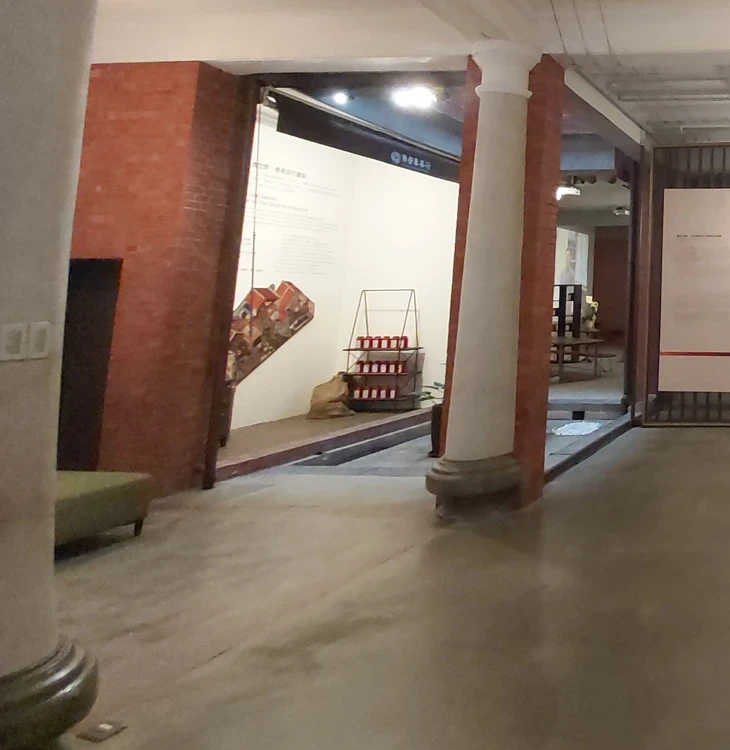
In Dadaocheng, Xinfangchun Tea Museum offers a surviving tea-processing setting. It was a different firm from Guo’s Jinmao business. Visit it to understand the relationship between production rooms, storage and circulation, not to claim you are standing in Guo’s premises or looking at his Java orders. Specific packaging mentioned in the archival account is not confirmed as being on display there.
Bring the wrapper’s question with you: what had to happen before tea could speak to an overseas buyer? Look at the space available for work, then return to the surrounding streets. The story lies in the steps between a crop, a processed commodity and something a customer recognises—not merely in the distance a ship could cover.