What should children in Chiayi see in Indonesian batik?
Jakarta’s Museum Batik Indonesia describes batik through the cultural meanings carried by a cloth, as well as its technique and patterns. In Taiwan, a team at the National Palace Museum’s Southern Branch faced a related teaching question: how could children meet Indonesian textiles through something they could do, while learning that one outfit could never represent the whole country?
A cloth carries more than a pattern
The Indonesian Heritage Agency places Museum Batik Indonesia in East Jakarta and explains that the meanings of batik extend to the course of people’s lives. That makes a useful starting point for looking across the sea. A floral cloth or a geometric border is something to examine closely, but its appearance alone cannot tell us everything about its maker or wearer.
In a November 2018 account, Southern Branch staff member 楊芳綺 described an Indonesian textile education exhibition at the Children’s Creative Center in Chiayi. The museum chose Indonesia partly because Indonesian migrants and families had become an important part of life in Taiwan, and partly because its own Asian textile collection offered material for teaching. Collection objects would lead to multimedia, practical activities and clothing experiences.
Begin with one identifiable sarong
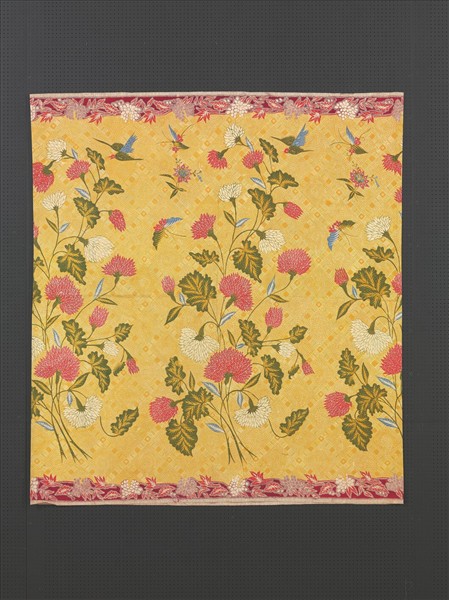
Yellow-ground sarong with repeated bouquets, small birds and butterflies, and red-and-white borders
One example in that account is the early twentieth-century yellow batik sarong, 南購織000248. The current catalogue identifies it as Javanese: repeated bouquets cover a yellow patterned ground, with butterflies, birds and red-and-white borders. The catalogue suggests a possible workshop run by people of Chinese descent on Java’s north coast. That attribution remains a possibility, rather than a maker’s name recovered from the cloth.
By the 2018 account, this sarong and a second cloth were already identified as National Palace Museum collection objects. Their collecting, acquisition and shipping dates are not supplied. In Chiayi, the education team gave these Indonesian textiles another role: their patterns became material for a child to compare, select and arrange.
Choose a pattern children can work with
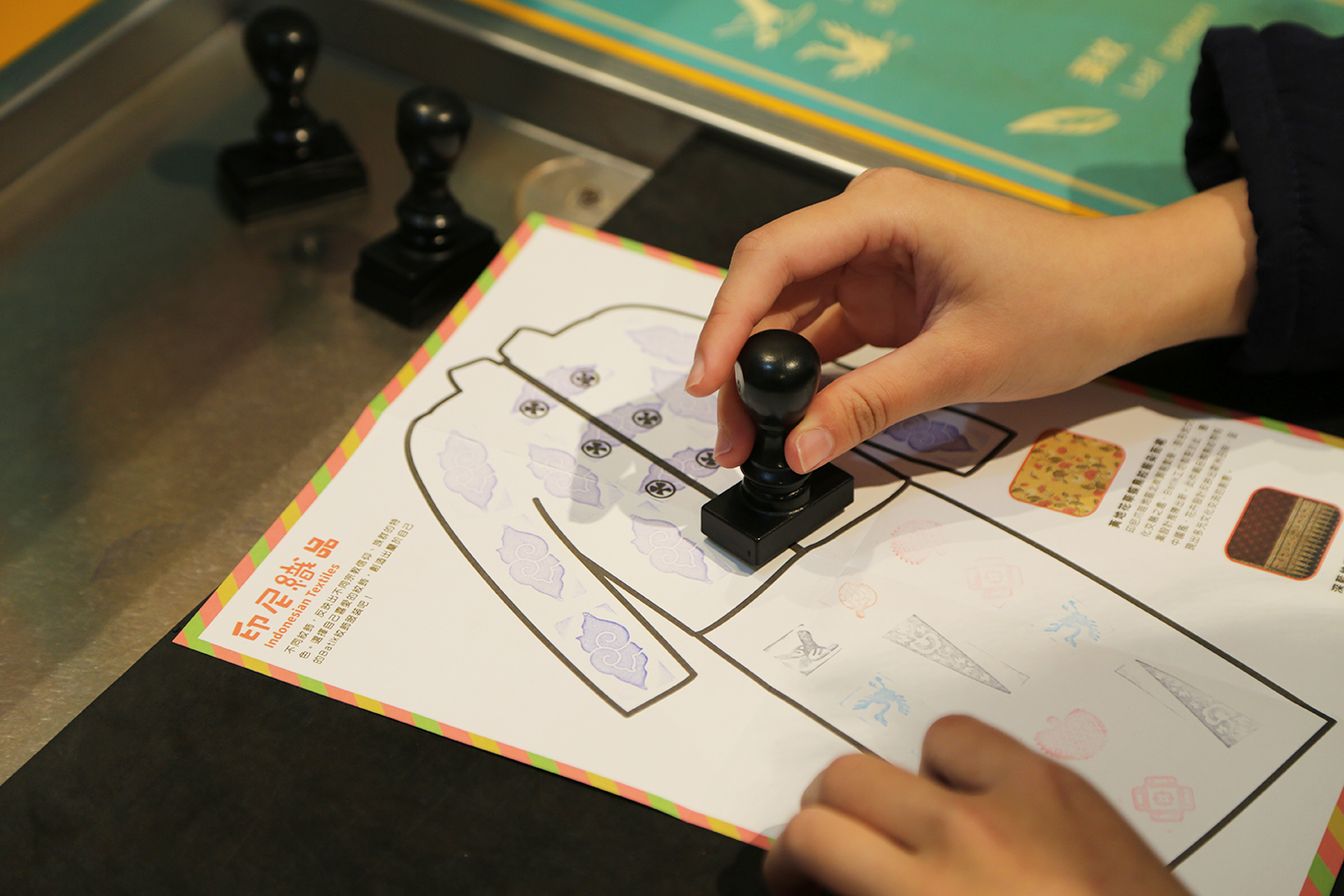
A hand stamps motifs onto a worksheet in the Children’s Creative Center textile area. This is an undated museum photograph available on the official area page, not evidence that an original collection cloth was handled.A dark cloth with repeated diamonds and pointed borders, photographed with rulers and colour charts
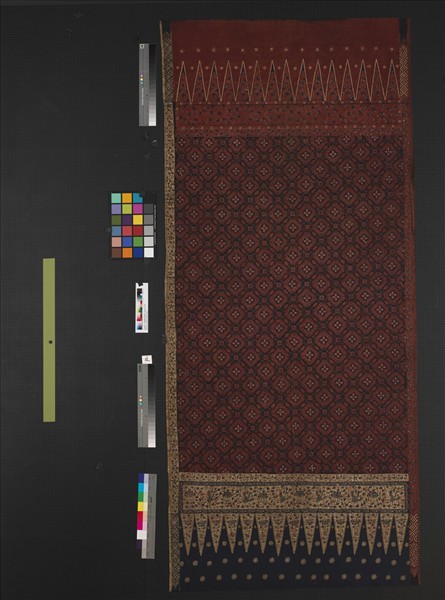
The second cloth, 南購織000488, also dates to the early twentieth century. The catalogue associates it with Muslim women in Jambi, Sumatra. Its repeated diamonds and pointed end borders sit alongside floral and bird decoration. The catalogue again uses cautious language about a possible workshop connection. The object lets the exhibition discuss several kinds of pattern within one cloth, rather than reduce Indonesian textiles to a single visual rule.
The team made a worksheet and rubber-stamp activity using patterns discussed in the textile section. Children could select patterns and stamp a design of their own. The consequence of that curatorial choice was a change in the visitor’s task: from looking at a completed design to deciding how parts might fit together. The activity did not put an original collection textile into a child’s hands.
Four choices, with their limits left visible
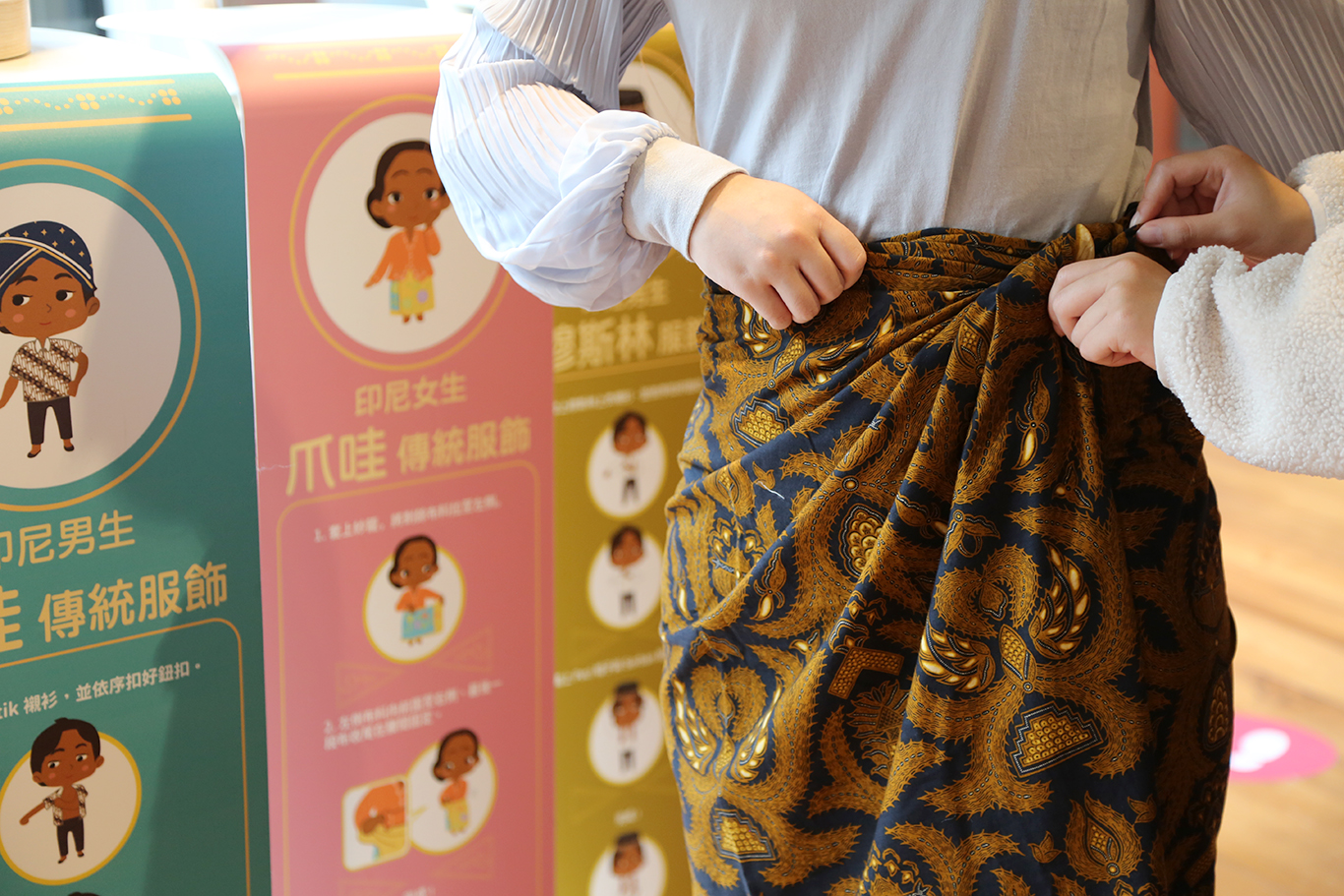
Hands tie a patterned cloth during a clothing experience in an undated museum photograph. The image shows one selected way of dressing, rather than all Indonesian clothing.
Clothing presented a further problem. The account says the team discussed the selection with specialists and offered four kinds of clothing experience: Javanese women’s and men’s dress, and Indonesian Muslim women’s and men’s dress. Actual garments for trying on made differences in cut and ways of wearing available through an activity. These were choices for a small educational space, not a claim to cover every Indonesian community.
At the end, 楊芳綺 described learning to avoid an excessively Western-centred interpretation, and the time needed for fuller research. The worksheets and clothing activities were concrete results of the team’s work. Joint planning by museum staff and new residents remained a next step: a proposal to let more people take part in deciding how their culture would be explained.
Carry the comparison into Chiayi
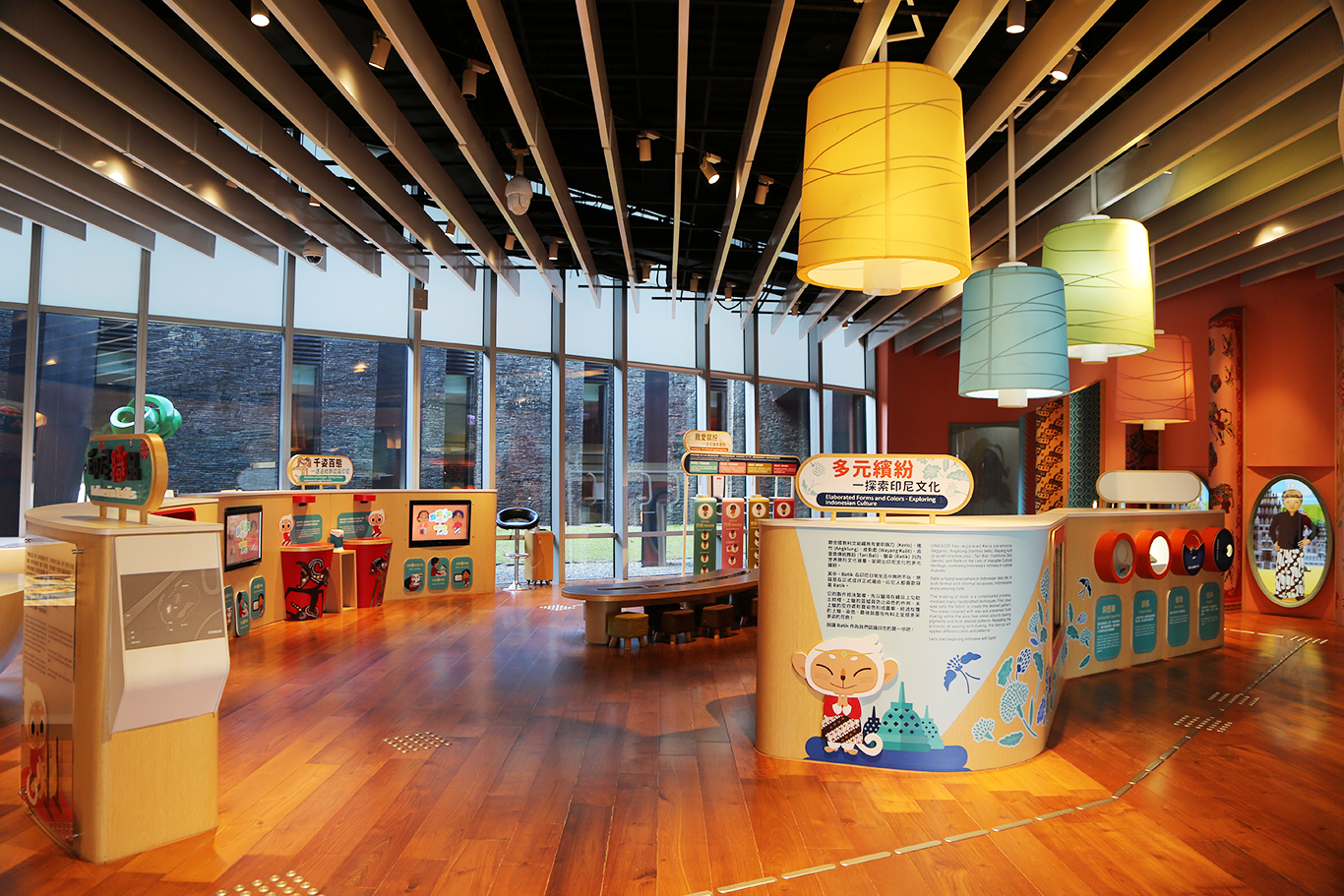
The actual Children’s Creative Center textile area in an undated museum photograph. Check the day’s accessible stations before a visit; the two catalogue textiles are not confirmed on display.
Before visiting, open the two official catalogue entries separately and compare their borders and repeated motifs. Follow each collection number back to its own description. A word such as “possibly” matters: it distinguishes a suggested workshop origin from the uses and places described in the record. The comparison continues beyond colour and shape.
The Southern Branch’s current website still lists the Children’s Creative Center, its textile area, colouring-and-AR activity and clothing experience. That provides a concrete place to continue this story in Taibao, Chiayi County. Check the day’s available activities rather than expect every 2018 installation to survive unchanged. The original sarong and cloth are not confirmed on display. What visitors can bring is a more precise question: which object, which place, and whose account helps explain this particular pattern?
Children’s Creative Center, Southern Branch of the National Palace Museum
Continue the documented textile-education story in the actual institution and compare the two official catalogue entries beforehand. The visit does not promise either original textile on display.
Address: 888 Gugong Boulevard, Taibao City, Chiayi County. The Children’s Creative Center is on the first floor of Feibai Hall. It is designed for ages 5–12; the museum’s downloadable leaflet also welcomes families and adults and requires an accompanying adult for children under ten.
Normal hours are Tuesday–Friday 09:00–17:00 and Saturday–Sunday 09:00–18:00, with Monday closed. Check special holiday arrangements and the current activity page before departure. The 2018 account is historical evidence, not a guarantee that each installation is operating today.
From THSR Chiayi Station Exit 2, the museum directs visitors to the BRT platform towards Puzi. Take BRT 7212 to the Southern Branch, Hall 1 shuttle stop; confirm the current platform and direction when boarding.
For the return, the official guide lists BRT 7212 from the Hall 1 shuttle stop to THSR Chiayi Station. Check the destination and the day’s timetable before arranging a rail connection. Travel-day arrival times and the final bus have not been verified.
Allow 15–20 minutes to compare the two online records, and 45–60 minutes for the center’s available activities; add travel separately. This is an editorial allowance, not a museum programme duration.
This photo-led tourism film uses ten mutually different genuine photographs for 67 seconds, with 23 seconds of original-speed ground-level footage. It contains no fabricated performance or manufacturing process. The visitor footage was uploaded on 30 September 2021 and does not establish the current exhibition poster or floor arrangement. The official textile-area photographs have no stated shooting date. The November 2018 staff account remains a historical account, separate from today’s website and from either collection object’s acquisition history.
The two catalogue images are provided under CC0, with their colour targets visible. Possible workshop attributions remain hypotheses and current display is unconfirmed. The official hours page, read on 6 November 2026, places the free Children’s Creative Center on the first floor of Feibai Hall: Tuesday–Friday 09:00–17:00 and Saturday–Sunday 09:00–18:00, Monday closed; special holidays may differ. Check current activity availability before travelling.
Image information
National Palace Museum collection 南購織000248, an early twentieth-century Javanese yellow batik sarong. Official low-resolution page image, 449×600, CC0 1.0. Individual photographer and photographic date not stated. The actual downloaded image is below one megapixel, not a claimed one-megapixel download. Possible workshop origins remain catalogue hypotheses; current display is not confirmed.
National Palace Museum collection 南購織000488, an early twentieth-century skirt cloth associated in the catalogue with Jambi, Sumatra. Official low-resolution page image, 445×600, CC0 1.0; photographer and photographic date not stated. A different object from 南購織000248. Original colour targets remain visible; no fabricated reconstruction or current-display claim.