
What remains after the sea
For readers familiar with Hội An’s ceramics, the sea connects a port with distant buyers, but it also leaves work for a museum. Hội An Museum records the regular cleaning and preservation of ceramics recovered from the wreck near Cù Lao Chàm. Objects can leave the seabed and still carry substances that affect their survival. Conservation continues after the excitement of discovery.
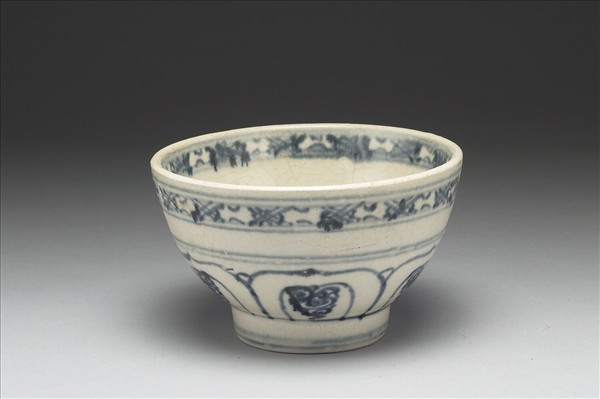
Two bowls now catalogued by Taiwan’s National Palace Museum belong to what researchers call the Hội An type. That is a classification based on comparison, rather than a documented place aboard a particular ship. The current catalogue suggests that they came from the Chu Đậu kilns in Hải Dương and notes their stylistic similarity to ceramics from the Hội An wreck. It does not establish that these two bowls were excavated from that wreck.
Pale marks during registration
In an article published in April 2008, Wang Chu-ping described a collection of Vietnamese blue-and-white ceramics acquired while the National Palace Museum was preparing its Southern Branch. The objects had travelled from Vietnam through Bangkok to Taipei. During registration for storage, staff noticed grey-white patches on the bases of several pieces. Two bowls were sent to the conservation laboratory.
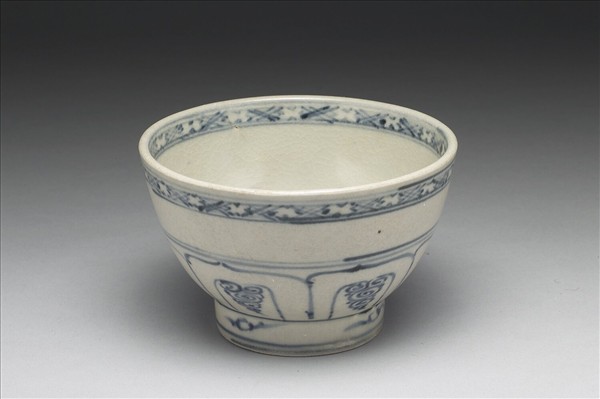
Their inventory numbers were Gouci 000239 and Gouci 000240. Both have a flowering plum branch inside and transformed lotus-petal patterns around the lower exterior. Their shared name and decoration made comparison possible, while separate numbers kept each object’s condition and treatment record distinct. Behind the familiar blue-and-white surface, there were now two individual problems to follow.
Identify the salt before choosing the treatment
The pale colour alone could not determine a treatment. Wang’s account identifies chloride and nitrate salts in the samples from both bowls; the tests did not detect sulphates. Because the identified salts were water-soluble, the team chose static immersion followed by drying. Material analysis gave them a reason for putting the bowls into water again.
Wang Hsin-heng assisted with records and charts. The team followed the conductivity of the immersion water and the bowls’ changing weights, so that visible appearance was accompanied by measurements. As the values stabilised, they could judge when to move from one stage to the next. Each bowl retained its own record, even though both were receiving the same broad form of treatment.
A result, and a limit to intervention
The published case records the removal of the visible salt patches and the eventual stabilisation of the bowls’ weights. Wang’s conclusion extended beyond these two pieces: keep the collection in a stable storage environment and treat individual objects when salt patches appear. The whole collection did not need to be put through immersion simply because two bowls had required it.
The treatment year is not stated in the article’s tables; April 2008 is the publication date. What the account preserves clearly is a sequence of observation, identification, choice and follow-up. Alongside the continuing care documented in Hội An, this National Palace Museum case shows how Vietnamese ceramics remain part of people’s work after their journeys between collections.
Read the catalogue, then follow the acquisition’s purpose
Before visiting, look up Gouci 000239 and Gouci 000240 separately in the museum’s official collection catalogue. Compare the outward-turning rims, high foot rings and painted lines. The official photographs help identify the two objects; they are not a before-and-after conservation pair, and their photographic dates are not stated. The treatment evidence lies in the case study’s records.
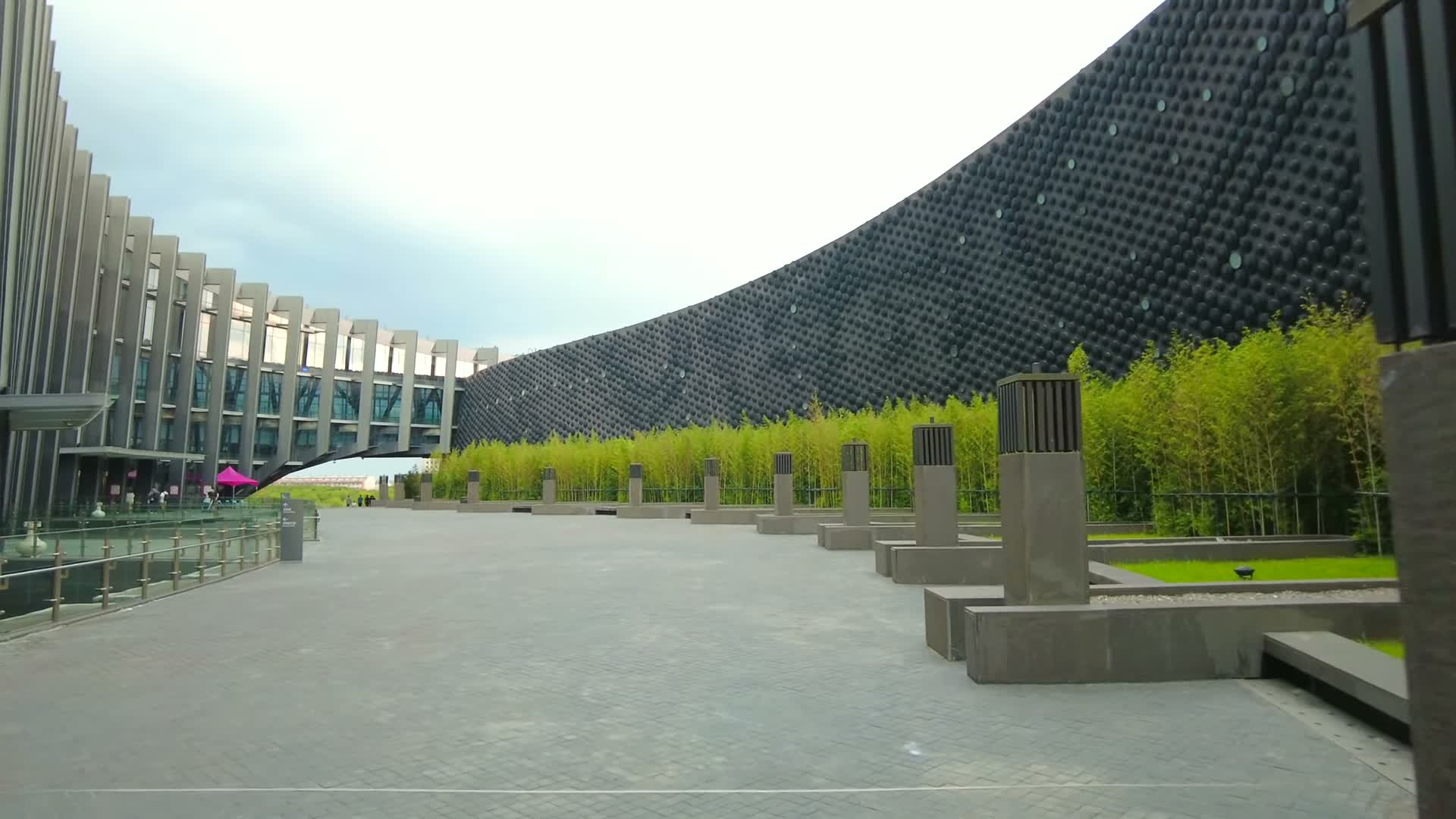
The acquisition was made while the museum was preparing its Southern Branch. Today, the Southern Branch in Taibao, Chiayi County provides a visit setting connected to that purpose. These two bowls are confirmed collection objects, but their current display status has not been verified, so a visit should not depend on seeing them. Choose from the exhibitions actually open that day and read how labels distinguish place, date and object identity. The journey also leads to the people who keep noticing how an object changes.