The shop holds the first working memory
Navin grew up above the family fabric shop in Chiang Mai, spending holidays cutting and measuring cloth. In his 2019 Masala interview, the Thai-Indian artist described wanting a brush in place of the measuring tape. The change of tools would not make the shop disappear from his work; it gave him a place to keep returning to.
For a reader familiar with the shops around Warorot market, this begins with work rather than an art-world reputation. Who remembers the people behind a counter when a place changes? Navin’s later choices give that everyday question a public form, allowing other households to recognise a concern of their own.
An exhibition uses the family telephone
Around 1992, Navin and fellow graduates used existing spaces near Chiang Mai temples and cemeteries for art. He later recalled listing his parents’ telephone number for public responses. Working outside a gallery meant a community could answer back; the artist’s own household became part of the arrangements.
In that same conversation, Navin explained why time spent meeting people mattered to him. The finished object could keep a record, but speaking and listening made the relationship. A picture on a wall is therefore only one part of his work; the process also needs people willing to share time and stories.
A fabric shop becomes a place to look back
In 2015, A Tale of Two Homes used the family shop and StudiOK in Chiang Mai. The store held paintings and recovered household objects. Family work and an exhibition occupied a related space, allowing a visitor to move between the business people remembered and memories the artist had chosen to present.
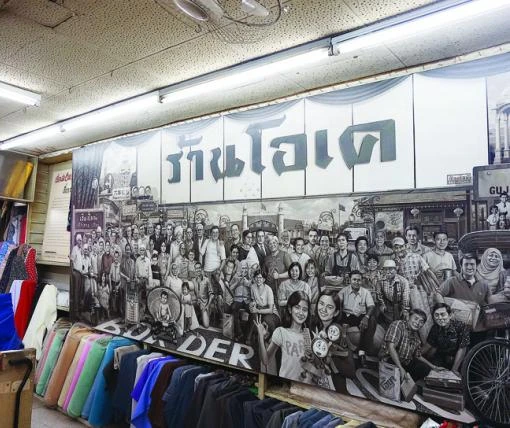
The 2015 show paired a painted walking stick from his great-grandfather with the shop’s measuring ruler. Two objects could carry different parts of a family’s movement and work. In the photograph, the painted gathering remains surrounded by cloth rolls; remembering people did not require removing every sign of the business.
Neiwei residents give the work their voices
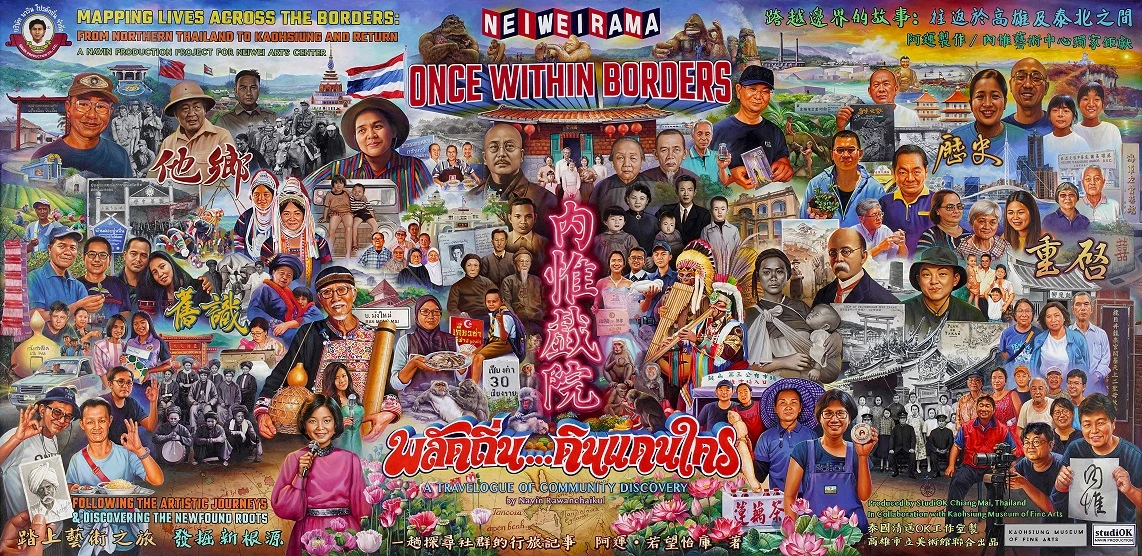
In the centre’s 2022 opening exhibition, Neiwei Rama’s first phase joined a movie-billboard painting with films and a letter. Neiwei residents read the artist’s letter aloud. The voice did not come only from a visiting maker: people living in the place became part of how the work addressed its audience.
A 2023 report describes interviews with twenty-eight groups of residents for Neiwei Portraits. Different recollections could sit beside one another rather than becoming one representative story. For the visitor, a painted figure can prompt a further question about the account behind it, and who had the opportunity to speak.
Returning to Taiwan does not complete every plan
In February 2023, Navin returned to Taiwan and met people depicted in the work at a Kaohsiung talk. The report also described research planned for a second phase. The meeting had happened; the proposed continuation still had work ahead. Keeping those moments distinct lets the people present retain their actual role.
Neiwei’s local-history account describes layers of settlement, industry and movement. One artist’s image cannot stand for every period or resident. When following this project, begin with the specific voices and keep the surrounding neighbourhood open to further questions; its life continues beyond the boundaries of an exhibition.
Choose today’s programme in a place that keeps working
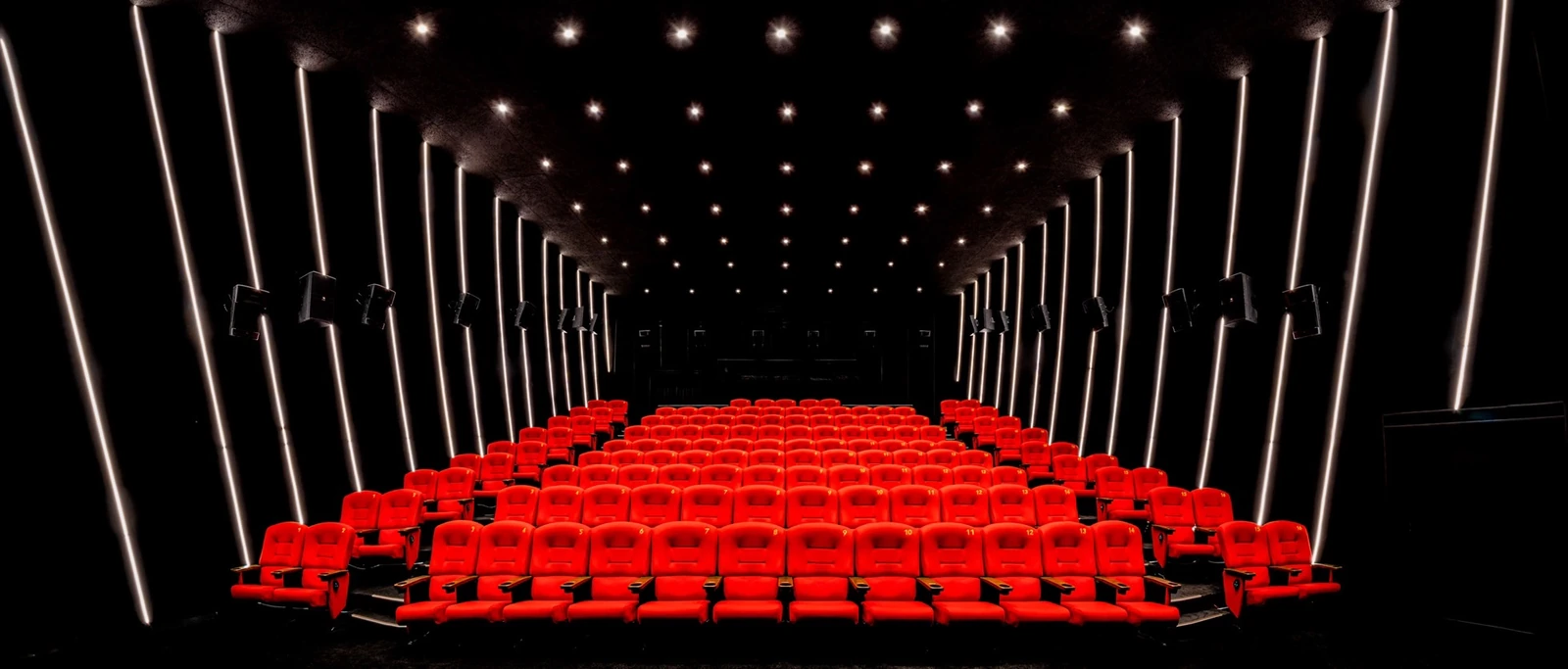
Neiwei Arts Center currently opens Tuesday to Sunday, 11:00–21:00, with Mondays closed. Its cinema runs its own programme. The centre offers a present-day place to enter, while the first-phase project belongs to its exhibition history; check current displays instead of assuming that work is continuously on view.
Start with the current artwork or screening you choose. Notice who tells a place’s history and how a voice moves between writing, image and sound. On the return walk to the light-rail or railway station, look at the street beyond the centre: people’s ordinary routes remain part of the setting from which an artwork can begin.