
A travel guide opens one door
A reader looking for a hot-spring stay in Taiwan may begin with Clarissa Wei’s guide for AFAR. Born and raised in Los Angeles and now living in Taipei, Wei writes across places familiar to different readers. Here, travel writing provides an introduction to Taiwanese bathing.
Beitou also invites a different question: how did one bathhouse remain available to people after bathing there had stopped? Following that question leads away from choosing a room and towards the history of a public building.
The visit begins with people who already lived and studied nearby. What they chose to notice would change the building’s future use.
A bath was also a public building
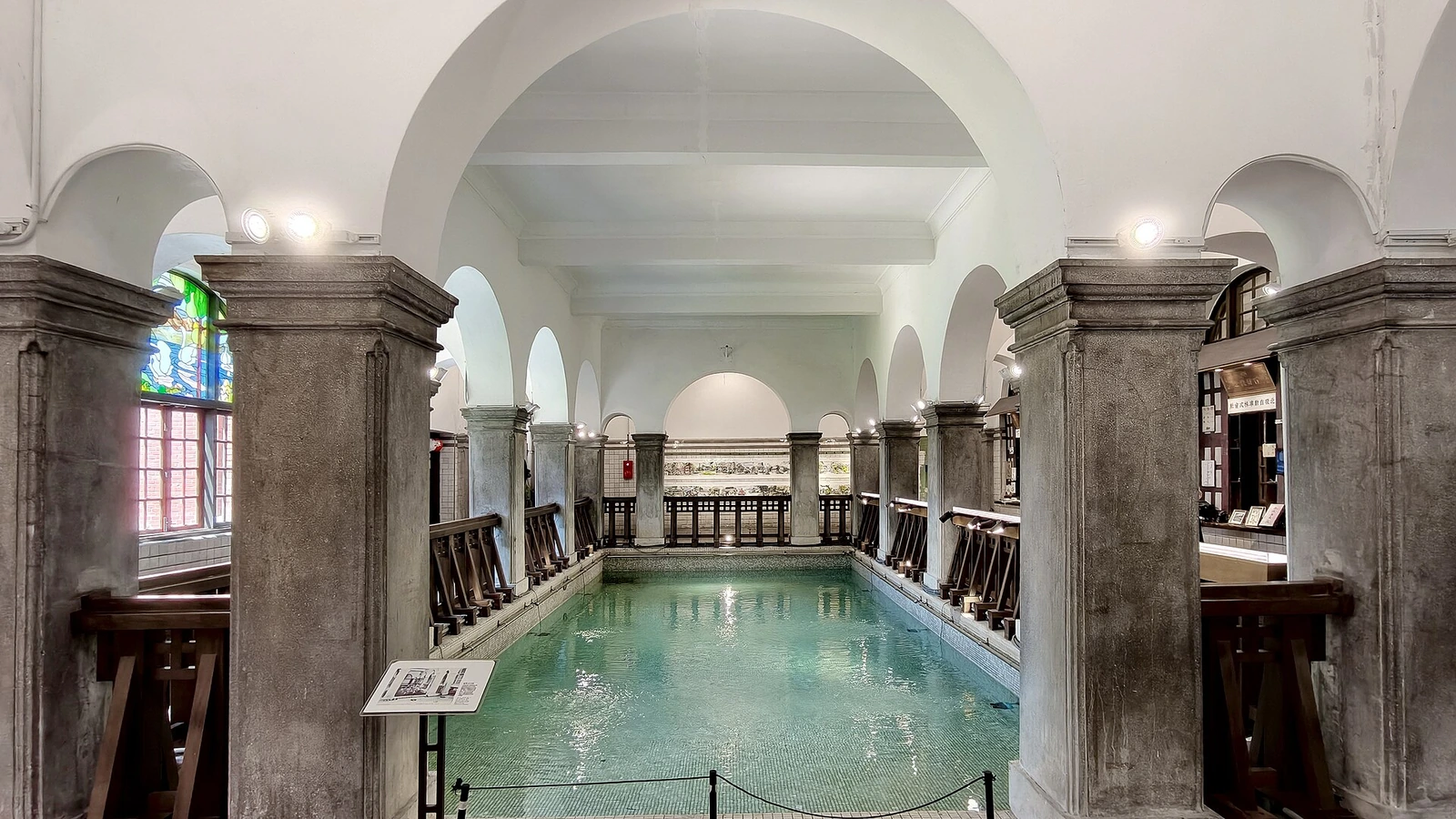
The Beitou public bathhouse opened in 1913. Its bathing rooms occupied the lower floor, while the entrance and spaces for resting were above. The large pool, arches and coloured windows still make the organisation of that building visible.
As you look at the pool, trace where a visitor would enter, change levels and stop. An old building can be read through such movements. Its form records choices about access, waiting and how bodies used the space.
Later abandonment broke that everyday use. The structure remained, but a building without a continuing purpose presents its community with a decision: what should happen to it next?
Children’s research changed what was noticed
In 1994, Beitou Elementary School’s outdoor research led pupils and teachers to the abandoned bathhouse. The museum’s history connects that discovery with residents’ preservation work. A place that could have remained a neglected structure became something people investigated and argued to keep.
There are several actions within that change: going outside the classroom, identifying the building, and bringing what was found into a public discussion. Research becomes consequential when its subject matters to the place where the researchers live.
Residents continued the work of preservation. After restoration, the building reopened as Beitou Hot Spring Museum on 31 October 1998. A new name also marked a new use: people would come to understand bathing history and local life.
Keeping a building connected to its neighbours
In a 2003 interview recorded in Chang(張慧君)’s study of Beitou’s recreational spaces, Huang(黃桂冠)described the museum as a marker for the community and related it to the green space along the stream. The building mattered as part of a larger living place.
That view adds a second task to preservation. Keeping walls and a pool is one part; continuing a relationship with the neighbourhood is another. The route between museum, park and street helps a visitor see why both belong in the story.
When you leave the museum, give the nearby public park a little time. Compare the contained bathing space with the paths outside it. The change of scale helps explain how a building can belong to everyday life as well as to a collection of historic sites.
Today’s visitor inherits a changed use
Let the building’s present purpose guide the time you spend there.
Start with the pool, then look for how the museum connects that structure to Beitou’s wider history. Leave time to return to the entrance and the park, rather than making the building only a backdrop for a photograph.
The story reaches this visit through several kinds of work: travel writing, children’s research, residents’ advocacy and restoration. Each brought different people into contact with the place. The museum’s public life is the result you can encounter now.