
A familiar arts centre, an unfamiliar score
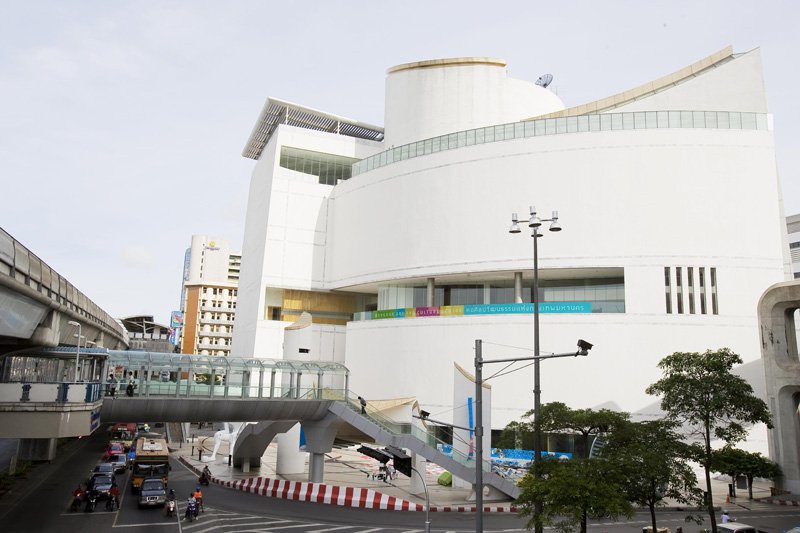
Bangkok Art and Culture Centre is the city entry point for this story. On 22 November 2012, the opening of THAITAI: A Measure of Understanding included Taiwanese sound artist Lin Chi-Wei’s Bangkok Tape. Contemporary reporting describes visitors joining the performance, following the syllables marked on a ribbon and producing a collective sound in the exhibition space.
Lin explained that the composition was written on a 120-metre ribbon. People could interpret its syllables through speaking or singing, and their voices together realised the piece. That choice gave the people in the room an active task. The performance’s shape depended on what they did with the material in their hands and the voices around them.
The work began before the exhibition
The exchange began when Taiwanese artists Hsu Chia-Wei and Liu Ho-Jang met the Thai duo jiandyin—Pornpilai and Jiradej Meemalai—during an ISCP residency in New York in 2010. Further visits to Taiwan followed. They developed a project that would require artists to spend time in one another’s surroundings and produce work through that contact.
For the Bangkok phase, OCAC, the artist-run Open Contemporary Art Center from Taiwan, rented an old three-storey building in Chinatown. Taiwanese and Thai artists took part in its clearing and repairs at different stages, then used it for residencies, presentations and discussions. The organisers’ result report describes a six-month research plan. Establishing a place to work was already part of the exchange.
Lin’s material puts the invitation into practice
Hsu told the reporter covering the Bangkok opening that the exhibition itself was an action: artists had made work while staying in Thailand, including collaborations with others. Lin’s ribbon made that principle tangible at the opening. A visitor did not need to bring a finished composition; the score provided a shared structure in which that visitor could contribute a voice.
The work also leaves room for difference. People following the same ribbon can choose how to voice a syllable; the result comes from those decisions occurring together. Lin linked the Bangkok piece to his experience of living in the city. This allows the performance to be read as a particular encounter shaped by a stay, while leaving each participant’s private feelings beyond what the record can tell us.
A return exhibition with named joint works
The Taiwan phase did take place. The organisers’ completion report records an opening at URS21 Zhongshan Creative Base in Taipei on 7 December 2013, presenting local production, documentary material, discussions, performances and publications from the exchange. The two phases gave the project a return journey, with Thai artists also working in Taiwan.
The submitted exhibition portfolio preserves concrete authorship. It includes a work joining Thai artist Wasinburee Supanichvoraparch with Taiwanese artist Syu Jia-Jhen, and P & V Bridge, Neihai Village, 2013, credited to Yeh Wei-Li with Suwicha and Kritsada Dussadeewanich. The portfolio also shows Lin’s Bangkok Tape. These credits establish actual shared work and a later presentation; they do not establish what each collaborator said in the studio or what every viewer learned.
Find the organiser in today’s Taipei
The present Taiwan connection is OCAC’s public space on Ganzhou Street in Taipei. Its own description identifies curating, research, publishing and encounters with the public as its work. Visiting an announced exhibition or talk offers a way to see the kind of small, artist-run infrastructure through which exchanges such as THAITAI can be organised.
The Ganzhou Street space is the organiser’s current address listed on its website. The 2013 return exhibition was at URS21, and THAITAI is a historical programme. A visit today should follow OCAC’s current announcements and confirm opening arrangements; it cannot promise the ribbon, a repeat performance or a meeting with the artists.
