Walk the Shuishan forest trail, then return to Beimen to understand the city that grew around timber and rail.
Official trail length, surfaces and visitor rules were checked on 23 October 2026. Separately check weather, current forest-park opening and your return bus before setting out. The trail is above 2,000 m: carry rain protection and a warm layer. Dogs, cats and other mammals are prohibited under the official visitor rules. This document review is not a same-day condition report or a field inspection of the whole route.
Zhaoping Station → Zhushan forest road → Shuishan trail entrance → giant cypress → timber railway bridge and platform → former Shuishan branch line → exit beside Jingguang Lodge
The official full-trail length is 2.36 km. The 2023 opening notice separately describes an approximately 860 m entrance-to-tree section; these figures cover different scopes and should not be added. Follow the existing itinerary from Zhaoping via the Zhushan forest road entrance and out along the old branch beside Jingguang Lodge. Allow 2–3 hours for the walk, its connections and pauses, with additional transport-station access and return travel.
Official elevation range: 2,271–2,317 m, a 46 m vertical range. This is not cumulative ascent.
Zhaoping Station
Zhaoping station is a landmark for entering this forest outing. Railway, travel and forestry share the surroundings. Distinguish operating tracks from public walking paths before following the Shuishan signs. Not every small path beside rails is open, and photography is no reason to stand on working tracks. Check layers and water: mountain weather can quickly require rain protection or warmth.
Compare the station yard, forest and trail approach. Match place names on signs with your next section, using the station to understand the park layout.
The intercity bus arrives at Alishan transport station, not Zhaoping or the trail entrance. Allow park entry and internal travel, according to that day’s service. Remember the return waiting place and time needed to reach it.
Shuishan forest-trail entrance
Approach from Zhaoping along the Zhushan forest road and confirm the Shuishan trail sign. This path was assembled from places already used by people. In 2023, the Chiayi forestry office connected an existing work path, former wasabi-growing plots and woodland with the giant tree and railway, using natural materials and hand-built trail techniques to reduce disturbance. The approximately 860 metres in the opening announcement refers to the entrance-to-tree section. The official 2.36 kilometres used here describes the full trail; the two figures should not be added together. Notice how the walking surface fits around roots and undergrowth. Follow marked boundaries rather than leaving the path to seek former cultivation. The park approach and Shuishan route remain separate parts of the journey. Allow additional access, rest and return time, pause securely on wet surfaces, and never use operating tracks as a shortcut.
Compare light near the entrance with the deeper forest and how trees enclose the narrower view. Listen quietly and let others observe too.
Blue-green shows the park approach; yellow shows the Shuishan trail. Treat their time separately. Follow the pedestrian path towards the tree, never working railway tracks. Allow rests and the return to the transport station.
Shuishan giant cypress
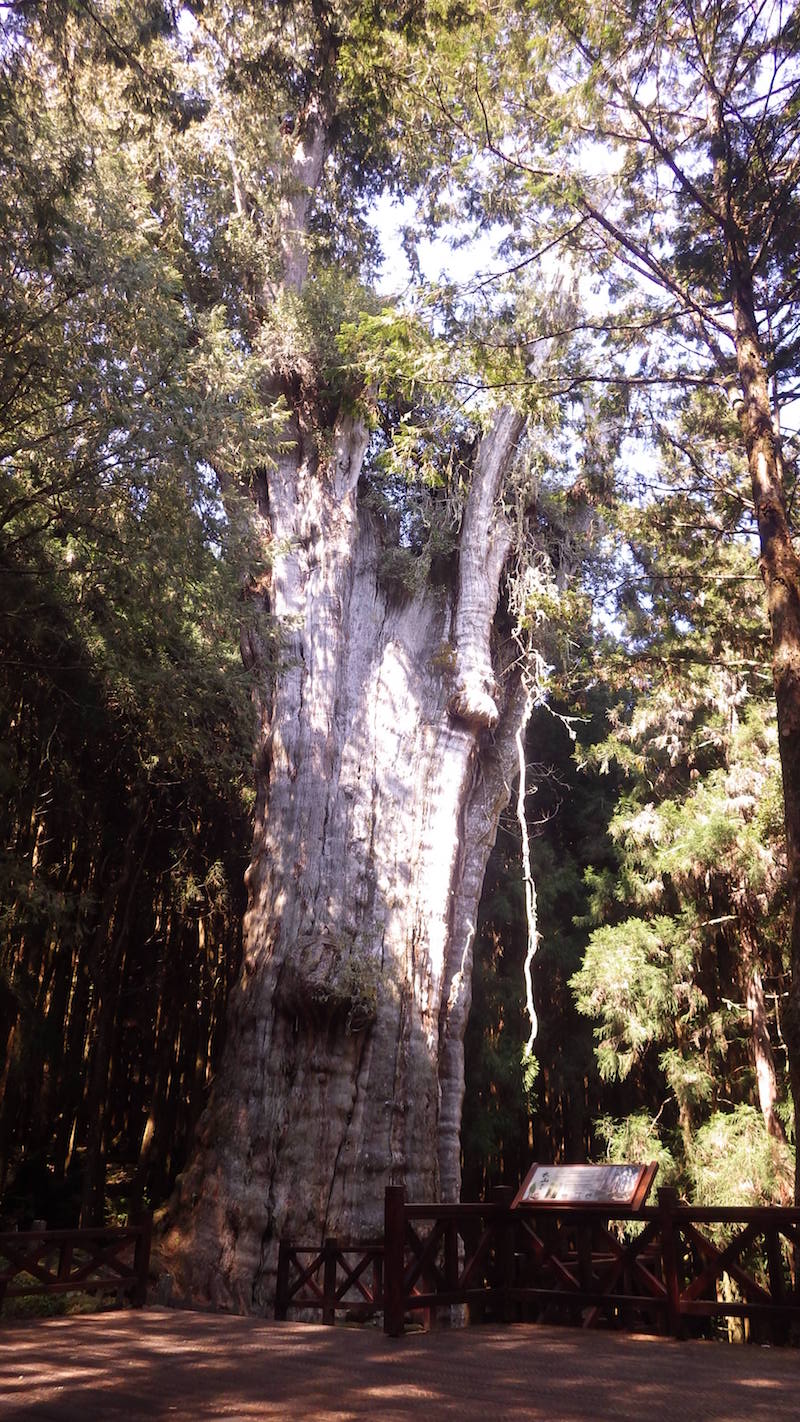
At the giant cypress, pause in the designated viewing place and look up the living trunk. The tree brings forest time into view. Study its shape and texture before trying to fit it all in a photograph; smaller trees and ground layers make its scale more tangible. Follow the bridge and established path, keeping outside root protection areas rather than touching or climbing.
From a clear passage, compare the nearby bridge with the tree beyond: walking facilities let people approach while leaving growing space.
The tree has no bus exit. Continue towards the former branch-line exit. Allow viewing and park walking without reducing return waiting time; active railway tracks cannot be a shortcut.
Former branch-line exit
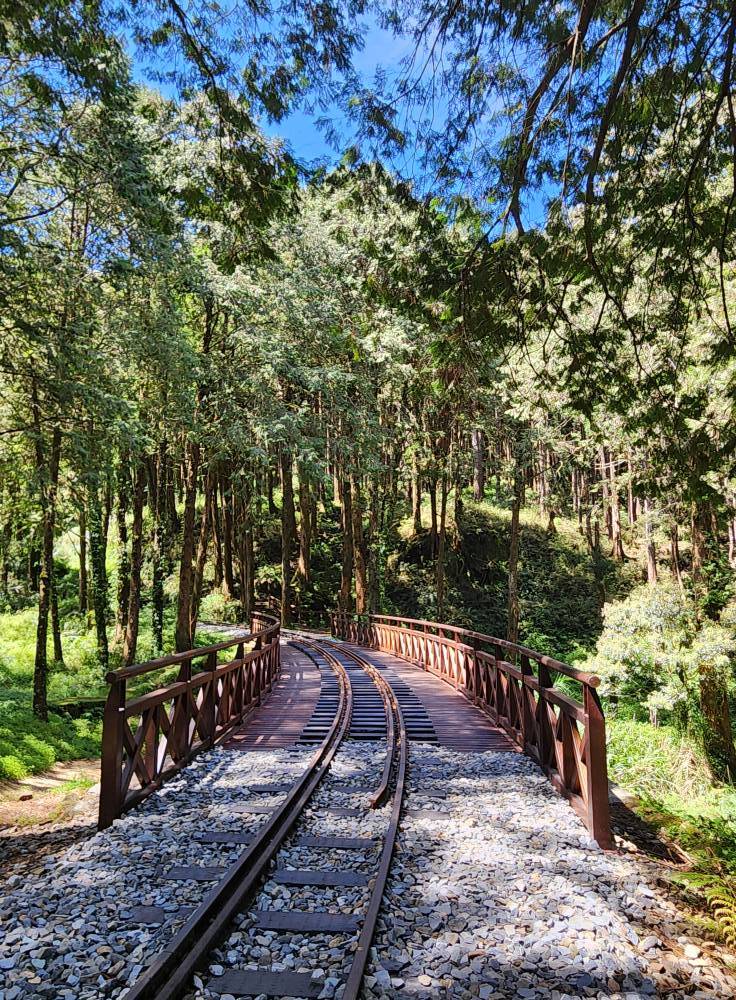
Follow the former Shuishan branch towards the exit beside Jingguang Lodge. The rails carry more than a photographic shape: the official account describes this railway as a reconstruction of part of the former Dongpu branch. Read its small platform and timber bridge separately from tracks still in operation. The bridge is not an untouched century-old structure either; the same account identifies it as an old bridge rebuilt in a historic style. From designated public space, compare its curve, supporting structure and connection with the platform. These details let an old transport setting be read through its present walking use, without entering tracks or approaching edges to inspect components. At the exit, locate the signs beside Jingguang Lodge and choose the direction back to Alishan transport station. The trail ends here, but the day’s journey does not. Allow park walking, internal transport, packing and waiting separately, rather than following visitors heading for a different station or lodge or planning to reach the final bus at departure time.
Compare the narrow forest exit with the broader park road. Identify signs separating paths, facilities and transport, remembering that your destination is Alishan transport station.
Park walking, internal connections and intercity buses are separate stages with their own service information. Reach the waiting place early, leaving time to pack and wait. Do not plan an arrival exactly at the final bus or shortcut along working tracks.
Getting there and back
Take Taiwan Tourist Shuttle 7322 from Chiayi TRA Station to Alishan. Check and plan both the outward and return services for your travel date first. Budget about 2.5–3 hours each way, with additional waiting and park access; this is an editorial allowance, not a promised journey time.
Return to Chiayi on the service you have checked for your travel date. Do Beimen’s forestry district on the previous or following morning if the return is late. Do not compress the mountain and museum visits into one short afternoon.
Beimen cultural walk: allow 1.5–2 hours separately. Dulishan in Zhuqi remains a future option: its right-hand trail is officially closed for repairs through 28 February 2027; do not follow an old full-loop plan.
When the railway stops carrying timber, what does it carry?
On the Shuishan path, rails curve into the forest and a timber bridge carries the eye towards a small platform. The railway is part of the walk itself. Later, in Chiayi, the question changes: what kind of city grew at the other end of the line?
In the forest · a different use for an old line
The former Shuishan branch is now part of a designated forest trail. Its bridge, platform and rails give the walk a rhythm of human work among trees. At the giant cypress, pause before continuing. A standing tree and a former transport line share the same visit; together they invite attention to what was taken from the forest and what is cared for today.
At Beimen · timber became a city’s working life
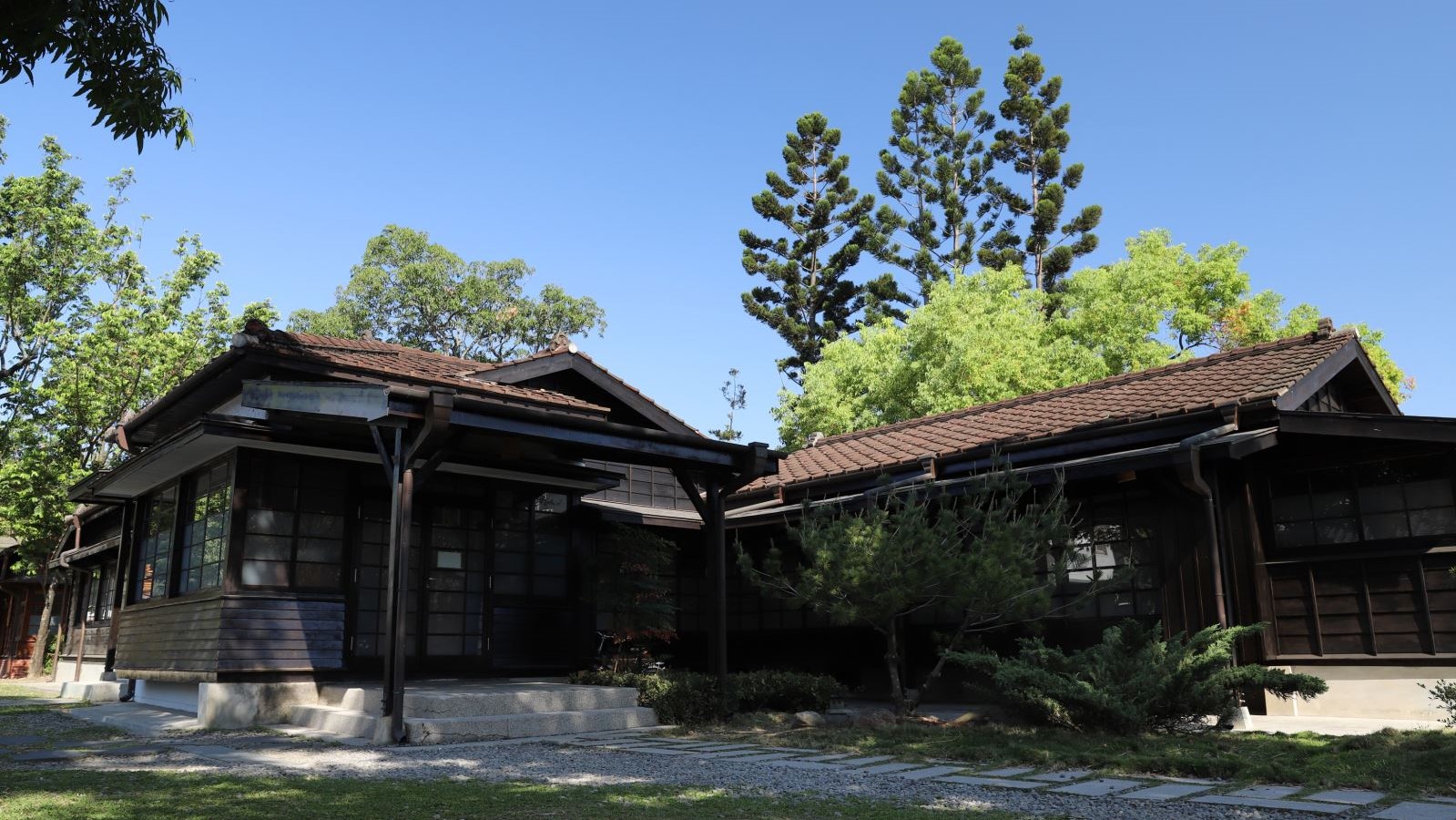
Return to Chiayi’s Beimen district on a separate, unhurried morning. The railway landscape included more than a station: forestry offices, timber storage, workshops and housing supported the movement of wood from mountain to city. Walk between the station area and the surviving timber buildings, noticing the difference between places for transport, repair, administration and home.
The forest journey continues here at street level. A rail line needed people who kept machinery running, handled materials and maintained buildings. Reading the district as a connected working landscape gives its wooden façades a life beyond their appearance.
1976 · preservation that still moves
On 9 July 1976, Oigawa Railway began full-scale operating preservation of steam locomotives on its main line. Keeping a train alive means more than keeping its shape: a working machine needs continuing care. When the railway partnered with Alishan in January 1986, the link joined two places where old railways still had a future to work for.
2015–2016 · a ticket became a reason to cross the sea
A Japanese-language reservation form for a 2015–2016 exchange offered eligible Oigawa pass holders an Alishan Railway ticket between Chiayi and Fenqihu. Travellers supplied a date, selected a direction and collected their confirmed ticket in Chiayi. The relationship had become a sequence of ordinary travel decisions, reaching beyond a commemorative plaque.
That offer belongs to those years. What remains in the story is the invitation: a journey through a familiar Japanese valley could lead to another journey into Taiwan’s mountains. At Beimen, notice the railway’s working spaces; on the Shuishan trail, follow the designated walking path. These are different ways to meet the landscape behind the name Alishan.
1986–2026 · another mountain railway across the sea
Alishan and Japan’s Oigawa Railway became sister railways in 1986. Technical exchanges and visits developed into a relationship that reached its fortieth year in 2026. The Japanese railway announced shared photo displays and commemorative train treatments: passengers could encounter the other railway while travelling on their own.
The relationship has several Japanese places, not one catch-all city: Kanaya and Shin-Kanaya in Shimada; Senzu in Kawanehon; and Ikawa in Shizuoka’s Aoi Ward. These are places along a railway corridor, each with a different position in the journey.
A journey that continues in another person’s day
For a passenger in Japan, a photograph inside a carriage can be a first meeting with Alishan. For a visitor in Chiayi, a familiar railway name can make a distant landscape feel approachable. The exchange becomes meaningful at this small level: a picture noticed during a journey, a station name remembered, a reason to take another trip.