Culture
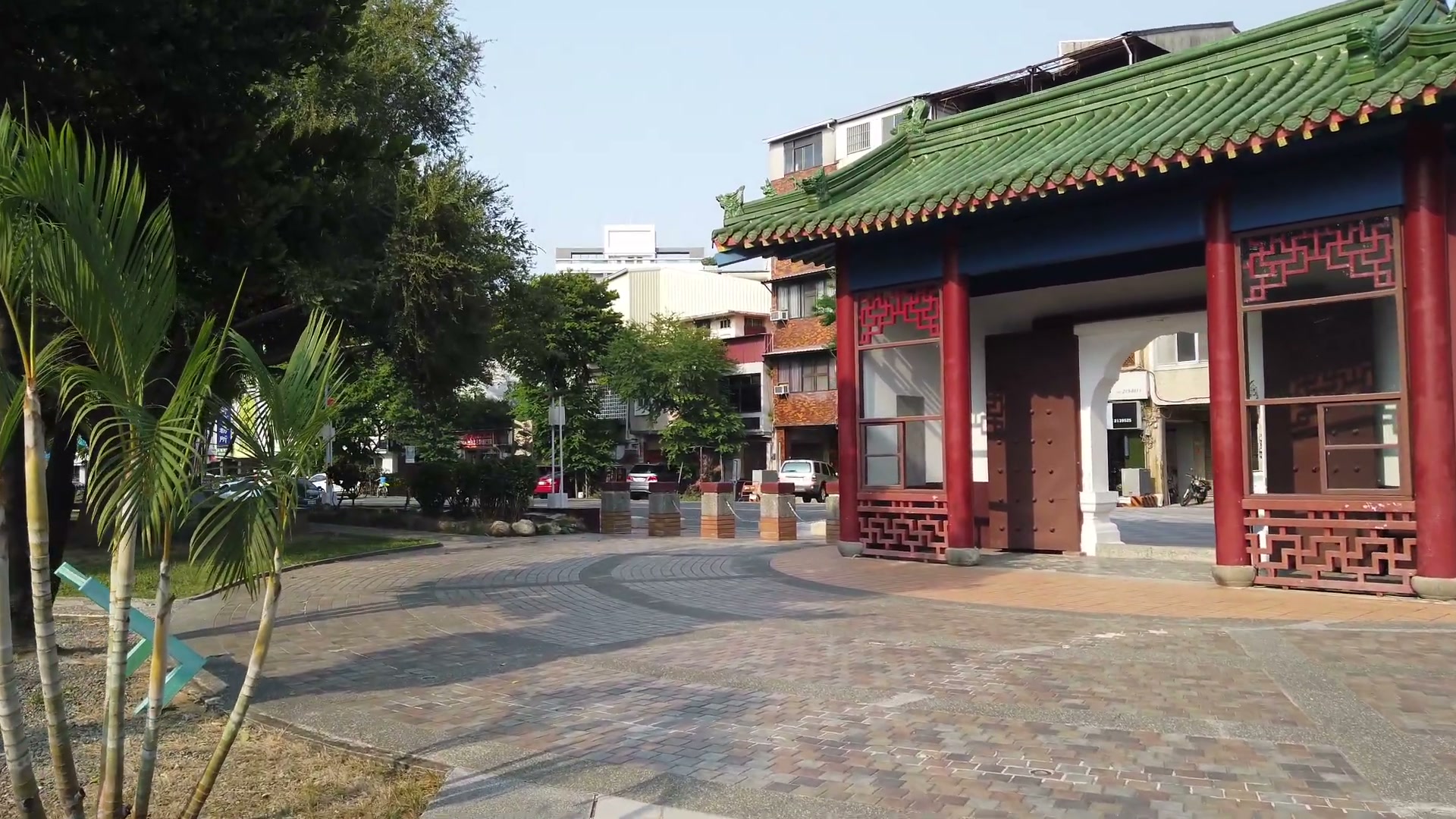
Koxinga Shrine, through the red gate
Enter through the red gate, follow lattice, columns and light towards the garden, then return to Tainan’s streets.
Koxinga Shrine, through the red gate
90 seconds. English captions are part of the film. Optional Traditional Chinese subtitles are available in the player.
Sam Kuo dates the walk to November 2020. Present repairs, interpretation, museum uses and room access require a fresh check. An earlier Hirado story ended with a Tainan courtyard photograph; this film develops a distinct walk through the precinct.
Complete English captions and Traditional Chinese translation
00:00:00,000 --> 00:00:07,000
Koxinga Shrine, Tainan.
Begin at the red gate.
臺南延平郡王祠。
從這座紅門開始。
00:00:07,000 --> 00:00:13,000
Step through.
A whole courtyard opens.
穿過入口,
整座院落在眼前展開。
00:00:13,000 --> 00:00:19,000
A doorway holds colour,
lattice, and calligraphy.
一座門框,
連起彩繪、窗格與書法。
00:00:19,000 --> 00:00:25,000
Follow the columns
along the edge of the court.
跟著紅柱,
沿著院落邊緣慢慢走。
00:00:25,000 --> 00:00:31,000
An arch opens
a view into the garden.
一道拱門,
打開望向庭園的視線。
00:00:31,000 --> 00:00:37,000
Look closer at
the red window lattice.
再靠近一點,
看紅色窗格的細節。
00:00:37,000 --> 00:00:43,000
Step outside again.
Read the roof with the trees.
再走到屋外,
把屋頂與樹木一起看。
00:00:43,000 --> 00:00:49,000
An open doorway reveals
the room beyond.
一扇敞開的門,
讓裡面的空間被看見。
00:00:49,000 --> 00:00:55,000
Light and shade lead
through the covered gallery.
沿著有頂的長廊,
看光影接續向前。
00:00:55,000 --> 00:01:02,000
The hall gives remembrance
a place in the city.
一座殿堂,
讓紀念在城市裡有了位置。
00:01:02,000 --> 00:01:08,000
Halls face one another
across a smaller courtyard.
走進較小的院子,
看殿宇如何彼此相對。
00:01:08,000 --> 00:01:14,000
Look back through the gate.
The spaces connect.
穿過門口回望,
把走過的空間連起來。
00:01:14,000 --> 00:01:22,000
Leave a little time
for the trees and garden.
也留一點時間,
給樹木與庭園。
00:01:22,000 --> 00:01:26,000
A walk filmed in November 2020.
這段走訪拍攝於2020年11月。
00:01:26,000 --> 00:01:30,000
Return to the city, slowly.
Taiwan, Layer by Layer.
慢慢走回城市。
島嶼年輪。
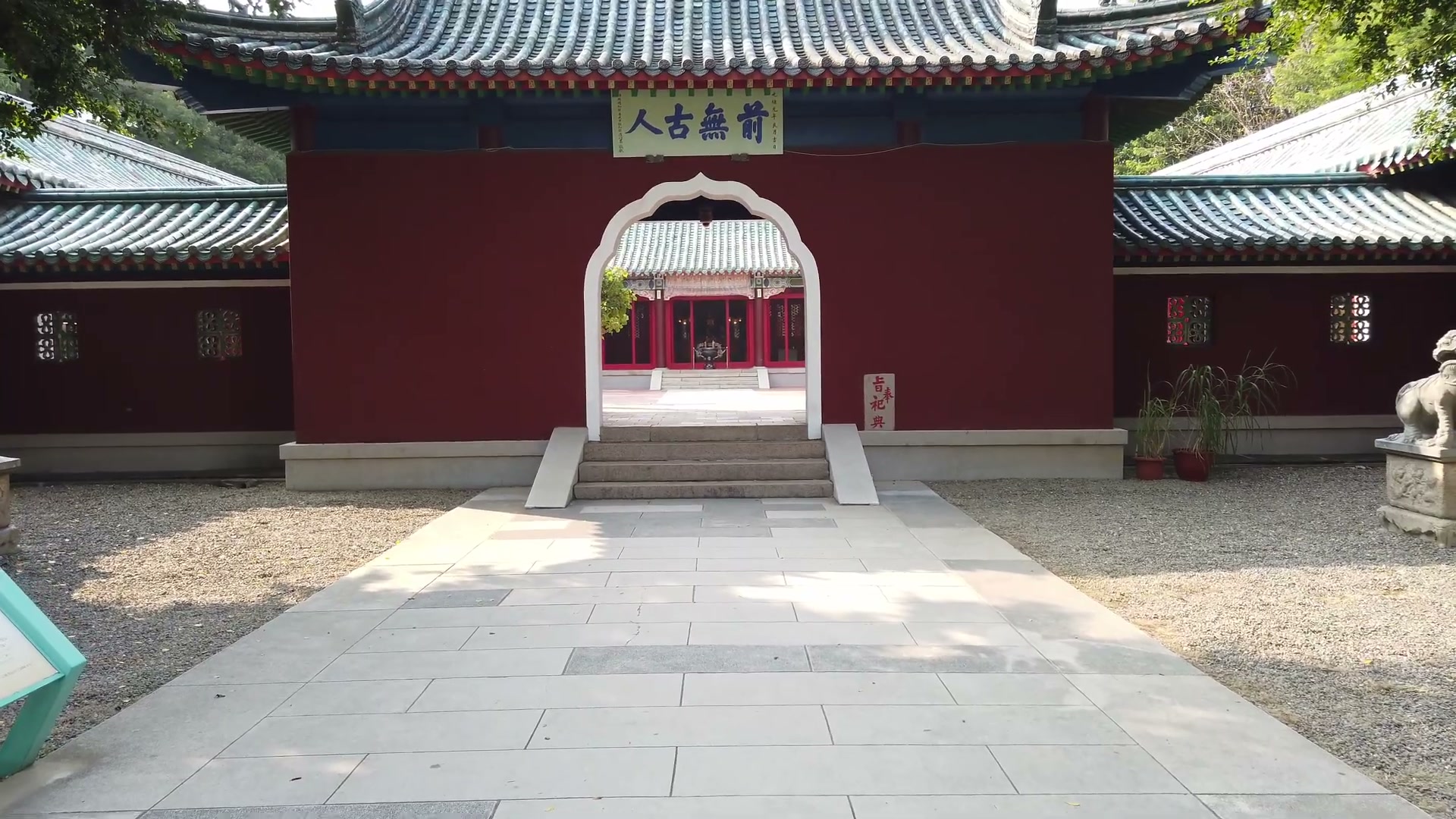
1. Begin with the whole red entrance
Approach Koxinga Shrine from Kaishan Road and pause before the red gate. A green-tiled roof stretches across the frontage. A white-edged arch makes the entrance clear, with another hall visible beyond. This view connects street, forecourt and precinct. Read the whole front before walking through: it offers a more memorable sense of the place than an isolated plaque.
The shrine commemorates the seventeenth-century Zheng Chenggong, but its main buildings belong to later remembrance. The national heritage record dates their comprehensive rebuilding from December 1963 to June 1964, adding a completion date to the formal article’s summary of the 1963 reconstruction. Separating these times invites a question: how did later people use a gate, roof and courtyard to keep a historical figure present in their city?
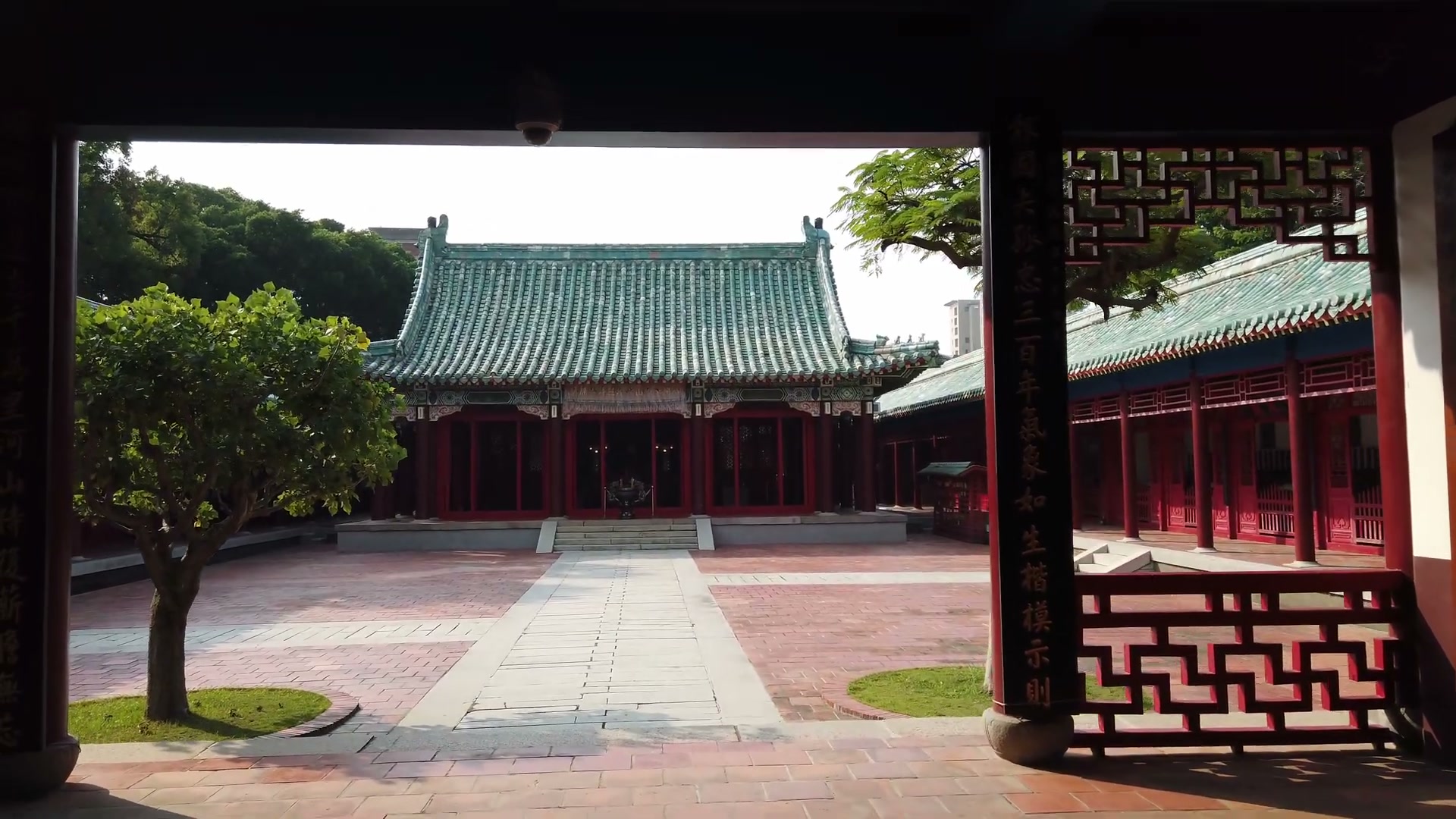
2. Let the columns lead around the court
Beyond the shaded entrance, the courtyard opens into daylight. The main hall, galleries, red columns and central paving become visible together. A tree gives the broad paved space another scale. Follow the covered edge, notice how columns divide a distant doorway into intervals, then look back across the court. The architecture itself gives the walk a direction.
A traditional roof does not make every component equally old. Heritage documentation records modern reconstruction and subsequent repair, with reinforced concrete used in parts of the precinct. Red paint and roof tiles cannot establish centuries-old timber. Begin with what can actually be seen: a doorway, column, eave or courtyard and the way they organise movement. Check materials and dates against interpretation on site.
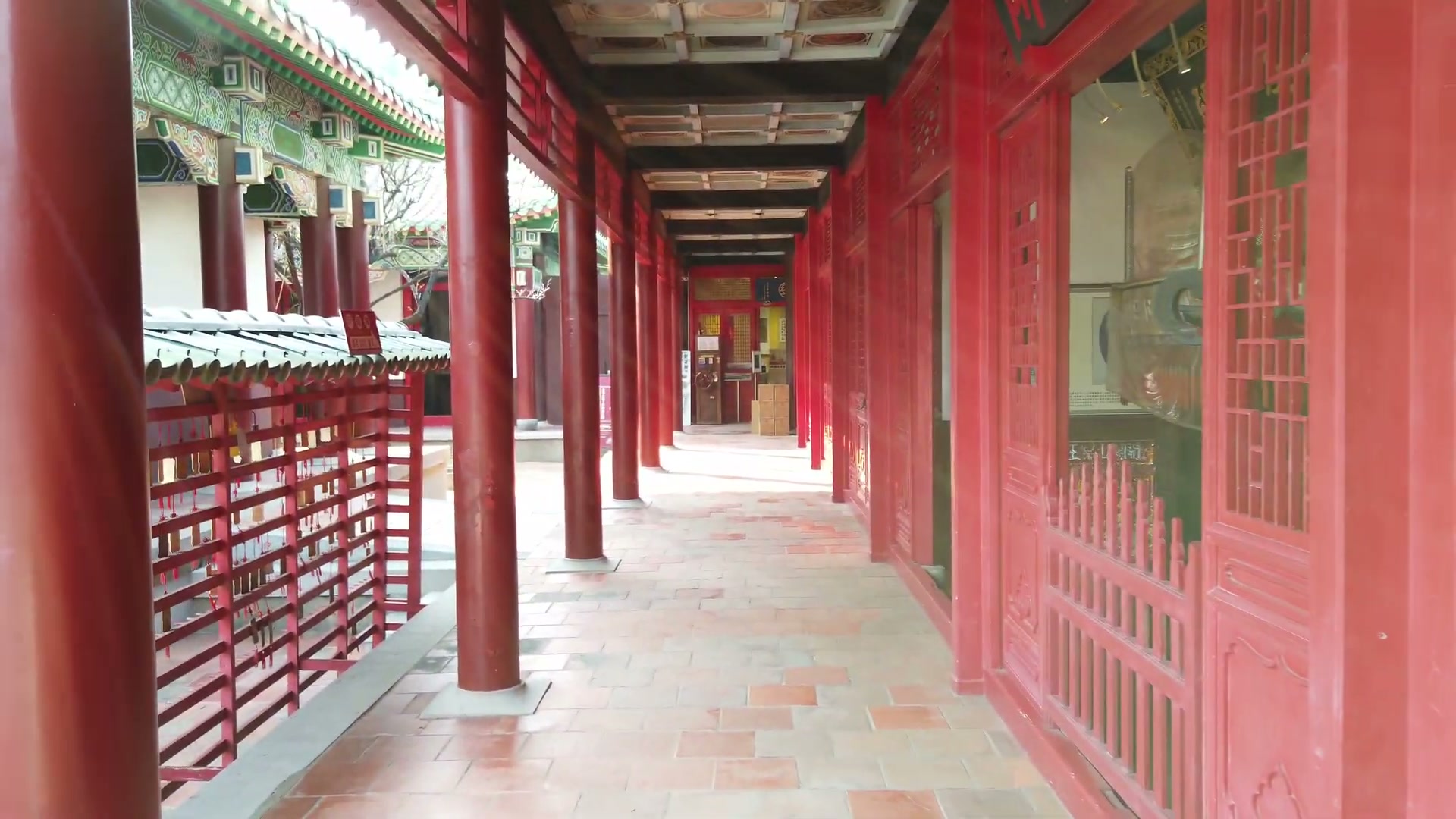
3. Look at lattice and the memory within
Close to a red window, open squares and intersecting lines change the view. As you move along the gallery, the room behind, a door opposite and the columns appear in different relationships. Painted ceilings and plaques add another direction of looking. The film then enters a hall open at the time of recording, keeping tables, images and doors within one room rather than reducing them to detached ornaments.
The formal article distinguishes the large central image from smaller devotional images and their different custodians. The heritage record identifies the main-hall Koxinga image as a 1961 work by Yang Ying-feng; rear rooms carry other commemorative roles. Not every image in the footage has been individually identified, and no private ceremony is shown. If entry is permitted, read the labels and observe from the visitor area. Doors open in this recording do not guarantee access to every room today.
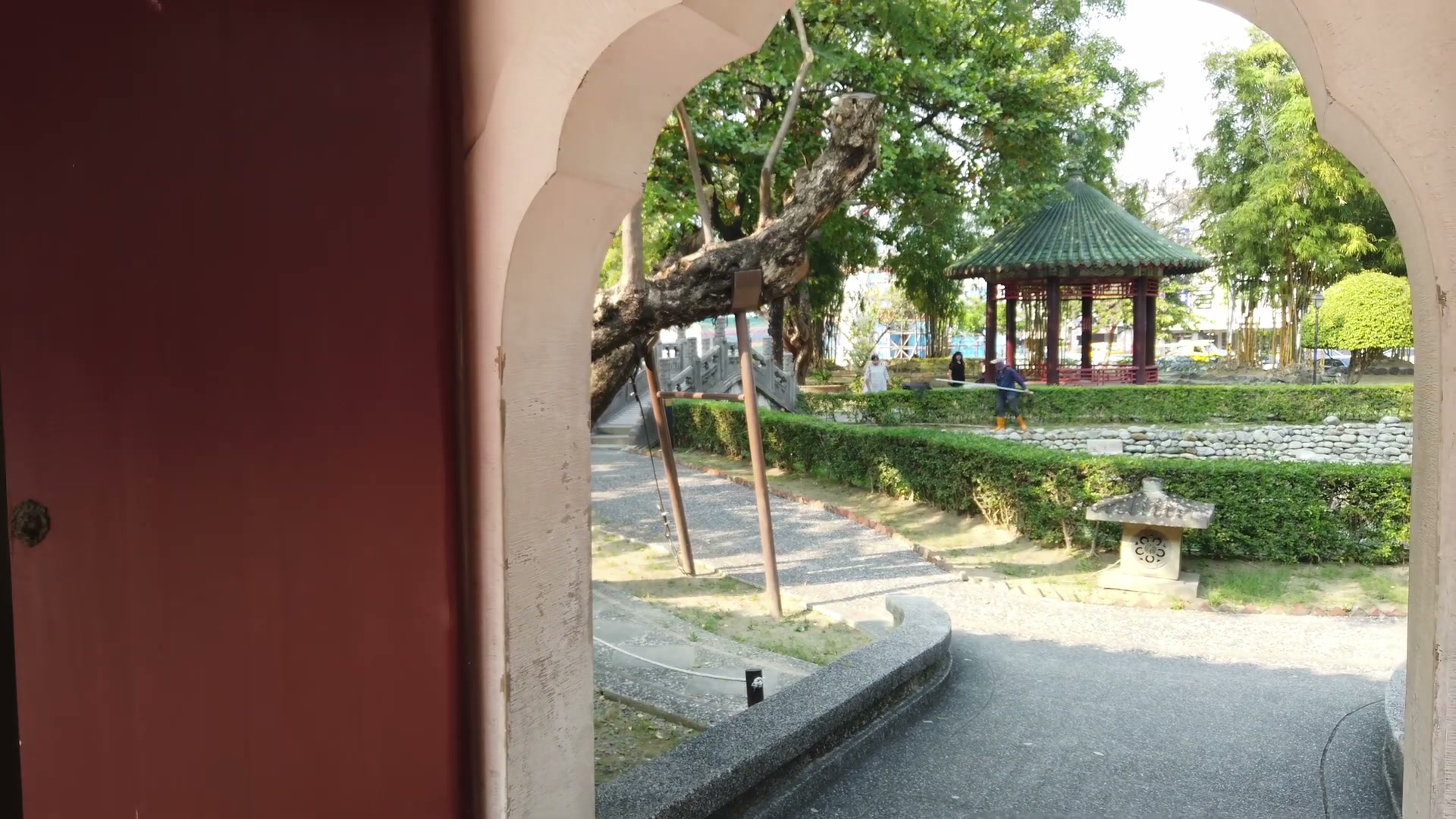
4. Find the garden through an arch
At a turn, a white-edged arch frames the garden. A branch crosses the view, a pavilion stands beyond, and gravel and curved edging extend the space for pausing outside the halls. Stay for a moment instead of hurrying to another inscription. Change position, read the tree inside the frame, then notice how the garden connects back to the red wall and gallery.
Interior shade and outdoor sunlight can take turns shaping the same visit. The garden is not presented as a surviving scene from Koxinga’s lifetime. Nor does old footage guarantee today’s planting, display panels or circulation. Follow the routes open on the day, watch changes in level underfoot and return to the court. A visit to a historic building also means caring for a place still in use.
5. Return to the city with the court in mind
Before leaving, look back across the court. Lattice, halls and eaves can now be placed in relation to one another. Under the trees of the forecourt, the street beyond the red entrance returns to view. The visit has both an arrival and a way back to everyday city life. Remembering a whole frontage, courtyard and garden is more specific than simply having visited a historic site.
The address is 152 Kaishan Road, West Central District, Tainan. The cultural bureau’s Chinese information lists usual hours of 08:30–17:30 and free entry; an English page gives an earlier start, so confirm the day’s arrangements with the manager or +886 6 213 5518. Sam Kuo dates this footage to November 2020, uploaded that December. Later repairs, neighbouring museum uses and room access may differ; recorded streets and interiors are not present-day guarantees.
Film, article and image sources
Sam Kuo dates the walk to November 2020. Present repairs, interpretation, museum uses and room access require a fresh check. An earlier Hirado story ended with a Tainan courtyard photograph; this film develops a distinct walk through the precinct.
- 島嶼年輪:延平郡王祠正式中英原文
- Sam Kuo:Walking Around Koxinga Shrine(註明2020年11月拍攝、12月7日上傳)
- 文化部國家文化資產網:延平郡王祠(含鄭成功文物館)
- 臺南市政府文化局:延平郡王祠中文參觀資訊
- 臺南市政府文化局:Koxinga Shrine英文頁(開門時間與中文版有差異)
- 內政部臺灣宗教文化地圖:延平郡王祠
1. Source walking footage: https://www.youtube.com/watch?v=UxT5kmOc-bE · 2020
2. Source walking footage: https://www.youtube.com/watch?v=UxT5kmOc-bE · 2020
3. Source walking footage: https://www.youtube.com/watch?v=UxT5kmOc-bE · 2020
4. Source walking footage: https://www.youtube.com/watch?v=UxT5kmOc-bE · 2020
5. Source walking footage: https://www.youtube.com/watch?v=UxT5kmOc-bE · 2020
Music: 把時間留下 (AI-generated instrumental).