Culture
Fengtian Temple: Between Hill and City
Begin with the whole temple, enter its halls on two levels, then look back at the city from the terrace.
Fengtian Temple: Between Hill and City
90 seconds. English captions are part of the film. Optional Traditional Chinese subtitles are available in the player.
The five chapters and complete original snapshots retain the hillside setting, local foundation, Yunlin connection, building changes and visit information. The creator dates the walk to 10 January 2024. Individual identities are unconfirmed; hill trails, classes and charitable programmes are not shown. Historical context follows the formal article and temple account, excluding the source description’s incorrect 1890 foundation and City God claims.
Complete English captions and Traditional Chinese translation
00:00:00,000 --> 00:00:07,000
Songshan Fengtian Temple.
Where the city meets Hushan.
松山奉天宮,
城市與虎山交會的地方。
00:00:07,000 --> 00:00:14,000
Start with its layered roofs,
then approach the open entrance.
先看層疊的屋頂,
再走近開放的入口。
00:00:14,000 --> 00:00:21,000
Inside, doorways connect
the halls and passages.
走進門內,
一道道門連起殿堂與通道。
00:00:21,000 --> 00:00:28,000
Follow the wooden stairs.
Another level opens above.
沿著木梯往上,
另一層空間逐漸展開。
00:00:28,000 --> 00:00:35,000
Carved columns frame
a route through the building.
雕刻柱間,
留著穿過建築的路徑。
00:00:35,000 --> 00:00:42,000
Look at the whole hall,
then let the details come closer.
先看完整殿堂,
再慢慢走近細節。
00:00:42,000 --> 00:00:49,000
Beyond the covered terrace,
the neighbourhood stays in view.
走到有屋簷的廊臺,
街區仍在視野裡。
00:00:49,000 --> 00:00:56,000
A place to worship,
and a place people move through.
這裡供人參拜,
也讓人們往來通行。
00:00:56,000 --> 00:01:03,000
Pause beside the route.
Leave room for those here to pray.
在動線旁停留,
把空間留給前來參拜的人。
00:01:03,000 --> 00:01:10,000
The stairs connect
two levels of temple life.
樓梯連接著
廟宇生活的兩個樓層。
00:01:10,000 --> 00:01:17,000
Back downstairs, a passage
opens into another hall.
回到樓下,
通道接向另一座殿堂。
00:01:17,000 --> 00:01:23,000
Some pause. Others pass through.
Each visit has its own pace.
有人停留,有人經過,
每趟到訪都有自己的步調。
00:01:23,000 --> 00:01:30,000
A temple beside the city.
Taiwan, Layer by Layer.
在城市身旁,看見一座廟。
島嶼年輪。
1. Place the temple between hill and street
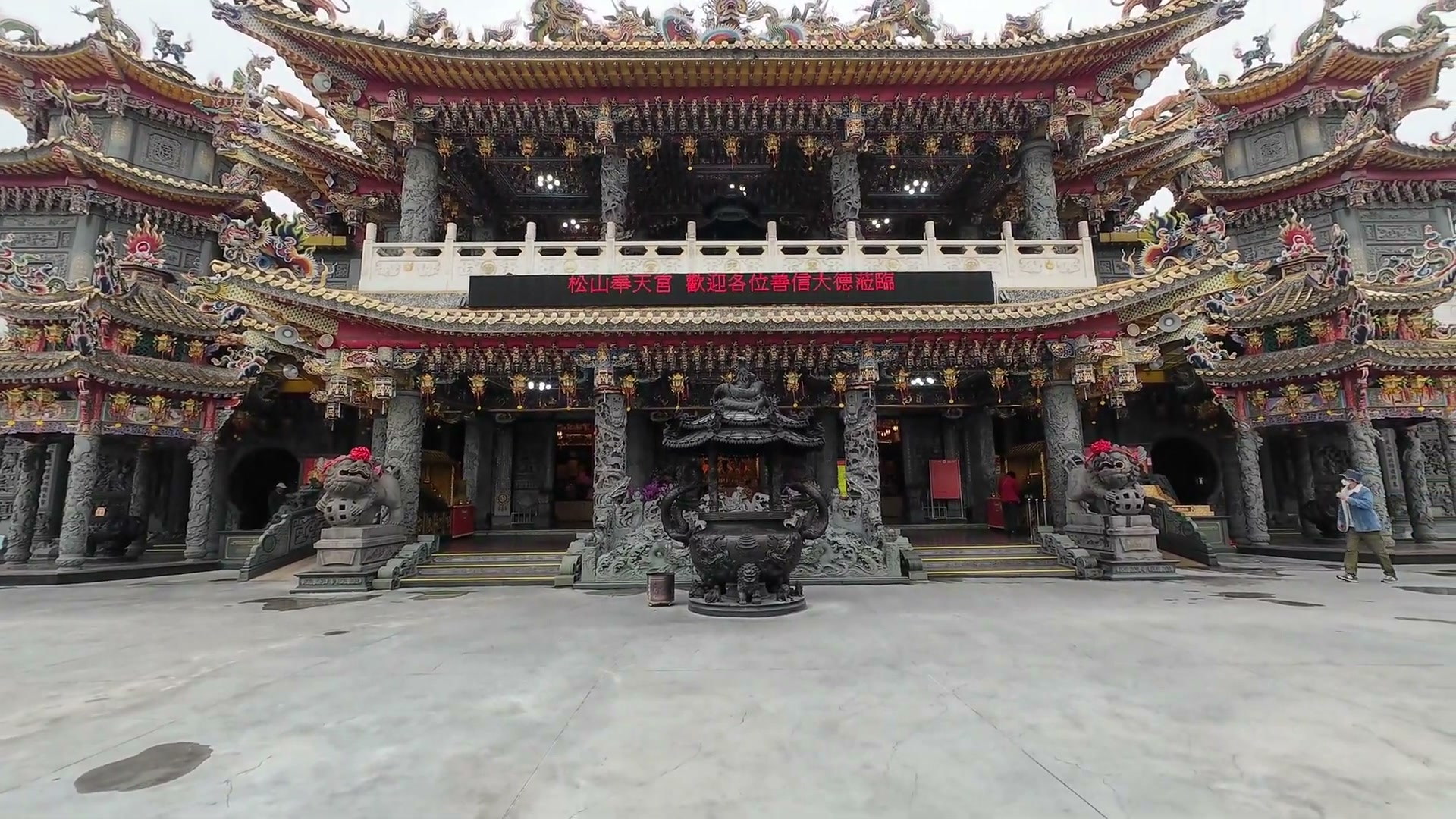
Songshan Fengtian Temple stands at the foot of Hushan in Taipei’s Xinyi District. Begin in the open forecourt, taking in the main halls, layered roofs and buildings to either side. Then approach the entrance. Seeing the whole gives the carvings, columns and doors a place within a temple that remains in use.
The formal article begins with movement between Fude Street and Hushan. Some people make the temple their destination; others pass its forecourt on a hill outing. This is a way to understand the setting. The identities of individual people in the footage are unconfirmed. The film follows the temple buildings and public passages; the hill trail needs a separate plan.
2. Different local histories meet in one temple
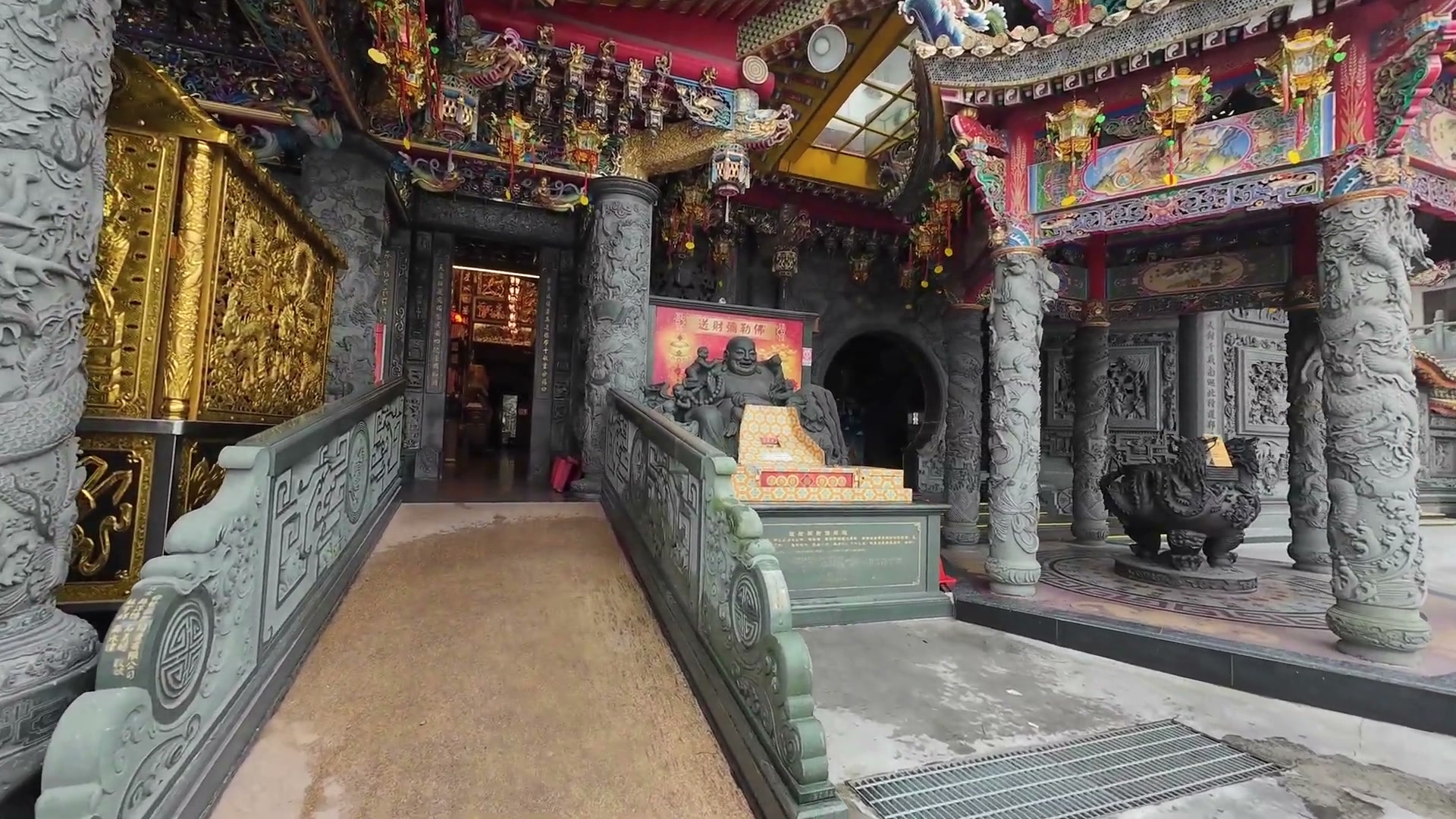
The temple’s principal deity is the Jade Emperor, known locally as Tiangong. Its official history records that Wen Chin-po, Liu Yung-hao and other local supporters raised funds for a bamboo building in 1953 and named it Songshan Fengtian Temple. The present complex grew through later expansion; its buildings were not all completed at the founding.
In 1959, Kai’an Temple on Yongji Road received the Five-Year Royal Lords from Maming Shan Zhen’an Temple in Baozhong, Yunlin. Local supporters later agreed to bring the two temples’ deities together, and a management committee was established in February 1967. The formal article retains this Yunlin connection alongside Hushan’s Tiangong tradition. Read the temple’s own labels when distinguishing worship spaces. The image shows the present entrance, not an archival scene from those dates.
3. Read the building through doors and stairs
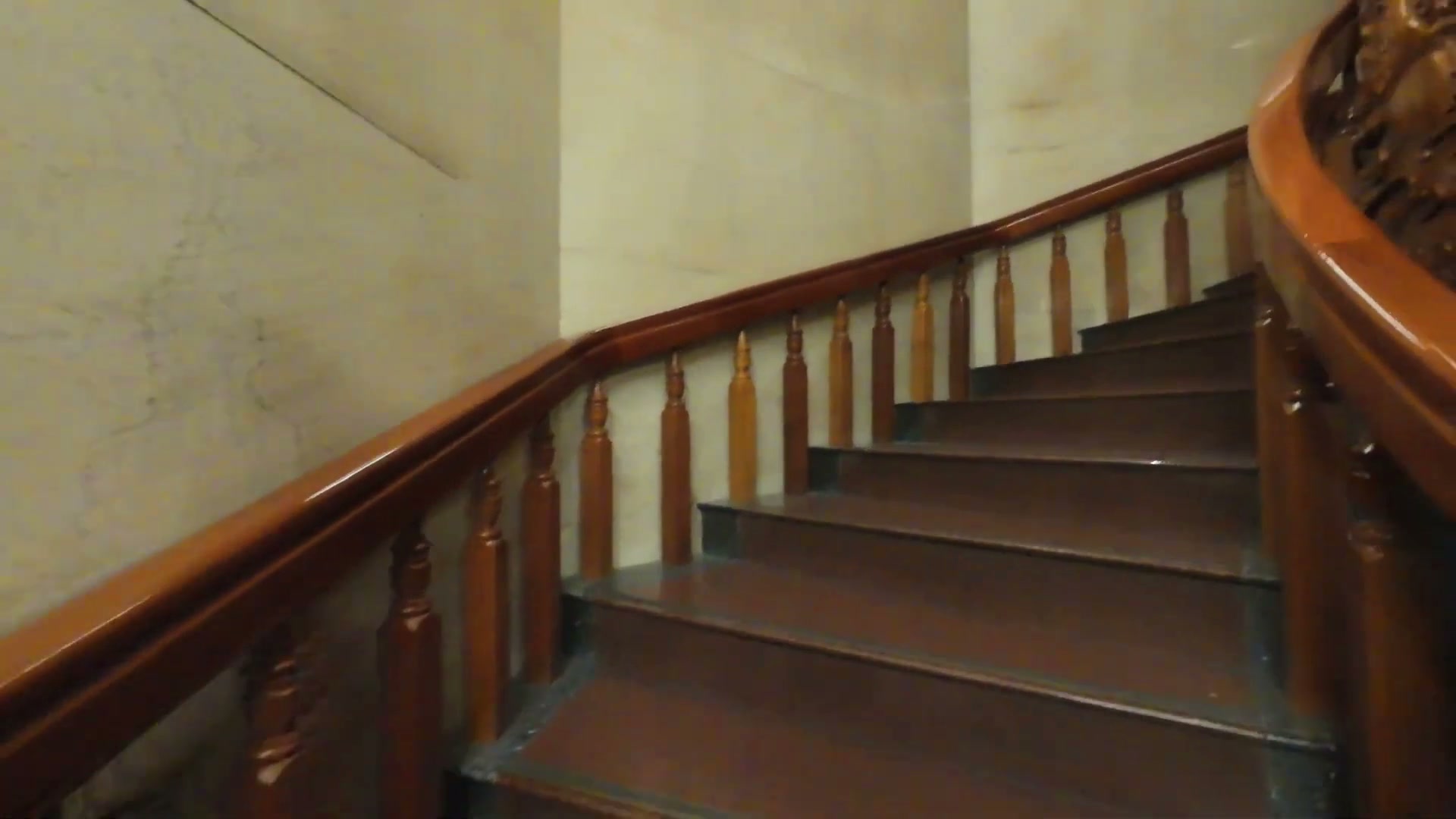
The wooden stairs carry the visit from the ground floor to an upper level. Look at carvings, doorways and railings together with the passages between them. Decoration belongs to an occupied building; columns and corridors also organise the way people move.
The formal article separates the roofline, halls and forecourt for observation. The film connects the two levels with stairs, establishing the building’s layout before moving closer to its details. Follow the temple’s current access and circulation arrangements. Working areas and closed rooms are outside the visit.
4. Worship and movement share a building
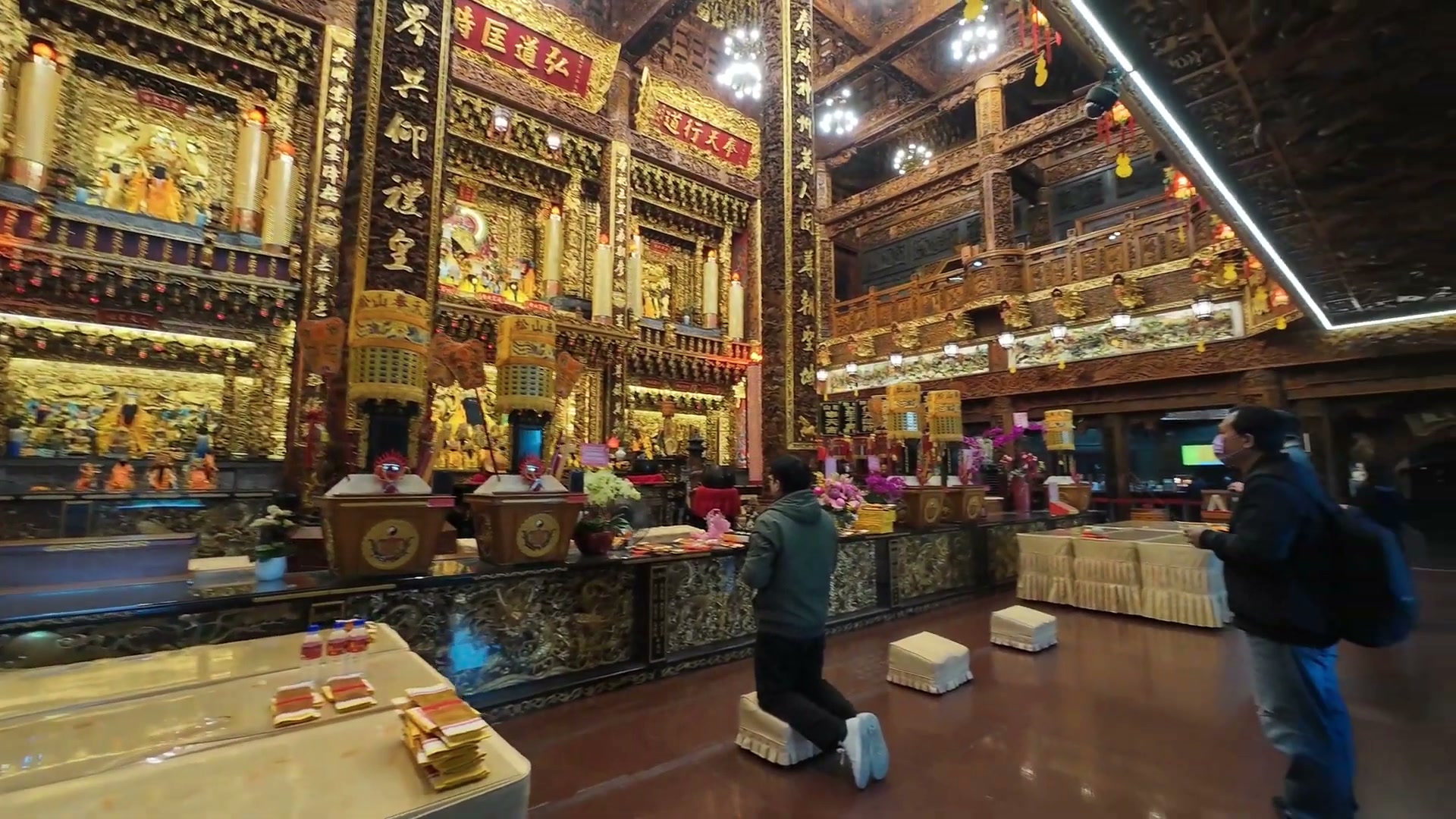
Some people pause in the hall while others continue along a passage. Keeping them within the scale of the room reveals how altars, railings and open floor space accommodate different ways of being there. Pause beside the route, leaving the space between worshippers and the altar clear.
The temple also records charitable, educational and cultural work, extending its role into learning and local support. This context helps explain why its buildings have gained different uses. The film does not show those programmes, and ordinary worship footage does not stand in for them.
5. Look back from the terrace, plan the hill separately
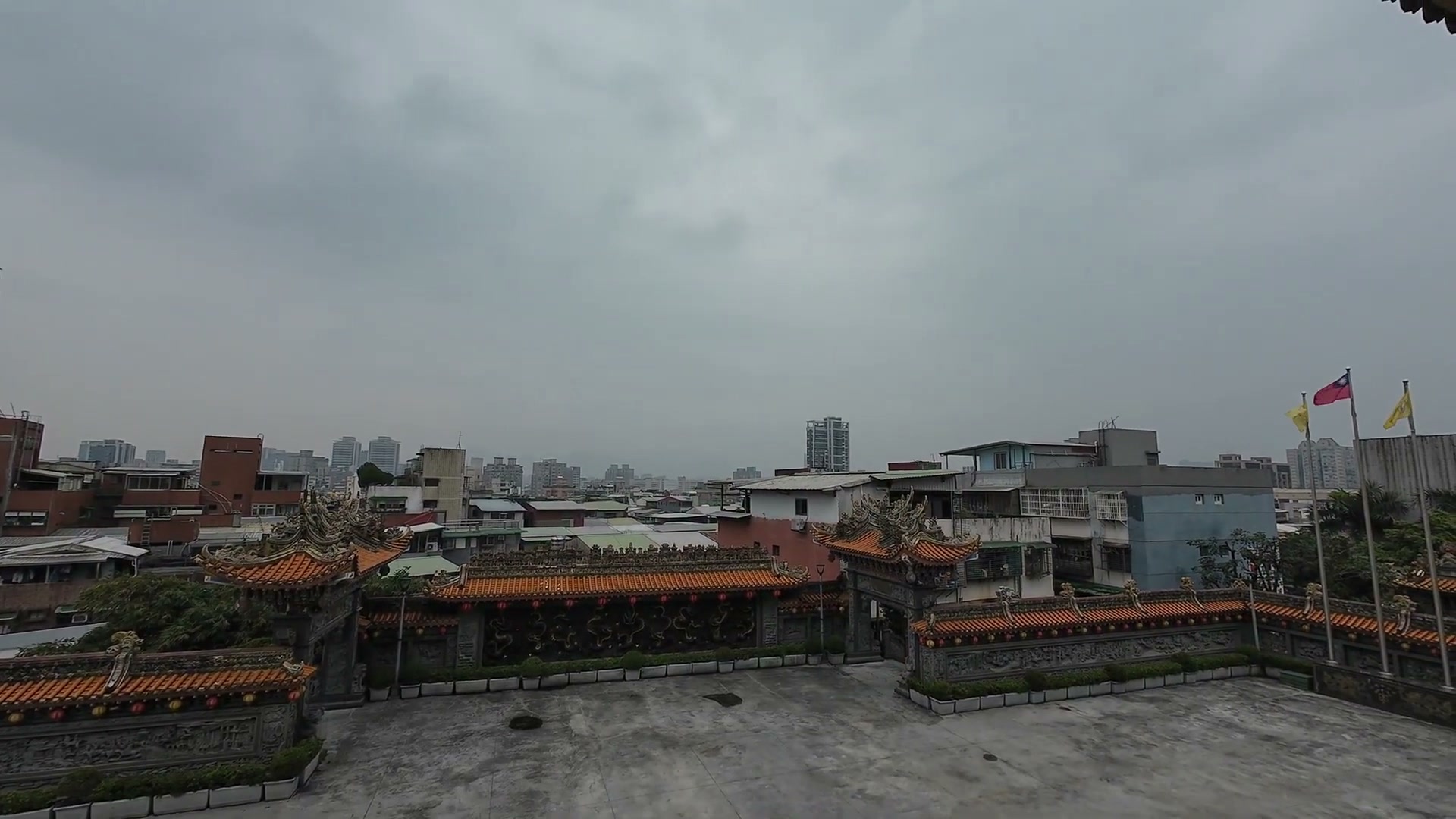
From the covered terrace, the temple and city remain in one view. Hushan is not a detached backdrop: the buildings at its foot receive people making different journeys. After visiting the halls, return to the forecourt and public streets, then plan your journey from where you actually finish.
The formal article gives 12, Lane 221, Fude Street, Xinyi District, Taipei, with the Fengtian Temple bus stop as an arrival reference. The temple’s transport update of 10 September 2026 lists Exit 2 of Guangci/Fengtian Temple Station on the Tamsui–Xinyi Line, followed by about three minutes towards Lane 177, Fude Street. It also lists Exit 2 of Houshanpi Station on the Bannan Line, followed by about ten minutes towards Dadao Road. These are the temple’s estimates; confirm services and directions for your travel day.
The forecourt and open halls make a separate cultural visit. Allow additional time for Hushan’s trails, climbing, transport and return travel; do not add this stop to trail mileage. The creator dates the footage to 10 January 2024. It does not establish current access, crowds or construction conditions. Check the temple’s current notices.
Film, article and image sources
The five chapters and complete original snapshots retain the hillside setting, local foundation, Yunlin connection, building changes and visit information. The creator dates the walk to 10 January 2024. Individual identities are unconfirmed; hill trails, classes and charitable programmes are not shown. Historical context follows the formal article and temple account, excluding the source description’s incorrect 1890 foundation and City God claims.
- 島嶼年輪:奉天宮廟前:登山的人與參拜的人(正式雙語原文)
- Taiwan Street Tour:Songshan Fengtian Temple實走,2024-01-11上傳;拍攝日由原作者標示
- 松山奉天宮:地理位置、歷史沿革與公益教育
- 松山奉天宮:建築之美
- 松山奉天宮:交通更新,2026-09-10
- 松山奉天宮:參拜禮儀
1. Original source: https://www.youtube.com/watch?v=xdtuVXANuZ0 · 2024
2. Original source: https://www.youtube.com/watch?v=xdtuVXANuZ0 · 2024
3. Original source: https://www.youtube.com/watch?v=xdtuVXANuZ0 · 2024
4. Original source: https://www.youtube.com/watch?v=xdtuVXANuZ0 · 2024
5. Original source: https://www.youtube.com/watch?v=xdtuVXANuZ0 · 2024
Music: 把時間留下 (AI-generated instrumental).