Cultural place
Oxford College: a classroom between two shores
Read a school’s changing life through its name, courtyard and roofline.
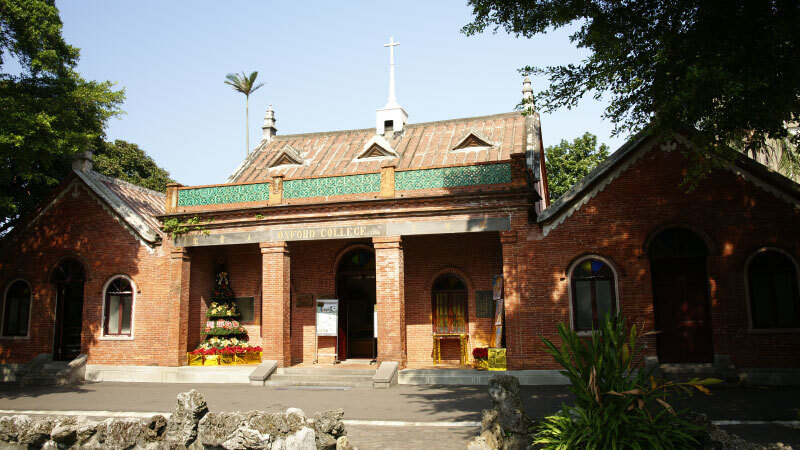
Look for: the entrance inscription, courtyard arrangement and roof details.
Visit by confirmed appointment; enter from the campus entrance agreed with the museum.
Begin with the name above the doorway
The English name Oxford College points across the Pacific to Ontario. In Tamsui, it belongs to a low brick school building whose Chinese name is 理學堂大書院. Reading the two names together opens a question that the architecture carries forward: how did a community in Canada become part of a classroom in northern Taiwan?
George Leslie Mackay arrived in Tamsui in 1872 and taught in rented rooms and outdoors. As the number of students grew, a permanent school became an increasingly practical need. During his return to Canada in 1880, people in his home county of Oxford contributed towards the building. Completed in 1882, the school acknowledged that support in its English name. A place-name became a lasting record of people helping a school take shape far from home.
A courtyard with more than one architectural language
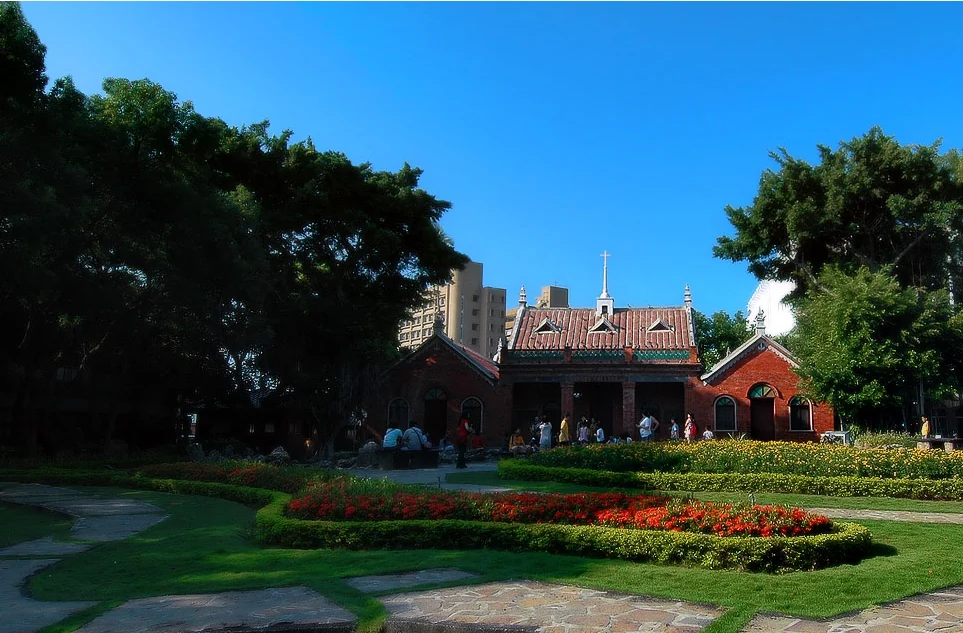
The building’s original arrangement drew on a Taiwanese courtyard house, with two successive sections and side wings. Look first at how the central entrance and wings frame the space, then lift your eyes. Above the familiar pitched red-tile roof are Western-style ventilation features; the frontage and arched window details bring another architectural vocabulary into the same building. The encounter is easier to see in these small transitions than in a single label for the whole school.
Oxford College has served as classrooms, accommodation, a library and a chapel, and now holds historical displays. Repairs and alterations accompanied those changes. Its present form can therefore be read as the result of continued use: a room’s purpose changes, people adapt the building, and the school acquires another layer of history.
Learning beyond the school walls
The curriculum reached from religious study to history, natural sciences and medical learning. Outdoor teaching and clinical observation connected lessons to the world beyond the classroom. This helps explain why the building matters within Tamsui’s history: learning, care and religious work met here, while students carried what they learned into other communities.
During an arranged visit, move from the name at the entrance to the courtyard, then to the roofline and historical displays. Those changes of scale connect a distant fundraising effort with the details of a working school. After leaving, the name Oxford is no longer just a word on a building; it belongs to a story of how learning found a place in Tamsui.
Materials that travelled, rooms that changed
The walls record movement of materials as well as a school’s name. Aletheia University identifies bricks and China fir from Xiamen, and a traditional lime mixture prepared with glutinous rice and dark sugar syrup. Overseas support took material form through shipping and building work. The standing arrangement is not an untouched replica of 1882. The university records the removal of the second range, additions in the courtyard and altered doors and windows. During an authorised visit, compare the present plan with historical images before reconstructing the original two-range layout. An account of the old plan does not mean every former room can still be found.
Look closer
At the entrance, compare the Chinese and English names. In the courtyard, trace the central axis and side wings. At roof level, find where red tiles meet ventilation and decorative details.