Read 23 October 2026: Taipei’s hydraulic authority announced that all flood gates and embankment ramps would close progressively from 00:00 on 23 October, making the outside access roads impassable. Do not enter the riverside or attempt this ride during the control. YouBike has also been suspended since 02:00; reopening will be announced separately.
Start near the Museum of Drinking Water in Gongguan, follow the Xindian and Tamsui riverfronts towards Dadaocheng, and allow separate pauses in the historic streets.
Read this route through its landscape and local life. Numbered stops provide interpretation; detailed navigation still requires signs and the original route map. Cultural stops are separate from uninterrupted riding time.
Museum of Drinking Water
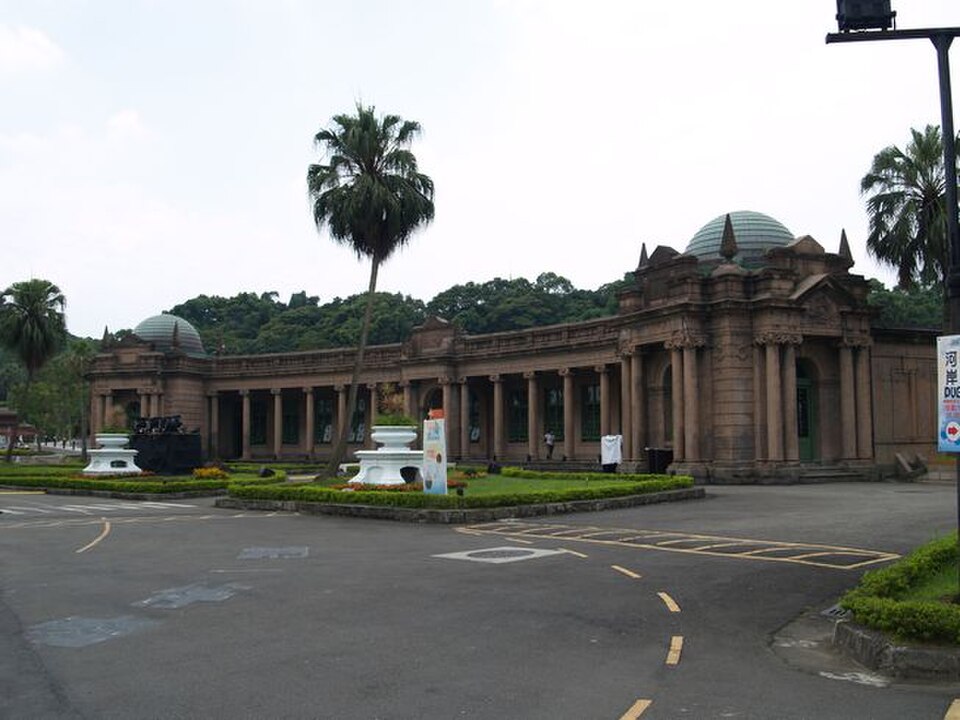
The Museum of Drinking Water's building may first make you stop for a photograph. As you approach, try asking a different question: how did Taipei once bring water into everyday life? Behind the attractive facade is an engineering story about how a city works. Notice the building's symmetry, windows and decoration, then turn your attention to the machinery. Looking at appearance and function together shows how carefully public facilities once expressed a city's progress. Water moves from the natural environment into pipes and eventually becomes something available at home with the turn of a tap. That journey requires collection, treatment and delivery. The museum gives these usually unseen stages a form you can understand. Close to Gongguan and the Xindian River, this stop connects a riverside journey with the city's infrastructure.
Compare the pump-house columns and domed roof with its working purpose; use permitted visitor areas to read the waterworks story.
Start near the museum and check the public connection to the riverside cycle route. The 15.6 km reference is not a verified turn-by-turn ride through all temple streets. For the Longshan Temple visit, confirm the street approach, park and continue on foot; museum admission and cultural stops need separate time.
Longshan Temple
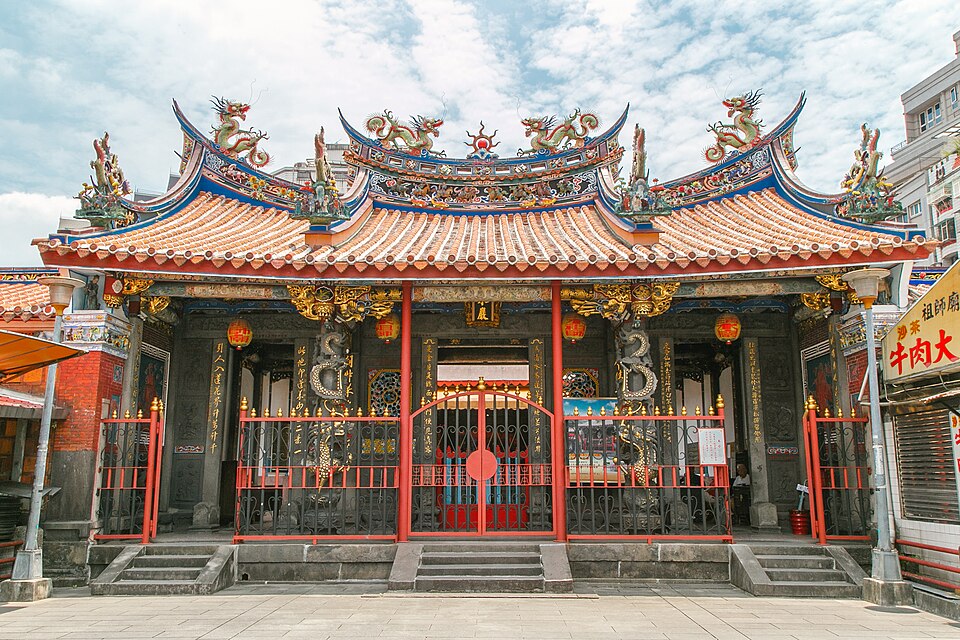
As you approach Longshan Temple, first look at the entrance hall's roof, caisson ceiling and carved columns, then watch how worshippers enter and leave. The major rebuilding of 1920–1924 brought Wang Yishun and craftspeople with different specialisms into the same project. Woodwork, stonework and decoration combine in the details you can observe today. The temple has also experienced war damage and rebuilding. The building before you is a place of continuing use and repair, rather than something completed once and never changed. You do not need to photograph every carved figure. Choose one column or a section of the eaves and study its materials and patterns to see the craftsmanship more clearly. Everyday worship continues here, so keep worship routes clear. Bopiliao, the next stop, is in the nearby streets. Follow pedestrian signals when crossing, and avoid walking along the road while taking photographs.
Choose one carved column or roof detail, then notice how worshippers move through the courtyard.
Keep the bicycle parked while visiting the temple and nearby Bopiliao. Use pedestrian signals and public walkways between them; do not ride through worship or pedestrian areas.
Bopiliao Historic Block
At Bopiliao, begin by looking slowly along the covered walkways. Red brick, arches and linked shophouses bring the streetscape into view at a scale close to the body. This area preserves the pattern of a Qing-era street, later used and changed in different periods. Walking into the historic block reveals how part of the city was retained and reopened for people to explore, rather than a photograph of the past that has stopped changing. When you turn from a riverside ride into this block, slow down: its stories lie in the proportions of walls, doors, windows and corners, rather than scenery passed at speed. Nearby Longshan Temple, Herb Lane and other temples can form another walk through Bangka. At this stop, however, keep your attention on how a street retains traces of earlier everyday life.
Look from the brick street corner towards the arcades and windows; observe the building proportions on foot.
For the Qingshui Temple stop, check public streets and crossings from Bopiliao and continue on foot. Opening of an indoor space is separate from access along the street.
Bangka Qingshui Temple
At Bangka Qingshui Temple, first pause in front of the temple to look at the building. Dedicated to Qingshui Zushi, it is connected with the beliefs of migrants from Anxi in Fujian. Founded in 1787, it has experienced damage and rebuilding and become an important place of worship in Bangka. Roof ridges, dragon-carved columns, brick carvings and timber details all invite a slower look. Choose one detail, study it clearly, then place it back within the whole building; this can be more rewarding than trying to see every decoration at once. Belief in Qingshui Zushi also reminds us that early migrants brought familiar ways of worship and a wish for safety and peace, as well as languages and skills. The temple and its neighbourhood are intertwined. Worshippers, shopkeepers and everyday journeys together keep this place in use.
Compare the roof ridge, carved columns and entrance, leaving the worship route clear.
Check the public walking connection towards Qingshan Temple. Keep entrances and worship routes clear, and return to your bicycle by the approach you have confirmed.
Bangka Qingshan Temple
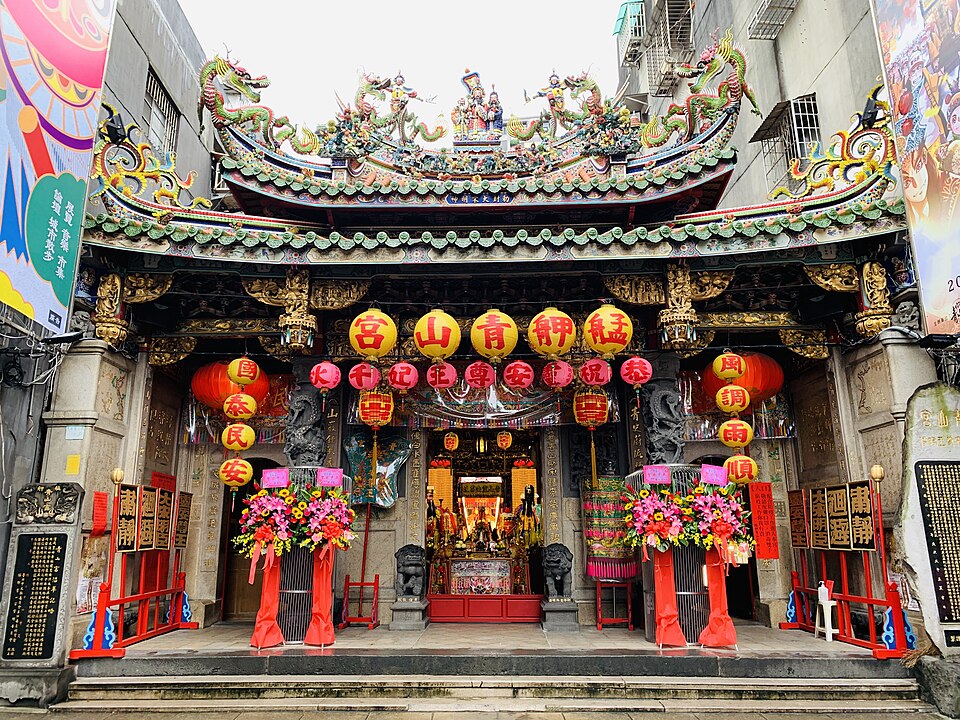
Bangka Qingshan Temple is dedicated to Ling’an Zunwang and connected with the beliefs of migrants from Hui’an in Quanzhou. Begin by looking at how the temple fits into the neighbourhood, then look up at its timber work and decoration. It does not need the distant views of a hillside temple to draw attention: the movement of neighbours forms its setting. Belief and everyday life meet closely here, and passing the entrance gives a sense of daily neighbourhood activity. Visiting Qingshan Temple and nearby Qingshui Temple on the same walk shows that Taipei's older temples carry different stories. Different migrant communities brought different deities and formed their own familiar gathering places in the city. Understanding these differences can be more interesting than simply remembering building dates. Close up, look at the craftsmanship; from farther away, see a place of belief that remains in use.
Read the temple name among the lanterns, then notice how its entrance fits between neighbouring buildings.
Before resuming the ride towards Dadaocheng, confirm a public connection back to the riverside cycle route. The next interpretation marker does not define a direct street cycling route.
Dadaocheng Wharf
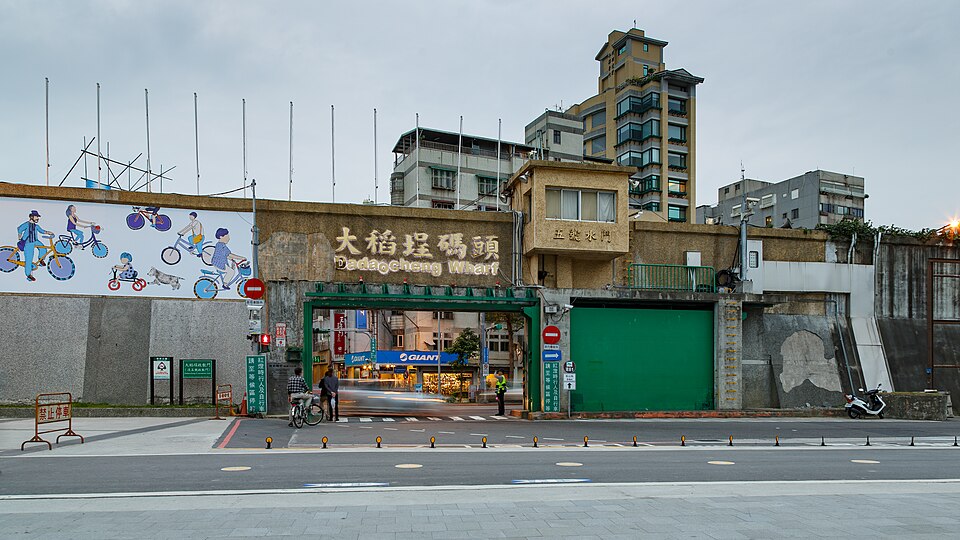
At Dadaocheng Wharf, the view suddenly opens from rows of shophouses onto the Tamsui River. Many people now come to walk, cycle or wait for the sunset, making the waterfront feel like an edge of the city where people can unwind. Looking at it together with nearby Dihua Street helps explain why Dadaocheng's commercial life is closely connected with waterways. Inside are streets, shops and everyday life; outside are open water and routes along the river. An access point links these two faces of the city. After riding here, set aside the urge to hurry. Locate the opposite bank, bridges and river in relation to one another, allowing the Tamsui River on your map to become a place whose width you can experience. The long layout of shophouses, shops' merchandise and people moving through the streets make the connection between waterfront and business easier to see.
Find the wharf access gate and compare the built-up street side with the river side; do not cross a closed gate.
Check whether the access gate and public approach to Dihua Street are open. If the gate is closed, do not pass it. Park before exploring the trading streets on foot; the street visit needs additional time.
Dihua Street, Section 1
Turning from the waterfront into the neighbourhood, first look up at the signs, then notice the depth of the shops. Dihua Street rewards a slow walk: goods are displayed at the front, buildings extend inward, and the street becomes a local history you can read with your feet. Instead of photographing every facade, choose a product that interests you and follow it along the shops. Dadaocheng is connected with the history of tea exports. Tea once made this neighbourhood an important centre for overseas trade. Along with architectural styles, ask who works here, how goods enter and leave, and where customers come from. After exploring the street, return to the wharf and try connecting mountain tea gardens, shops and waterways. Following this connection is not an attempt to reconstruct the past as a photograph. It offers a way to see, next time you pass a shop entrance, both the merchandise and the character this place has accumulated through years of business.
Look at shop signs, upper-storey windows and shop depth; do not enter a private working area without permission.
Finish the street visit, deal with bicycle parking or return, and check the journey towards Beimen MRT from your actual finishing point. Do not assume a bicycle can be taken straight into the station; current transport rules apply.
Getting there and back
Read 23 October 2026: Taipei’s hydraulic authority announced that all flood gates and embankment ramps would close progressively from 00:00 on 23 October, making the outside access roads impassable. Do not enter the riverside or attempt this ride during the control. YouBike has also been suspended since 02:00; reopening will be announced separately.
Start at Museum of Drinking Water. After Dihua Street, use the return link towards Beimen MRT; check connections from your actual finishing point. Travel and cultural visits are additional.
Time is a planning allowance from the existing itinerary, not a measured duration. Check bicycle condition and riverside notices. Park before entering temples, shops or pedestrian streets. Check weather, closures and return transport. Optional culture extensions are not included in the distance.
Who paid to keep the temple standing?
Bangka’s Longshan Temple carries a history of decisions made locally. Its institutional history records structural decay in 1919, the monk Fuzhi’s contribution of savings and a community fundraising effort that brought craftspeople including Wang Yishun to rebuild it. Skill from across the sea depended on local money, organisation and care.
Observe how the building, worshippers and street share space. Follow temple access arrangements and keep worship routes clear. If you approach Bangka from the riverside, check the separate street connection: this story does not place both temples directly on the riverside route.
The building that once lifted a city’s water
The Museum of Drinking Water occupies the former pumping room built in 1908. Its machinery belonged to a system that took water from the Xindian River, treated it on nearby Xiaoguanyin Hill and lifted it to a reservoir so gravity could carry it to households. Looking between the riverside building and the hill puts the decorative façade back into an engineering relationship: height, pumps and storage were part of the same supply.
In 1977, worsening downstream pollution led to the intake moving upstream to Qingtan Weir, and the old pumping room ceased its work. Heritage protection also encompasses the reservoir, measuring room and raw-water pumping station. The museum building is one part of that larger history; the designation does not make every surviving facility freely accessible. Follow the areas opened for the visit rather than extending a riverside ride through operational or closed waterworks.