A monk’s savings and community fundraising helped craftspeople rebuild Longshan Temple, keeping faith and skilled work in the neighbourhood.
Taiwanese architecture researcher Li Chien-lang visited Xidi village in Chongwu, seeking Wang Yishun’s home and descendants. Buildings in Taiwan had left him with questions; following their craftsman took him back across the sea. The temple’s overseas history was also becoming a research journey.
A short exhibition in Quanzhou in August 2024 used that research to present Wang’s work. The skill had travelled to Taiwan; study of the surviving buildings helped make it visible again in the place he came from.
Distance
3 stops
Time
2.5–3 hours, visits included
Terrain
Easy urban walk · crossings & temple thresholds
Connection
Quanzhou × Taipei
Bangka Longshan Temple
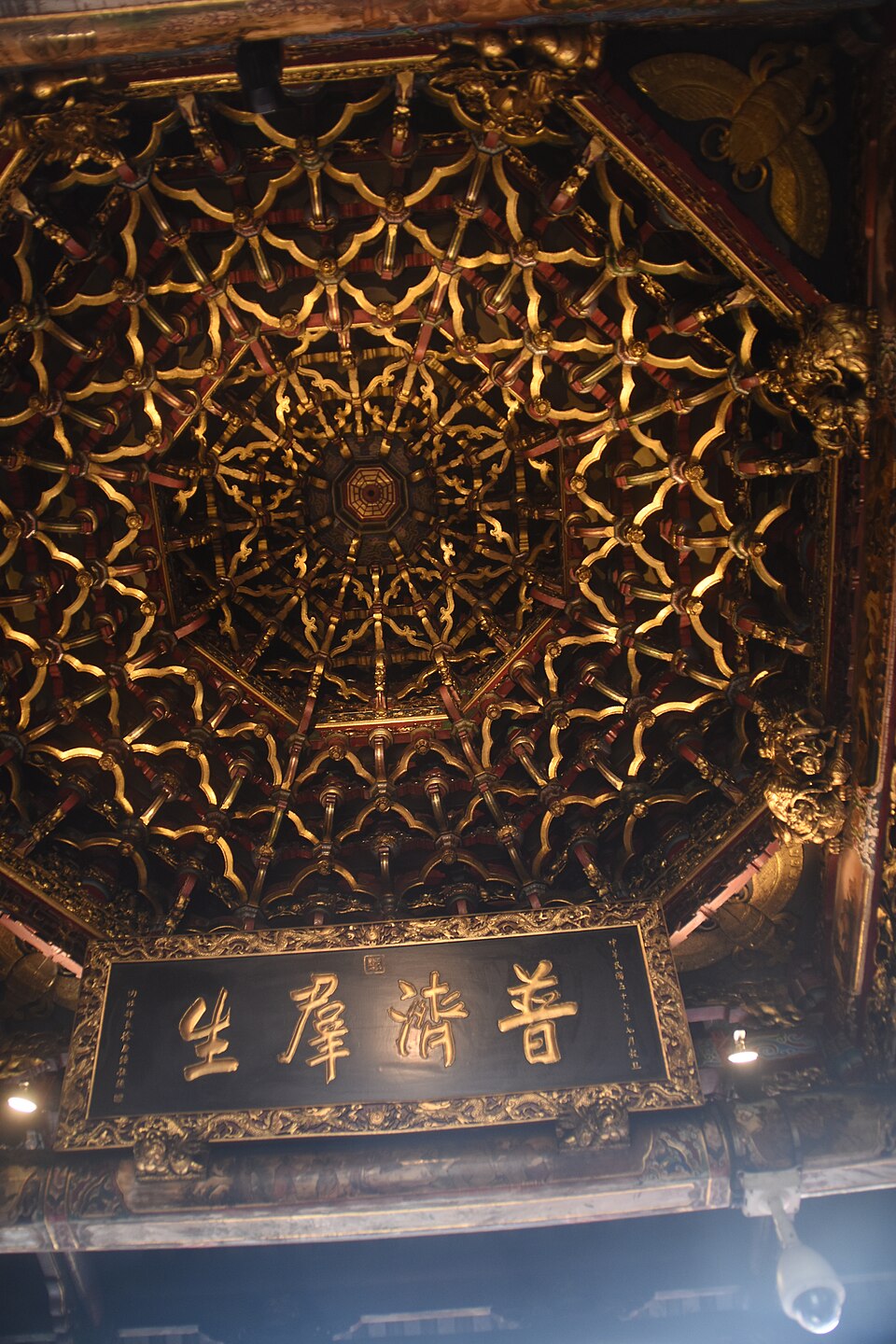
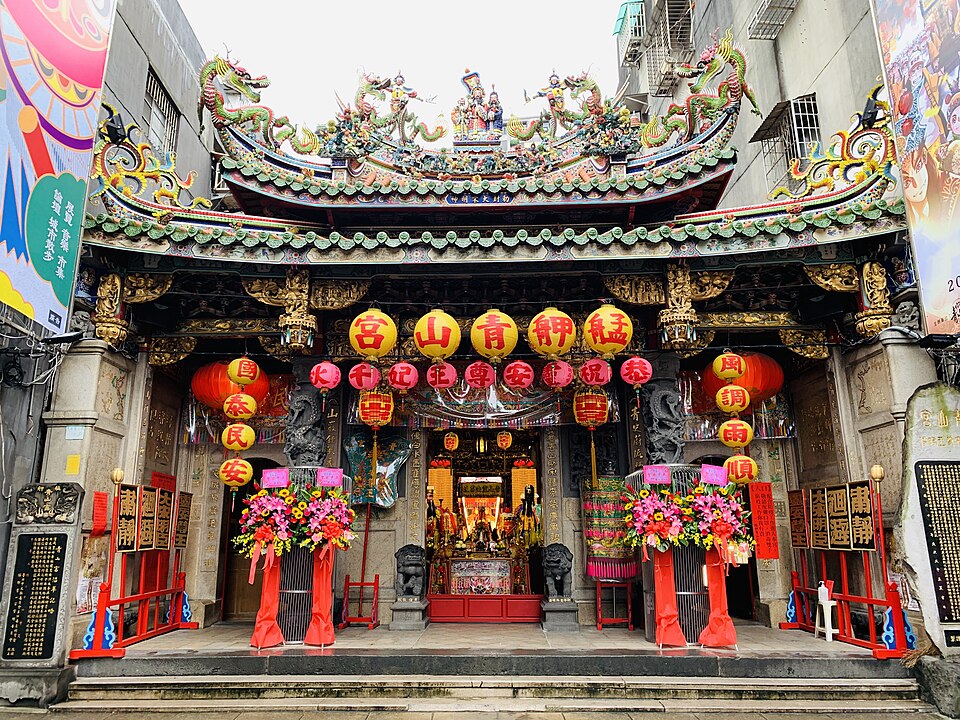
As you approach Longshan Temple, look at the entrance hall’s roof, decorative ceiling and carved columns, and watch how worshippers enter and leave. Its name and Guanyin belief connect with Anhai; migration also brought skills for building temples. The major rebuilding of 1920–1924 brought Wang Yishun and other specialist craftspeople into the same project. Woodwork, stonework and decoration combine in the details you can see today. War damage and later rebuilding are also part of the temple’s history. It remains a place of use and repair. Choose one column or part of the eaves and study its materials and patterns. Bopiliao, the next stop, is in the nearby streets. Use pedestrian crossings and stop somewhere safe before photographing.
Look at roofs and carved columns while keeping worship routes clear.
Travel reminder: this is the start; Bopiliao Historic Block is next. Check this page’s transport information and allow additional time for travel and waiting.
A short visit at Longshan Temple
Choose the length of the visit
For a short architectural visit, allow about 20–30 minutes as a planning estimate, with travel and worship additional. If you continue through Bopiliao to Qingshan Temple, use the full three-stop schedule below.
Look at one material at a time
From an allowed place, compare a bronze column with nearby stonework and roof details. Read the existing story about the makers, then look for the change in material and technique. Keep enough distance for worshippers to pass.
Use the temple’s visitor routes
Follow current entrance signs and staff instructions. Leave ritual queues, offering tables and doorways clear; ask before photographing people. Check the temple’s current notices before choosing a time, as ceremonies may change where visitors can pause.
Return or continue
You may finish at Longshan Temple and return through public streets to the MRT. Continuing to Bopiliao and Qingshan Temple is a separate choice within this walk; check each venue’s opening arrangements rather than treating the temple visit as admission to all three.
Visit planning checked on 28 October 2026; follow current temple notices.
Bopiliao Historic Block
At Bopiliao, walk slowly beneath the covered frontages. Red brick, arches and linked shophouses bring the streetscape into close view. The area preserves the pattern of a Qing-era street, later used and changed in different periods. Walking here reveals how part of the city was retained and reopened for people to explore. Look at the width of a shopfront and how the interior meets the street. As you walk along the buildings, slow down to notice walls, windows and the proportions of corners. Before leaving, find a view that includes both shophouses and people. Along with a photograph of red bricks, take away a way of observing Taipei’s older homes.
Compare a sheltered shopfront with the street beyond it.
Travel reminder: you have come from Longshan Temple; Qingshan Temple is next. Check this page’s transport information before continuing.
Bangka Qingshan Temple
Qingshan Temple is dedicated to Ling’an Zunwang and connects with migrants from Hui’an in Quanzhou. Street activity forms its setting: belief and daily life meet close to the entrance. Comparing it with nearby Qingshui Temple offers an optional way to see that Taipei’s older temples carry different stories. Different migrant communities brought different deities and formed places to gather. Temples sustained shared memory and worship, while streets connected them with residents’ shopping, work and journeys home. Understanding these differences adds more than simply remembering building dates. Close up, look at the craftsmanship; from across the street, observe how the temple continues to function as a place of belief.
Notice how the temple entrance connects with everyday street traffic.
Travel reminder: this is the last stop. Use this page’s start and return information to head towards Longshan Temple MRT; allow additional time for transfers and waiting.
Getting there and back
Take the Bannan MRT line to Longshan Temple station, then follow signs towards Longshan Temple and meet outside its main entrance. Visit Longshan Temple, Bopiliao and Qingshan Temple in that order. After the last stop, walk back to Longshan Temple MRT. Local return walking is included in the time budget; MRT travel and waiting are extra.
Allow 30–45 minutes of walking including the return, and about 100–130 minutes for three pauses. Bopiliao opens Tuesday–Sunday: street 09:00–21:00, exhibitions 09:00–18:00; closed Monday. Check current notices and temple ceremonies before departure. On closed exhibition days, use public exterior views only. Wear comfortable shoes; do not block worship or photograph people without permission.
Longshan Temple → Bopiliao → Qingshan Temple → Longshan Temple MRT. Qingshui Temple and Ximen are optional separate extensions, not stops on this three-stop map.
Budget 30–45 minutes for walking and the local return, plus about 100–130 minutes for three stops. Round up to a 2.5–3 hour outing for pauses. These are planning allowances, not a timed walk. Extra temples and Ximen are not included.
Bopiliao normally opens Tuesday–Sunday: indoor spaces 09:00–18:00, outdoor streets 09:00–21:00; closed Monday. An evening visit offers a different, exterior-focused experience. Temple access depends on the venue and ceremonies; it is not guaranteed by Bopiliao’s street hours.
From Bopiliao, you may return to Longshan Temple MRT without visiting Qingshan Temple. At any temple, stay outside if a ceremony or access restriction prevents a visit; keep entrances and worship routes clear.
Who paid to keep the temple standing?
Bangka’s Longshan Temple carries a history of decisions made locally. Its institutional history records structural decay in 1919, the monk Fuzhi’s contribution of savings and a community fundraising effort that brought craftspeople including Wang Yishun to rebuild it. Skill from across the sea depended on local money, organisation and care.
One strand connects Longshan Temple with migrants from Anhai in Fujian. Qingshan Temple has a different institutional history: people from Hui’an brought devotion to Qingshan Wang and raised funds for a temple. Anhai and Hui’an are separate places, just as the two temples and their deities are distinct.
Accounts of Qingshan Wang’s identity include different traditions. They tell us how a deity has been remembered, rather than supplying a settled biography. A temple did not arrive fully formed and remain unchanged: rebuilding, worship and neighbourhood participation sustained it.
Observe how the building, worshippers and street share space. Follow temple access arrangements and keep worship routes clear. If you approach Bangka from the riverside, check the separate street connection: this story does not place both temples directly on the riverside route.
A dragon column made by two trades
The bronze dragon columns at the front hall make the collaboration more specific. The temple’s account credits Hong Kun-fu with modelling them in the 1920s and the Taipei ironworks of Li Lu-hsing with moulding and casting. A craftsperson known for ceramic and cut-and-paste ornament supplied the form; a metalworking workshop realised it in bronze. Reading only a sculptor’s name would miss that second stage of production.
From a permitted viewing position, follow the descending dragon towards the waves and fish at the base, then look for the smaller mythological figures and plant ornament. The detailed surface was possible through that sequence of modelling and casting. Comparing it with nearby stonework distinguishes materials and processes within the same building, rather than treating every decorated column as the product of one carving technique.
Film & source information
The two native films were published in March and August 2023; individual filming dates are unverified. These are later visit settings, not footage of 1920s construction or a continuous three-stop walk. Rear-hall stone columns are not identified as Longshan’s front-hall bronze columns, and Qingshan’s street arch is distinct from its temple entrance. All windows run at original elapsed speed; the opening 3.1 seconds is conservatively excluded from the 56.9 seconds counted as live footage. No photos, held frames or AI-generated pictures/video are used. Check each venue’s current arrangements and keep worship routes clear. Music only, using an existing generated instrumental.
Longshan Temple native film · published 17 March 2023 · Original record
Bangka native film · published 1 August 2023 · Original record