
Annual event
Zuoying’s fire lion: carrying a neighbourhood’s wishes
A lion waits outside a temple, then becomes the centre of a moving procession. Follow its changing role—from a made object to a bearer of wishes—to understand the people and temples around Lotus Pond.
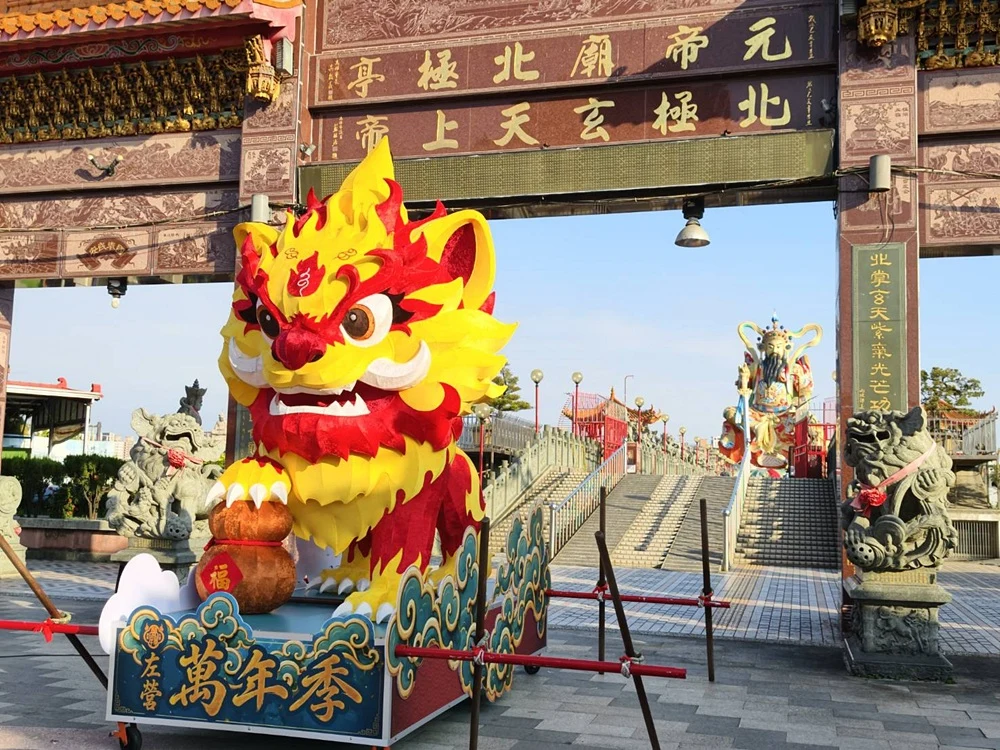
An October festival with temple visits, processions and performances scheduled each year.
The fire lion’s meaning develops through making, ritual and collective movement.
The 2026 event dates have passed. Confirm the next edition before travelling.
Before the lion moves
In daylight, the 2026 lion can be seen as a carefully arranged object: bright yellow surfaces, red flame shapes and a gourd held against its body. Lantern artist Huang Wen-chuan supervised its making. The gourd carries a spoken association with blessing and prosperity; the rounded body is intended to hold wishes. These choices give visitors something concrete to read before drums and a crowd draw attention to its movement.
The setting matters too. In the photograph, the lion stands beneath the temple gateway, with a carrying frame extending at either side. It is large enough to become a shared focus, yet it must still pass through streets and be moved by people. Looking from the decorated surface down to that frame connects visual design with the practical work that will carry it through the neighbourhood.
The 2022 programme gives the base another function: participants hung written blessing cards there. The figure did not merely represent good wishes in its shape; it gathered individual messages on a shared structure. This is a documented arrangement for that edition, rather than a promise that cards can be attached whenever a visitor encounters a Fire Lion. Notice the difference between looking at the finished lantern and being invited into a particular ritual action.
A festival connects temples that remain themselves
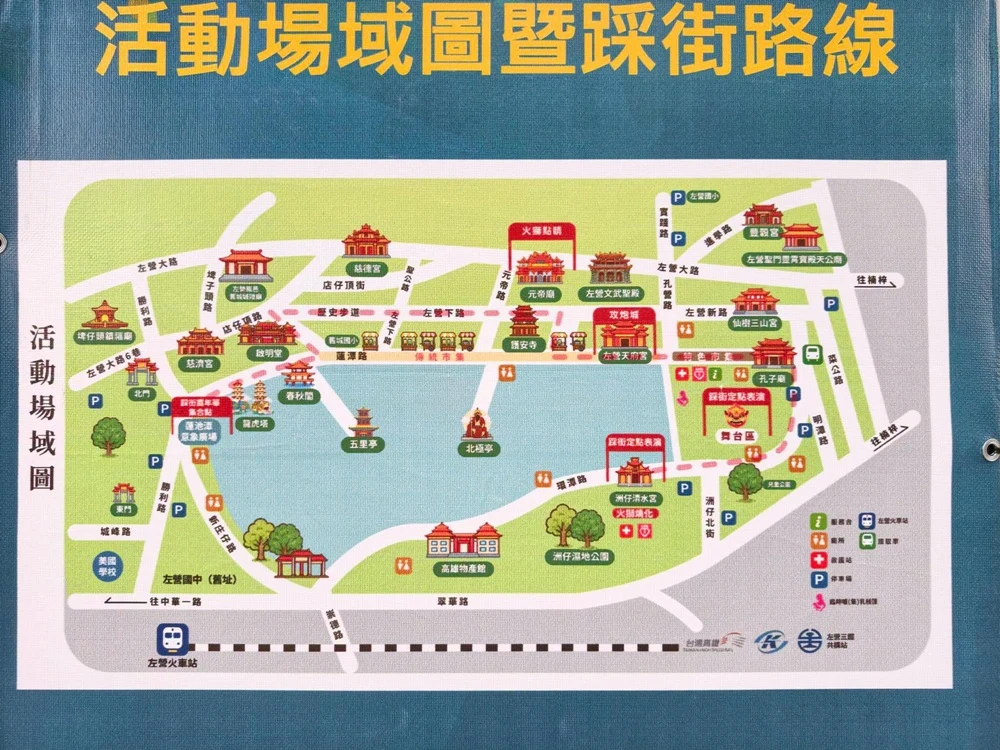
Local groups and the district office launched the Wannian festival in 2001, drawing on temples and neighbourhood culture around Lotus Pond. The shared programme made those places part of a larger public occasion. It also gave visitors a reason to move between them. A temple is no longer only a building glimpsed across the water; on the procession route, it becomes somewhere the neighbourhood receives the lion.
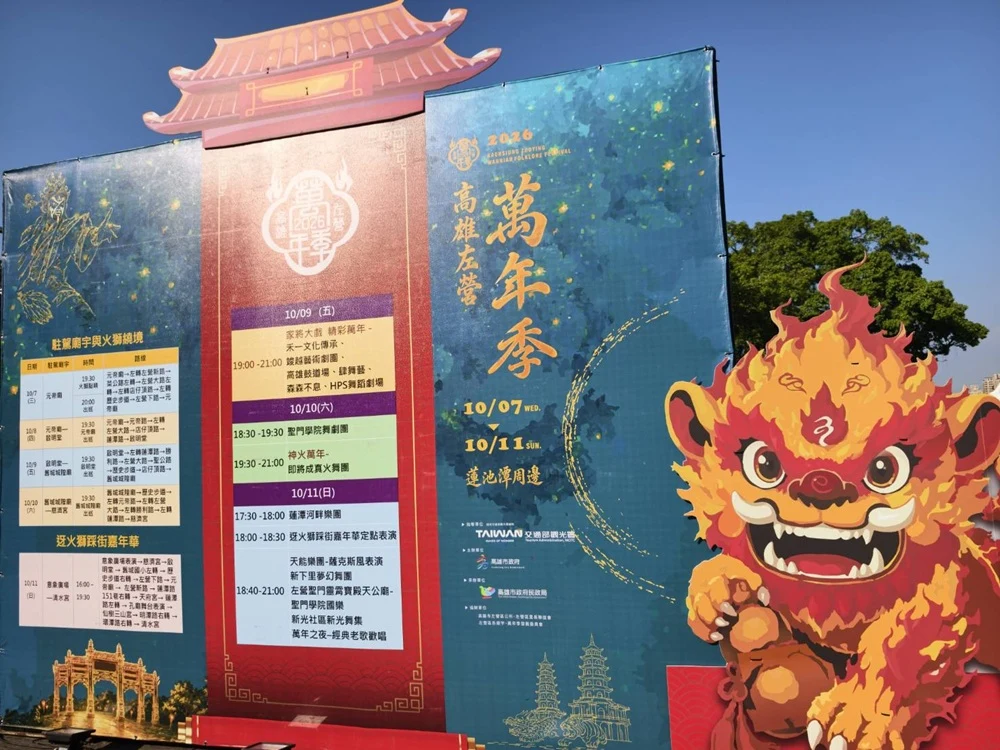
For the 2026 edition, the listed stops include Yuandi Temple, Qiming Hall, the Old City Chenghuang Temple and Ciji Temple. The route map makes their different positions visible. Rather than trying to follow every movement, choose one stop and arrive before the procession. Watching people prepare and receive it lets you notice the relationship between a moving festival and the place hosting it.
Before the festival, a temple’s fire lion
A 2010 city publication traces the fire lion to Zuoying Ciji Temple and its worship of Baosheng Dadi. It relates the creature to the deity’s Black Tiger General and describes an earlier rite for the god’s birthday: a papier-mâché head, a bamboo frame and firecrackers wrapped around the body. The idea that burning carries prayers upward belongs to the religious meaning recorded in that account.
When local groups and the district office organised the larger festival in 2001, welcoming the lion joined a wider programme of temple visits and processions. That expansion did not make every later lion physically identical to the earlier object. It offers a way to compare continuity and change: the birthday observance, the temporary crafted body and the modern city programme have connected histories, but are not one unchanged event.
A ceremony becomes a shared evening
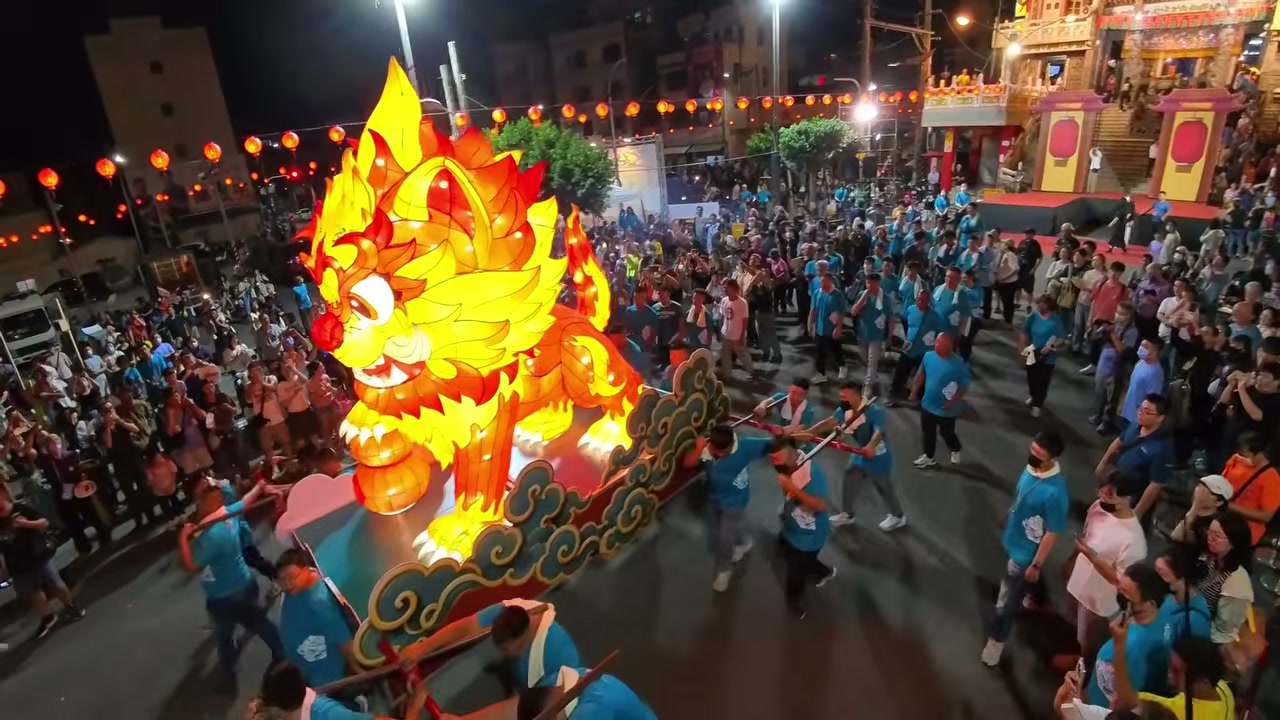
The opening-night photographs from 7 October 2026 follow the lion from the temple forecourt into the street after the eye-opening ceremony. People carry, guide and watch; the object seen earlier in daylight now belongs to a sequence of actions. The final-day burning gives that sequence an ending, understood as carrying prayers onward. Making something splendid and then letting it go are both part of the event’s meaning.
Around that ritual sequence are performances and ordinary decisions about the evening. The 2026 programme places stage events at the Confucius Temple and a market along Liantan Road. A visitor may meet friends at the stage, walk to a temple and eat on the way back. Keeping those places distinct makes it easier to see the whole occasion: ceremonies, performers, vendors and residents each contribute a different part of the time spent together.
At the end of that programme, the cards were to enter a specially made Fire Lion furnace during the sending-off rite. In the organisers’ explanation, burning carried the wishes upwards. Paper could therefore be valued because it would be transformed, rather than kept as a souvenir. Following a card from the base to the furnace reveals a part of the ceremony that a photograph of the large figure alone cannot show; another edition must still announce its own procedure and viewing areas.
A carrying frame makes the work visible
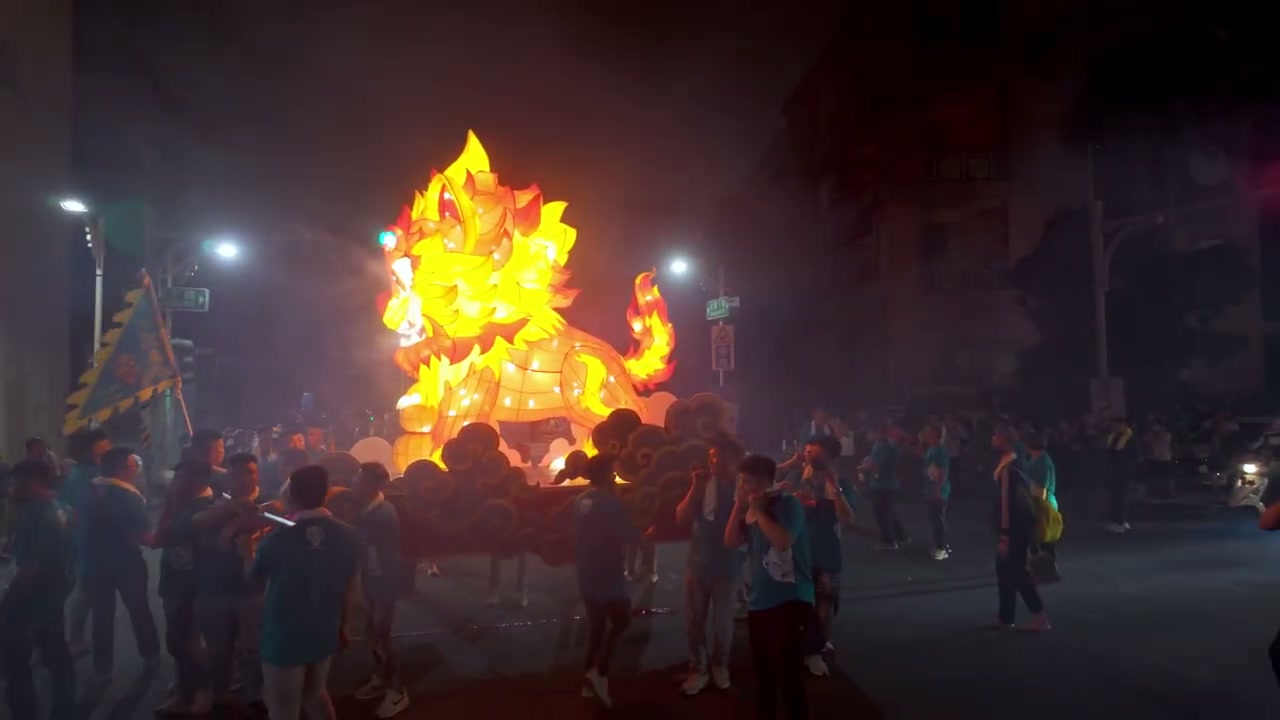
The glowing lion is larger than any one person beneath it. Looking lower reveals the long frame, the spacing of carriers and the room needed to turn. A visitor can follow these practical details without knowing every ritual term: the decorated object moves because people keep adjusting their positions around it.
The change of setting adds another layer. At the temple, the lion is a shared centre; on a neighbourhood road, the same frame must move between buildings, parked vehicles and spectators. Give the procession its passage and watch from the side. The street explains how a festival meets a place where people also live and work.
The fire gives the festival an ending
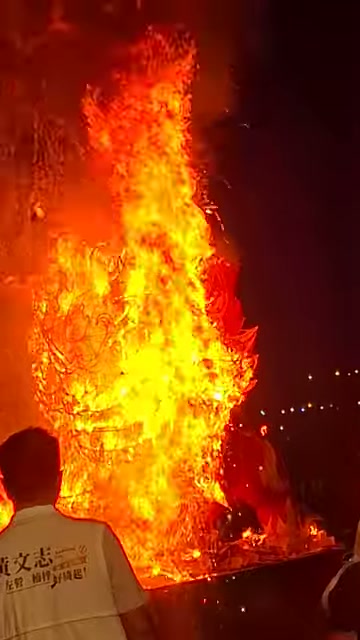
The 2026 programme separated the opening on 7 October from the final procession and burning on 11 October. The burning is not simply an extra spectacle after a parade: the organiser describes it as sending people’s wishes and blessings onward, with prayers for peace. The lion’s making, its journey and its release therefore belong to one sequence, even though they occur on different festival days.
The announced 7–11 October 2026 dates have now passed. For a future visit, check the next edition’s dates, temple stops, viewing arrangements and transport before choosing a meeting point. A clear plan leaves time to watch one place receive the lion and to return safely after the final ceremony; it does not assume a procession is available every evening.
Look closer
Look from the lion’s decorative forms to its carrying frame and the space needed to move it.
Choose one temple stop and watch how its forecourt changes as the procession arrives.
Visiting information
- Date pattern
- An annual October programme, with dates and routes announced by the organiser.
- 2026 dates
- 7–11 October around Lotus Pond. The final procession is scheduled for 11 October, 16:00–19:30.
- Choose a destination
- Stage performances: Zuoying Confucius Temple. Temple stops and the procession use different locations; choose the date’s stop before setting out.
- Getting there and returning
- From Zuoying HSR, Xinzuoying railway station or MRT R16, walk towards the Confucius Temple area; the organiser estimates about 15 minutes. Allow additional time to walk back through festival crowds before your train.
- Watching the procession
- Use the viewing areas and keep the procession’s route clear. Choose a meeting point outside the moving crowd.
Sources & historical context
- Kaohsiung official feature: 2026 fire lion, design and ritual sequence
- Taiwan Tourism Administration: Wannian Festival history
- Wannian Festival organiser: check the next edition’s programme
- Kaohsiung Travel: 2026 event listing
- Opening-night footage · 嚴重啦頻道
- Temple and street-procession footage · Takao walker
- Final burning footage · 蘇東鴻; capture date unstated