
Cultural story
Yuanli rush weaving: the lives woven into a hat
From softened stems to three-dimensional forms, follow the work that joins household skill and a maker’s own choices.
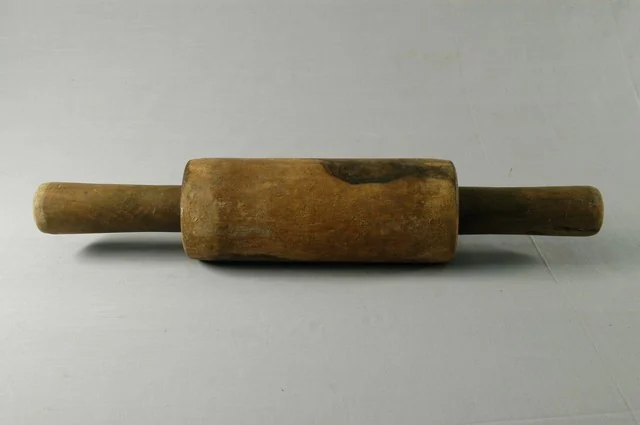
Look at preparation tools, curved forms and finished edges.
A family apprenticeship and a return to craft give the regional name a personal history.
A woven surface begins with preparation
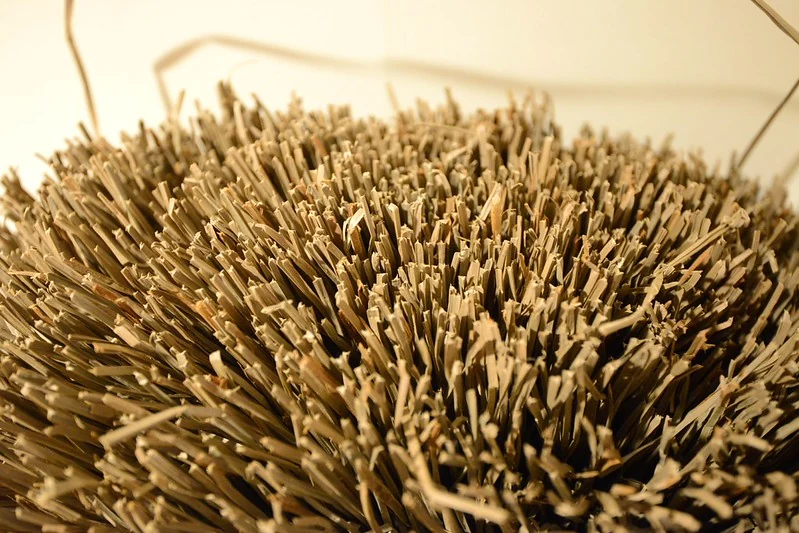
Look closely at a rush hat or mat and the surface becomes a series of crossings. The material has to bend without losing the shape the maker intends. Before these visible patterns comes the less conspicuous work of preparing the rush. A finished object begins long before its first recognisable flower or border appears.
A wooden roller in the National Museum of Taiwan History, numbered 2004.025.0736, makes one part of that work visible. Handles at both ends allow the cylindrical body to roll over and soften rush. The tool tells a material story: flexibility is worked on, not simply assumed. Beside a woven object, it helps explain why preparing fibres belongs to the craft itself.
Learning between different hands
Yuanli maker Lü Chin-hsia learned weaving in her family as a child. Her mother worked quickly; her father’s slower pace gave her more time to follow the method. That difference matters. Knowledge moved through doing together and watching particular hands, rather than arriving as a set of instructions detached from family life.
When the industry declined she moved into beauty work, then returned to rush craft in 1999. Her later work explored forms beyond flat mats, including three-dimensional objects. The return was not a simple resumption of childhood production. Skills learned for household income became a resource for developing a different kind of work.
Giving the material another shape
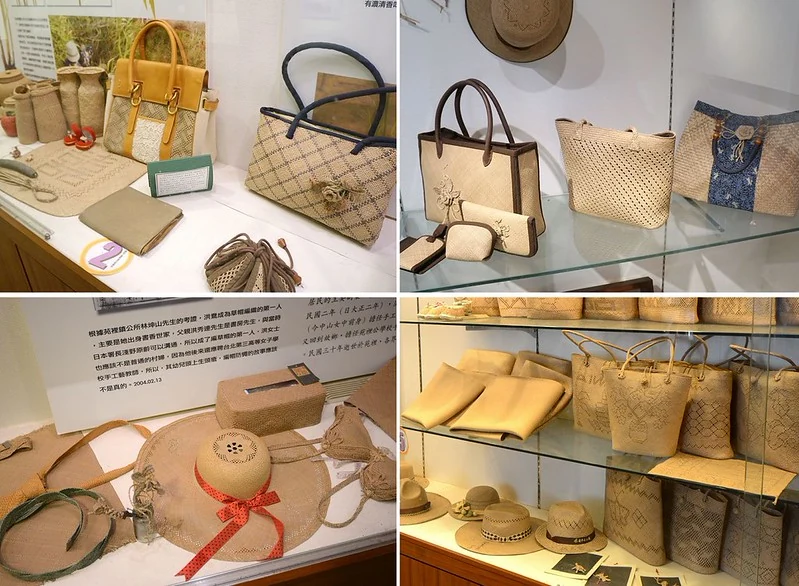
Her fish and teapot forms, and her experiments with ideas from knotting and bamboo weaving, show how technique can move between crafts. The question shifts from repeating a familiar product to controlling volume, edges and concealed joins. Look for the point where a flat pattern turns into a curve: that is where a maker has had to decide how the next part will stand.
At Yuanli’s public displays, read makers’ names as carefully as object names. Local heritage records distinguish this work from the broad commercial label Dajia hats and mats. Naming Yuanli gives the work a more precise home, while asking who made an object restores the individual life behind the regional craft.
Making a form and teaching someone else to make it are different tasks. For a workshop on 6 July 2024, Lu Chin-hsia organised nine weaving patterns as teaching material. The hall’s record notes that one experienced learner completed all nine, while others completed seven or only one; participants also learned from one another. A finished sample therefore did not set one pace for every pair of hands.
The workshop turned weaving experience into another kind of work: organising knowledge into patterns that other people could practise. A visitor need not finish a complex object to begin reading the craft: learning to recognise one repeated crossing and the place where it changes can reveal a small part of the decisions hidden inside a hat or a three-dimensional piece.
Look closer
Compare the start, curved side and finished edge of one object, then find the maker’s name.
Visiting information
- Place
- Yuanli Rush Exhibition Hall, No. 99, Wanli Road, Yuanli, Miaoli. Its website lists regular hours of 09:00–17:00; check temporary changes before travelling.
- Visit
- Begin with the preparation tools and woven objects, then choose an experience. Confirm demonstrations or group sessions with the hall at 037-741319. The 2024 workshop is a historical example, and the NMTH preparation tool discussed here is a collection object rather than a promised exhibit in Yuanli.
- Getting there
- Arrive at Yuanli railway station, then use a local bus connection or taxi to the hall. The hall’s official transport page provides the railway-station bus connection and taxi information.
- Return
- Plan the connection back to Yuanli railway station before leaving the town centre. If taking a taxi, arrange the return pickup at the hall as well.