
Annual festival
Yanshui’s beehive fireworks: the town behind the sparks
The Lantern Festival procession brings Guan Di through the town, where preparation, offerings and protected space shape the night.
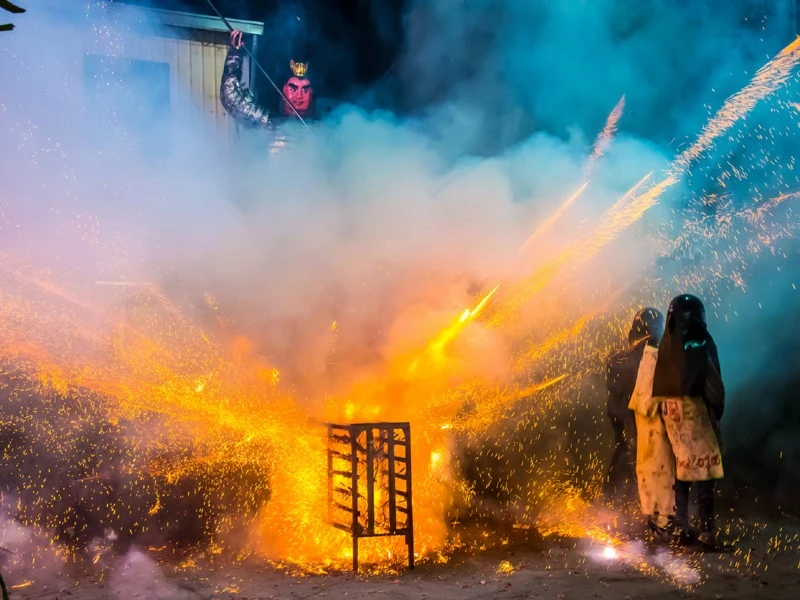
The fourteenth and fifteenth days of the first lunar month; 2–3 March in 2026. The 2026 public festival has ended.
Look at the construction of the fireworks structures and the protective equipment; remain within the designated viewing arrangements.
The palanquin gives the fireworks a route
Yanshui’s beehive fireworks accompany the procession of Guan Di from Wumiao Temple. The two-day festival falls on the fourteenth and fifteenth days of the first lunar month; in 2026 it took place on 2–3 March. Palanquins travel through different parts of town, bringing the ritual to neighbourhoods rather than keeping it within one performance ground.
The best-known origin tradition tells of residents seeking divine help during an epidemic in the late nineteenth century. Firecrackers accompanied the deity’s journey, and the annual return became an act of gratitude and protection in local belief. Seeing the palanquin at the centre of the event explains why the fireworks are offered along its route: the night has a religious destination as well as a dramatic sound.
Long preparation, brief light
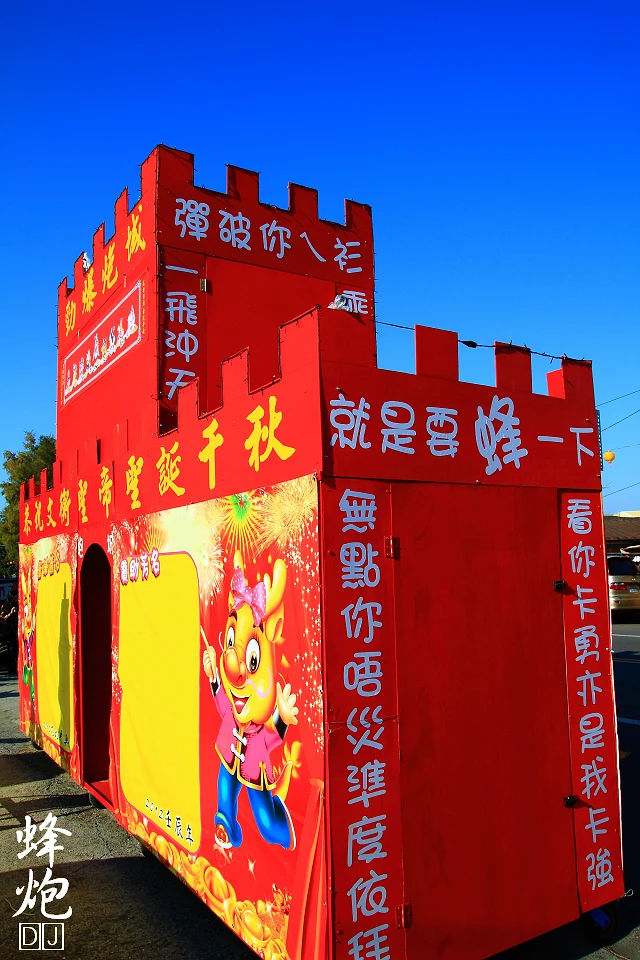
The structures known as paocheng have changed as the festival has grown. Earlier bamboo and timber frameworks were joined by metal structures and increasingly elaborate outer designs. The work still requires people to organise materials and prepare the display before the procession arrives. A finished exterior can resemble a gate or a brightly decorated building, concealing the scale of preparation behind it.
In daylight, those forms can be read as objects made for a specific encounter: a household or group prepares an offering for the passing deity. At night, the carefully prepared object is transformed by a brief burst of sound and light. The contrast between the long preparation and the short release is part of what makes the festival a collective undertaking rather than simply a fireworks show.
The 2021 arrangements show how worship and public attendance could be separated. After announcing a pause because of the pandemic, the temple arranged a restricted, concentrated firing for structures already prepared. Chair Weng Tsai-chin explained that the offering was for Guan Sheng Di Jun, while the public could watch a broadcast. This was that year’s exceptional response, not a standing access rule. It makes the recipient of the rite especially clear when the usual crowd is absent.
A household waits for the palanquin
A paocheng is prepared for an arrival, not simply set off at an arbitrary hour. The Interior Ministry’s account describes households registering beforehand, then bringing out their structure when Guan Di’s palanquin reaches the doorway. The host unveils it and offers a blessing before it is fired. The palanquin responds through a ceremonial movement of approaching and retreating three times. The exchange gives the display a recipient and a place in the procession.
This also explains why a procession map needs a year. The same account notes that the route is decided at a preparatory meeting. Streets familiar from an earlier edition are therefore a historical reference, not a promise of where a later palanquin will pass. For a reader, the useful contrast is between a structure waiting outside a home and the moving group that will acknowledge it: one night joins many separately prepared acts of hospitality.
Choose a place in the night
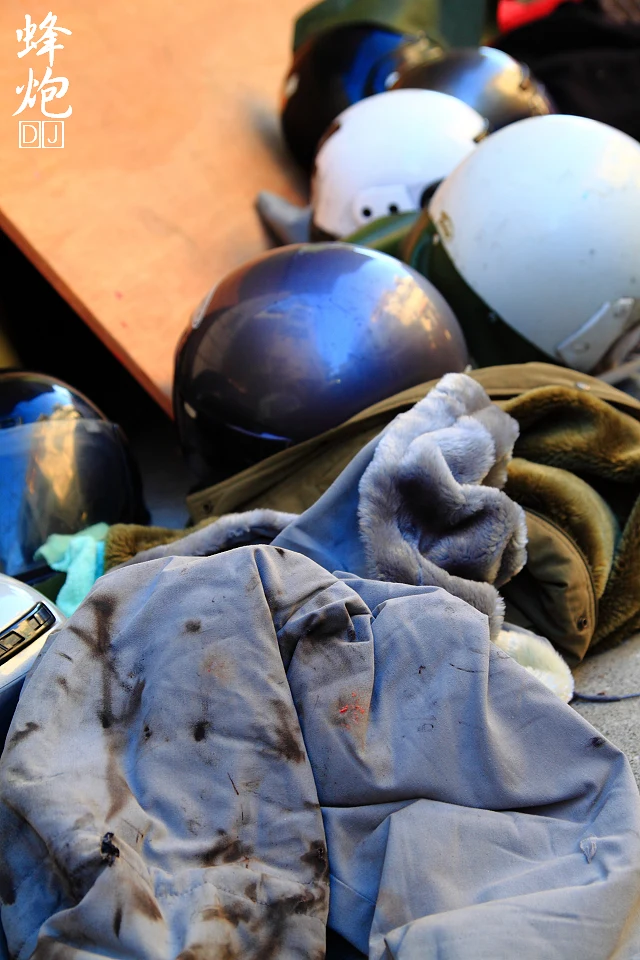
Participation begins with deciding where to stand. The concentrated firing area requires protective equipment and controlled access; it is also possible to visit the temple and streets without entering that area. Helmets, protective clothing and the work of marshals belong to the event’s present-day organisation. The most useful preparation for a visitor is a clear meeting point and a return journey, not an attempt to follow every palanquin.
During the 2026 festival, buses were diverted to the edge of town, including a temporary stop at Zhongxiao and Nantai roads. This changes the final part of the journey into a walk. Returning in daylight or on another day reveals Wumiao and the surrounding streets at their ordinary pace, making the festival easier to understand as an exceptional moment in a town that continues living after the sparks disappear.
An ordinary temple visit offers a quieter object to notice. Tainan’s location record identifies the tall Guan Sheng Di Jun statue and a guandao-shaped incense burner in front of Wumiao. The blade form connects the utensil to the deity’s martial identity, placing an everyday act of offering incense beside the much louder procession. Read it from the worship space; neither the object nor a historical location page implies permission to enter a fireworks preparation area.
Look closer
Look for the relationship between the palanquin route, prepared displays and the places kept clear for movement.
Visiting information
- Date rule
- The fourteenth and fifteenth days of the first lunar month; 2–3 March in 2026. The listed 2026 public festival has ended.
- Place
- Yanshui Wumiao Temple, 87 Wumiao Road, Yanshui District, Tainan.
- Transport
- From Xinying Railway Station, use the bus station opposite the railway entrance and take the Brown trunk line towards Yanshui. During the 2026 festival, Brown trunk buses used the temporary Zhongxiao–Nantai intersection stop. Plan the return bus and train together before entering the evening crowds.
- Viewing and protection
- Enter firing areas only under the event’s access rules and with the required full protective equipment; stay behind barriers when watching, and never touch a prepared fireworks structure.
Film & source information
This cultural montage combines different editions, cannon towers and palanquin teams. The 2013 release keeps the order of one cannon tower while omitting waits. Construction and the 2020 palanquin scenes, 2024 night footage and 2026 daytime footage do not document one continuous itinerary. Another source was published in 2020; its filming year is unconfirmed. Check the current edition’s programme and public viewing arrangements.
- 発柴 Sofashiba · S · 20200228 · Original record
- Kel Hsu · K · 20200219 · Original record
- 阿農 · W · 20130224 · Original record
- 樂活站長reesion · A · 20200208 · Original record
- 樂活站長reesion · L · 20200208 · Original record
- 中央社南部地方組 · H · 20240224 · Original record
- 中央社南部地方組 · D · 20260302 · Original record
Instrumental music only; no narration. Existing music was mixed separately; original source audio is unused.