
Cultural story · Food and local life
Xinshe flowers: the working fields beneath the colour
Flower fields and sculpted displays share a hillside with a seed farm. Following that connection reveals how an agricultural open day became an autumn journey into Taichung’s mountain towns.
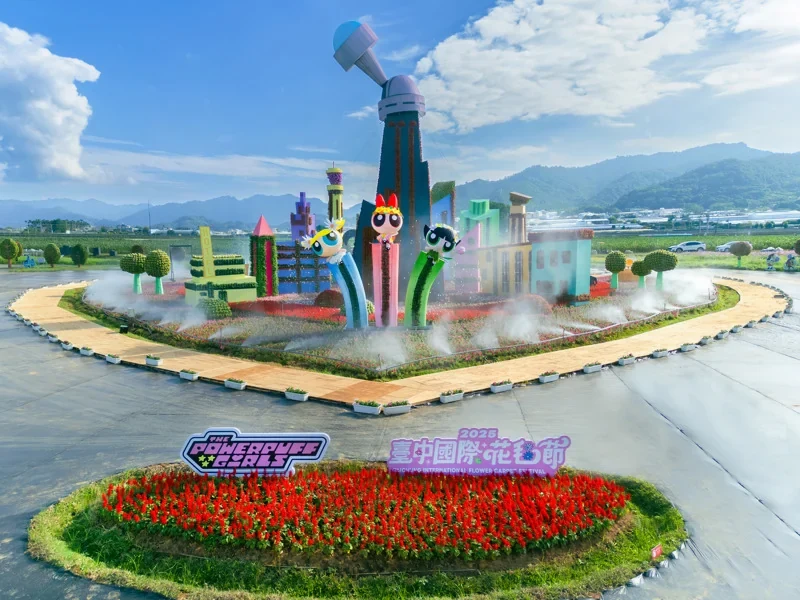
A seasonal event on a working agricultural site, with dates announced for each edition.
Broad flower fields and constructed flower carpets offer two different ways to look at plants.
A field has work to do before it blooms
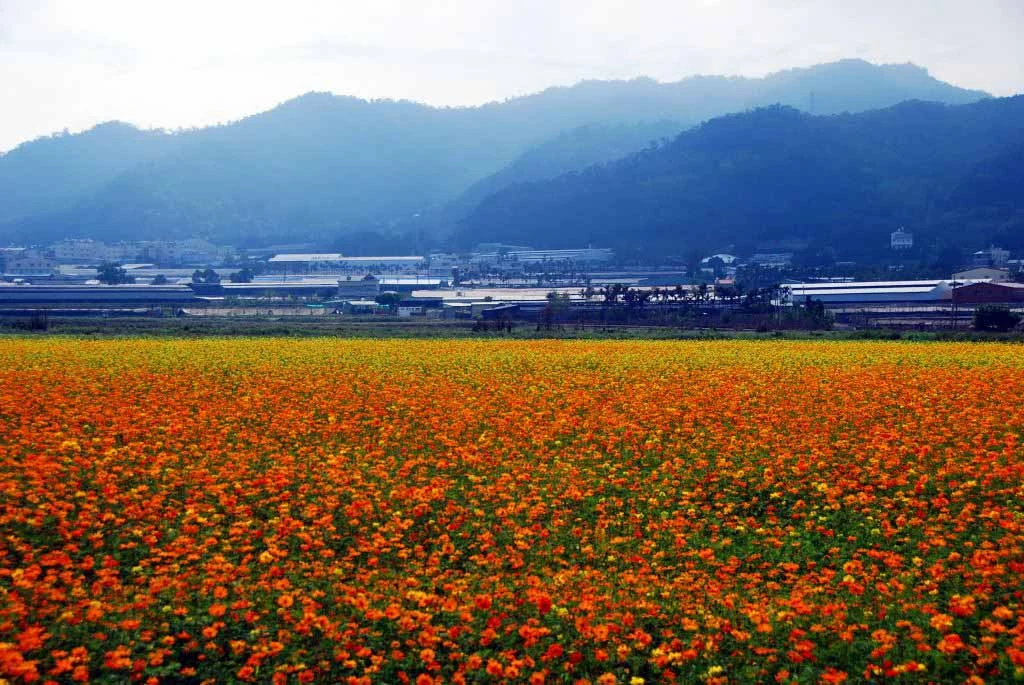
A visitor sees colour stretching toward the hills; a seed grower sees a field with a production calendar. Xinshe’s Second Farm has grown maize, sorghum and green-manure crops for seed supply. Its autumn display arose from opening that agricultural ground to visitors. In 2005, a two-day open house planted flowers across 32 hectares; the following year the name Xinshe Sea of Flowers entered the programme. What became a destination began as an invitation into a workplace.
The older practice of sowing rapeseed, sunflowers and other green-manure plants during fallow periods joined soil care with a visible landscape. Flowers could draw attention to work otherwise easy to overlook. Look along the paths between planted blocks: their divisions make it possible to notice growing space, access and maintenance as well as colour. A photograph may gather the field into one surface, but walking restores its smaller parts.
The nursery’s work also depended on water arriving from elsewhere. Historian Lee Tsung-hsin’s 2017 Water Resources Agency account links Baileng Canal to the need for improved sugarcane cultivation and nursery fields. Construction began in December 1928; the main conduit was completed in May 1932 and formally opened that October. Local residents and nursery farmers contributed labour. A field of colour therefore rests on an earlier effort to make this plateau reliable agricultural ground.
The route takes water from the Dajia River at Baileng towards the nursery, crossing difficult ground through open channels, tunnels, aqueducts and inverted siphons. Designer Isoda Kaneo had to connect fields separated by hills and valleys. These structures explain the agricultural landscape; they are working water infrastructure, not a continuous visitor footpath. A distant pipe or channel can be a clue to land use without being somewhere the visitor is entitled to enter.
From growing flowers to composing a flower carpet
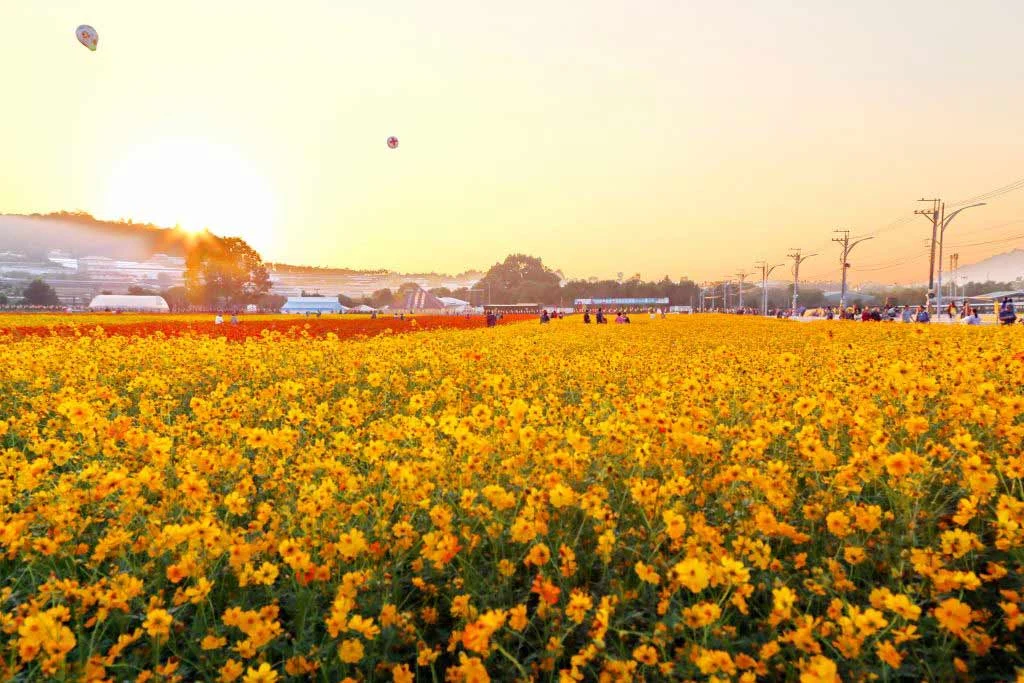
By 2020, the display paired sown fields with concentrated planting: a geometric rose feature used about 200,000 pots, while an edible landscape brought 28 kinds of herbs into view. Those arrangements ask different questions of a grower. A field needs a flowering rhythm across an area; a patterned display also needs plants to hold an intended outline. Seen together, they make cultivation and design visible in the same visit.
The landscape photographs also show how strongly distance and light change the experience. From farther away, orange and yellow planting becomes a band below the mountains; from close to the path, separate flower heads regain their shape. Instead of trying to include every installation in one photograph, pause at two scales. One tells you where the field sits; the other reveals the plants doing the work.
The people beyond the flower field
The event’s agricultural connection extended into local businesses early on. In 2007, surrounding townships and farmers’ associations joined the programme, bringing processed farm products and places to visit into the same journey. A bag of produce or a conversation at a stall connects the display to work that continues after the flowers have gone. The field is an entrance to the area’s economy, rather than the whole of it.
For 2026, the announced flower-carpet programme adds a different kind of participation. Children and older residents from Dongshi and Xinshe have been making work together through a project begun in 2023; their pieces are planned for the new interactive installation. Alongside the large themed display, these smaller contributions give the event another timescale: people returning, learning and making something across several years.
Water later became a matter of community repair as well as engineering. After the 1999 earthquake damaged the canal, local efforts organised as the Baileng Canal Revival Movement worked alongside public agencies towards reconstruction. The heritage account treats the canal as part of the settlement’s cultural landscape. This makes the flower season one moment within a longer dependence: when displays are removed, cultivation and the need to maintain a shared supply continue.
Look closer
Compare the edges of sown fields with the more precise outlines of planted displays.
Read the crop names at agricultural displays and connect one of them to a product at the market.
Visiting information
- Date pattern
- Held in late autumn; dates and displays are announced for each edition.
- Working nursery
- The flower venue is a working nursery, not a year-round open flower park. Confirm a specific public opening before entering; a previous edition’s dates do not establish access on another day.
- Visit
- The recorded flower venue is at 30 Xiexing Street, Xinshe, Taichung. An address identifies the place; it is not permission to enter fields. For an announced public opening, keep to the designated visitor paths and allow for open-air conditions.
- Transport scope
- Festival shuttles serve a particular edition and are not a year-round farm service. Check current public access first, then the corresponding transport and return arrangements.