
Traditional festival
Toucheng’s ghost grappling: the work beneath the flag
Before competitors climb, villages weave bamboo towers, gather offerings and remember those who never returned.
The final night of the seventh lunar month; 2026 held rites and learning activities without the formal climbing competition.
Read village identities through the bamboo offering towers; arrange accommodation or a booked ride for late-night participation.
Remembering through food
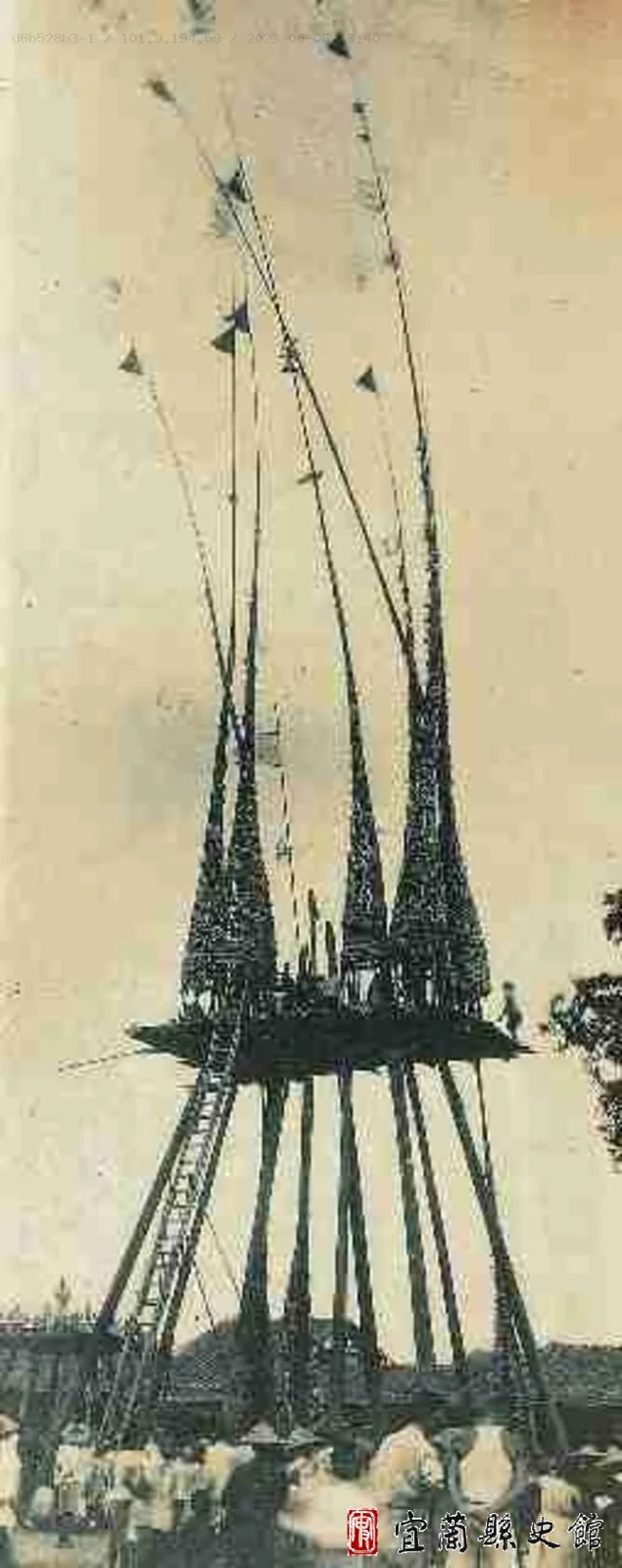
Toucheng’s Ghost Month rites grew alongside settlement and trade on the Lanyang Plain. Local accounts connect them with people lost to disease, conflict and the dangers of migration. Food was prepared for spirits without descendants to care for them, and distribution after worship linked remembrance with the needs of the living. The high climbing competition is one part of this longer sequence of hospitality.
Preparations begin in the seventh lunar month with rites marking the site, followed by offerings and ceremonies before the final night. A rice-offering platform and the taller competition structure serve different purposes. Separating them makes the event easier to understand: feeding, inviting, sending off and competing are connected actions, not a single contest performed in isolation.
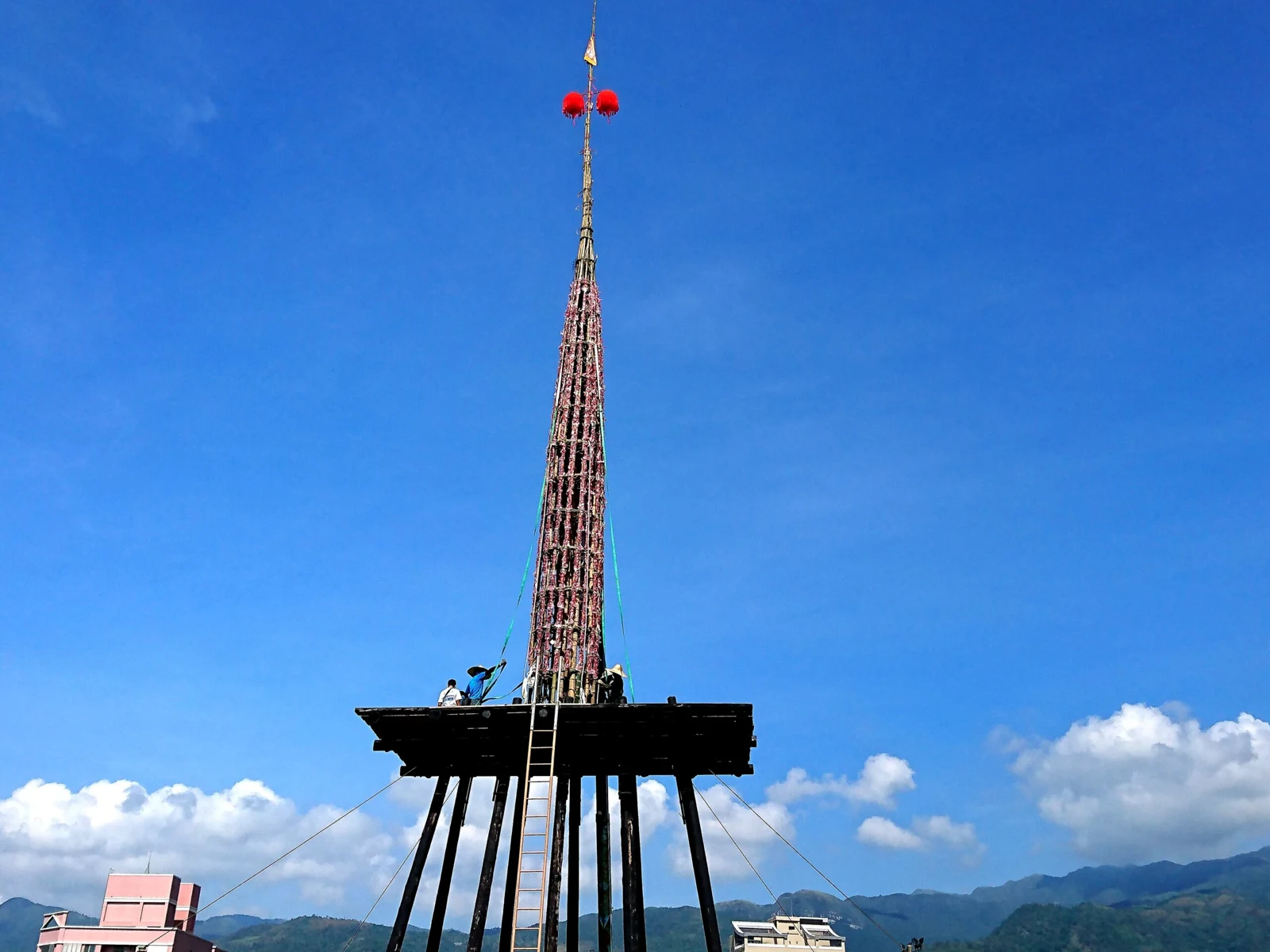
The Lanyang Museum account identifies a second kind of height beside the climbing platform: the lantern poles. It records one sky lantern raised by day and seven earth lanterns, also called seven-star lanterns, raised at night. In the ritual explanation, the lights make the offering place visible to wandering spirits. A tall pole and a high competition platform therefore address different tasks, even when both draw a spectator’s eyes upwards.
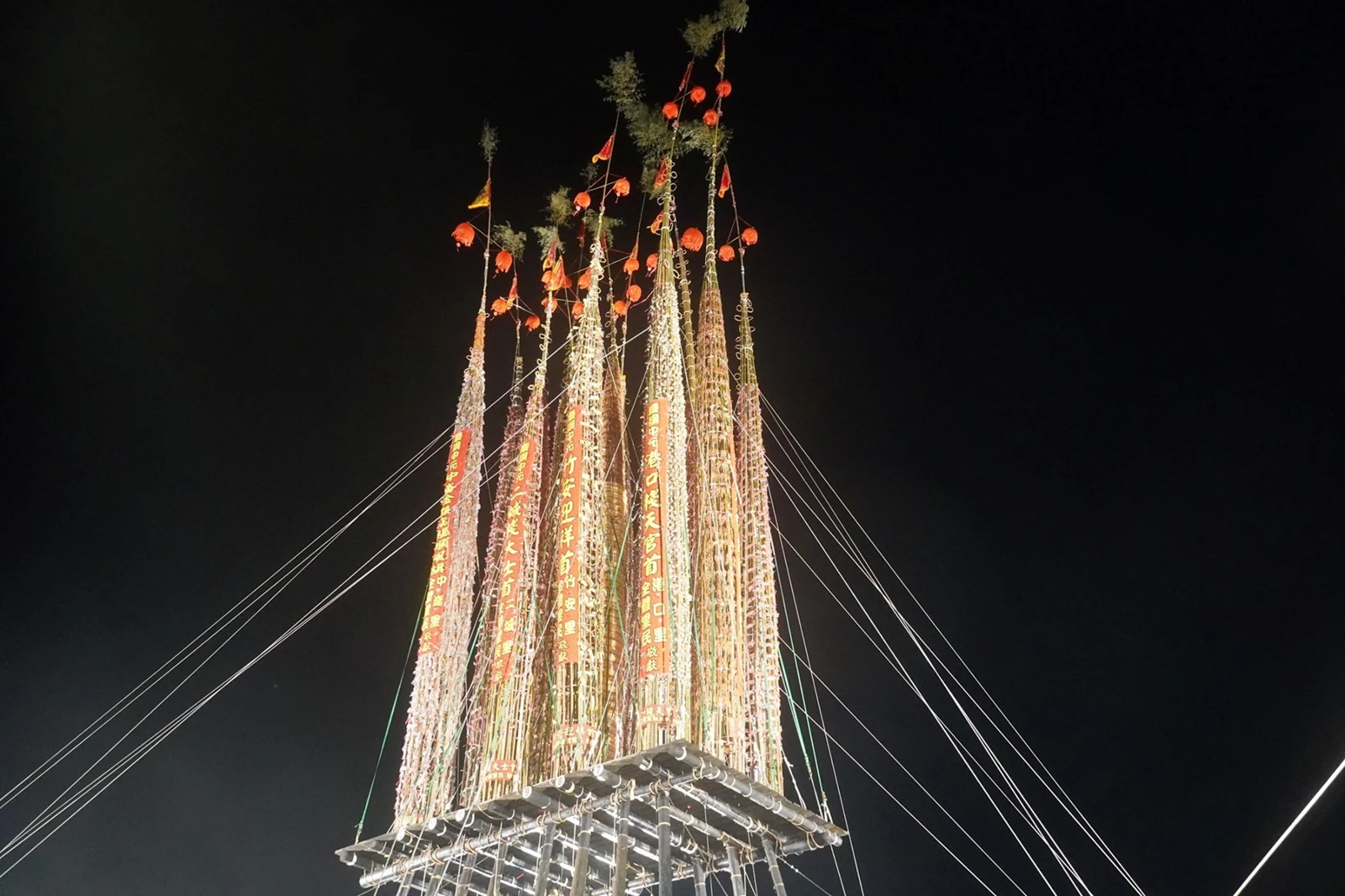
Bamboo towers carry village names
Bamboo and rattan give the offering towers their tall, narrow form. Different settlements prepare their own towers and attach foods that once reflected local production: meat, poultry, seafood or rice products. Baishijiao, now partly within Jiaoxi, has continued to join this shared ritual geography. Administrative boundaries changed, while the obligation to contribute a tower kept older connections visible.
The towers also have distinct ways of arriving. Bayalin’s Wind God tower is known for being carried upright, while the Xiabu King’s tower has its own entry tradition. Once erected above the platform, their names and offerings turn height into a map of cooperation. A flag at the top represents success for a team, but the structure beneath it holds the work of many households.
The offering tower travels through town first
In a 2023 programme, Lanyang Museum described working with elders from Xiapu to make an offering tower for the separate rice platform. Its announcement specified a traditional construction method without nails or iron fittings, and invited people to push the finished tower from its Wushi Harbour station through town to the festival grounds. This planned journey brought craft into the festival’s public story before the contest: a tall finished form would first require knowledge of how to bind and support it.
The rice-platform tower remains distinct from the thirteen village towers on the high platform. The museum explains that it is installed earlier and is the first to be taken in the final sequence. Its 2023 invitation also limited active pushing to men under the ritual’s then-stated rules, with women invited to observe. That restriction belongs to that particular announcement; a workshop or public festival listing alone does not establish who may join a later rite.
Keeping a skill alive between competitions
The modern event has experienced both revival and pauses. The 1991 revival brought new organisation and safety arrangements; in 2026 the formal competition paused in the local election year, while Ghost Month rites and learning activities continued. Workshops in tower-making and supervised climbing give younger participants a way to encounter the knowledge without reproducing the full contest.
At the festival grounds, the distance between the visitor area and the structure is part of how the event works. Looking at the tower from below allows the eye to follow its bamboo lines and suspended offerings. The lasting question is who will bind, carry and recognise these forms next time—a form of inheritance measured in shared work as much as in the moment a flag is taken.
The same study distinguishes water lanterns at the Zhu’an river mouth: they light a route for spirits associated with the water to receive offerings. Land, river mouth and altar are connected through acts of invitation before the final competition. These are the study’s recorded ritual meanings, not evidence of identical routes or dates in every edition. A visitor can ask the hosts what is happening at the chosen location rather than treating all lanterns as one decorative display.
Look closer
Look for each tower’s village identity and offerings before following the competitors upward.
Visiting information
- Season
- The final night of the seventh lunar month; 2026 held rites and learning activities without the formal climbing competition.
- Place
- Toucheng festival grounds near Kailan East Road and Section 3, Toubin Road, Yilan.
- Transport
- Arrive at Toucheng Railway Station and take a taxi to the festival grounds. Arrange a pickup point outside the controlled area; late-night competitions require an overnight stay or a booked ride.
- Viewing
- Stay in the public viewing area; climbing is for registered participants or supervised workshops.
Film information
The overall still photograph dates to 2009. Moving excerpts were recorded on different dates in 2019 and illustrate stages rather than one continuous climb. The falling flag or streamer is not labelled a championship result. These are historical records, not a 2026 competition announcement.
- Overall photograph: Tseng Kun-cheng / Tourism Administration, “The Beauty of Ghost Grappling Fireworks at Night”, 24326_PH_20091130, 18 September 2009. Original archive record. Resolution adjusted; overall structure retained.
- 2019 offering-tower preparation: Lanyang Museum, original video.
- 2019 competition and closing excerpts: Yu Peggy, competition record and falling flag-and-pole record. Excerpts edited with a separate music track; original audio unused.