
Cultural place
Tainan Confucius Temple: a road between the gate and the school
A photograph, a dismounting stele and the space between them reveal how learning became part of the city.
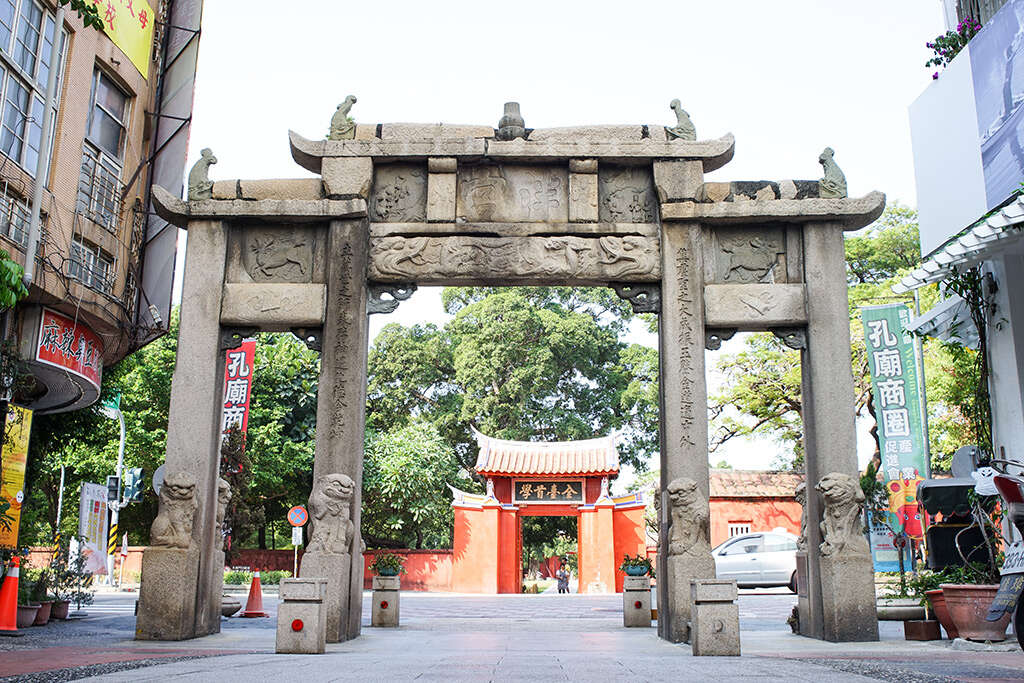
A temple and school share one precinct, linking ritual space with the history of public learning.
Changes to gates, steles and circulation reveal a monument that has repeatedly adapted to the city.
An ordinary passer-by
An umbrella crosses the foreground of an old photograph of Tainan’s Confucius Temple. Behind the woman stand the Pangong stone gate and the gateway bearing the words “First Academy of Taiwan”. Preserved in a Fuji Maru voyage album in the National Museum of Taiwan History, the image records both a monument and an ordinary person passing through the city.
A photograph holds together details that a monument label usually separates: the person in front, the carved stone above, and another gate beyond. Let your eyes follow that depth. The temple was part of a journey through Tainan as well as a destination; its public meaning also took shape through countless ordinary arrivals and departures.
Respect becomes a gesture
The temple combined ritual space with an educational institution. During Japanese rule, construction of Nanmen Road led to the Pangong gate being shifted eastward, separating it from the temple. Today the two remain within sight, but reaching one from the other involves city traffic. Institutional continuity and urban change occupy that small distance.
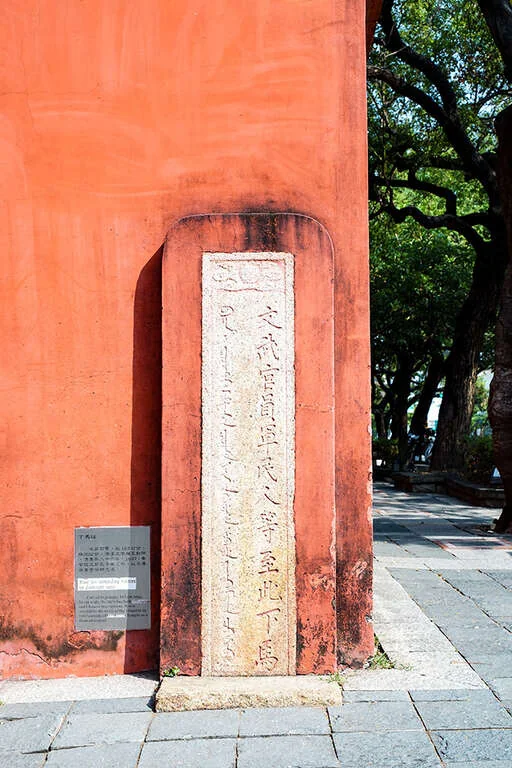
Founded in 1665, the temple later served as Qing Taiwan’s official school. The dismounting stele uses Chinese and Manchu to address arriving visitors. Respect for learning was expressed through the body: getting off a horse before entering. The small stone makes an educational institution easier to imagine than a founding date alone.
The city keeps moving
Notice the gate’s relationship to the road, then look back at the temple. The unnamed umbrella-bearing passer-by in the old photograph returns the monument to a street people used. Today, consider the needs of education, worship and city traffic in turn. Cross at the signals and read Tainan’s changes through that distance.
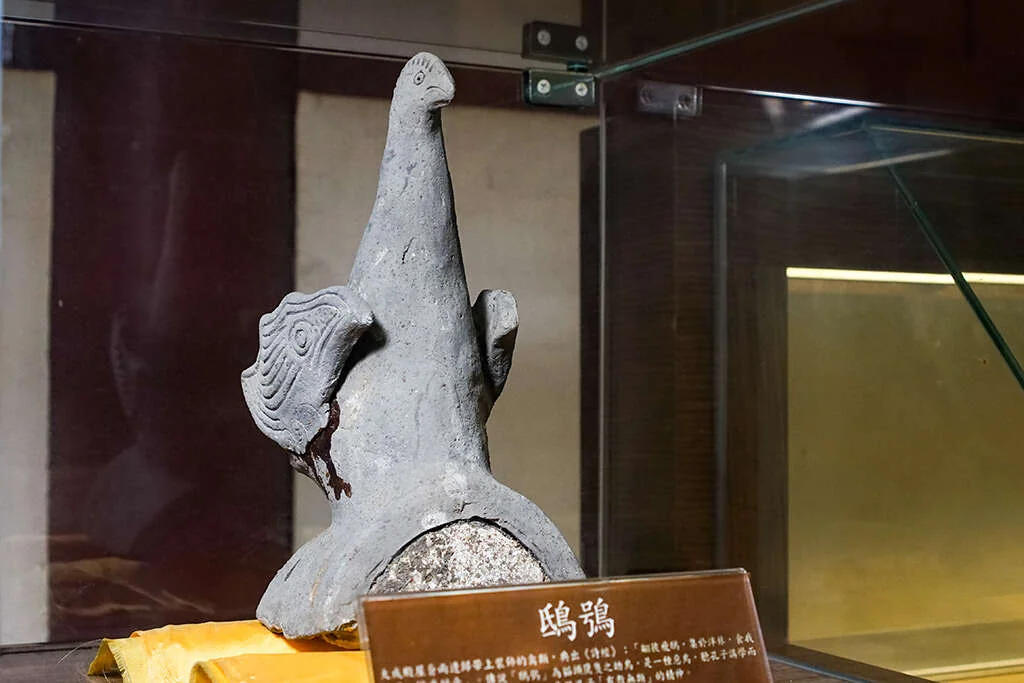
Inside, compare a roof ornament with the courtyard and the halls. Outside, look back from the marked crossing. One visit moves between small objects and a larger urban arrangement: a school precinct changed by streets, while its buildings and ceremonies continue to draw people together.
A plaque can leave the hall so that it can survive
The objects inside the precinct have also had to move. Tainan’s cultural-heritage office recorded that the earthquake of 6 February 2016 damaged Dacheng Hall, the side halls, Minglun Hall and Yicheng Academy. Work proceeded through emergency stabilisation, repair design and reconstruction, with the building project completed in early 2022. An apparently settled courtyard therefore holds a recent history of disruption and repair as well as a much older founding date.
During that work, the damaged stele recording repairs to the prefectural Confucius temple and its ritual and musical equipment was repaired and reinforced. Eight Qing imperial plaques were taken from Dacheng Hall to the Koxinga Museum for study, cleaning, conservation, educational display and digital scanning. The side halls’ storage and display conditions for ritual and musical instruments were also improved. These were different conservation tasks for different materials; the repair of a building did not automatically complete the care of everything it held.
This is a record of the conservation project, not a promise that those plaques are still displayed at the same off-site venue. It changes what is worth looking for on a visit: a date on a stele, the setting of an object and a label identifying its current status can reveal the work that made survival possible, alongside the names and authority originally inscribed on it.
A vessel, a signal and a part to play
The ritual objects have tasks as well as age. The temple identifies its square bronze ding and ceramic taizun as gifts commissioned by prefect Jiang Yuanshu in the forty-first year of Qianlong. The ding was used to cook and hold meat; the taizun held wine. A jue is also a wine vessel, while fu and gui hold grains. Instead of treating every old vessel as an incense burner, follow what each was made to contain. Materials and forms begin to reveal the different actions that an offering requires.
Music has an equally visible beginning and end. At the start of a movement, the zhu on the east side of Dacheng Hall is struck: it is a square wooden percussion vessel. At the close, the tiger-shaped wooden yu on the west side is sounded by striking and scraping. The temple’s account also identifies eastern and western signal-bearers who direct the music and dance. Reading the two instruments together makes their position meaningful: they help many participants begin and finish as one group, rather than simply adding sound to a solemn setting.
The dance likewise gives objects and people distinct roles. In the temple’s six-row, six-column formation, 36 dancers hold the feathered zhi in the right hand and the flute-shaped yue in the left. During the three offerings, the principal officiant and accompanying officiants make offerings at different places, with music and dance coordinated around them. Yicheng Academy continues the work of the earlier temple music association. The precinct’s heritage therefore survives in distributed knowledge as well as repaired objects: who carries, who offers, who plays and who gives the signal. Read these roles through the temple’s explanations; ordinary admission does not promise a rehearsal or ceremony.
Look closer
Compare the Dacheng Hall axis with the school side: courtyards arrange people before decoration catches the eye.
At the steles, identify the date and the work being recorded; distinguish the moved stone arch from its earlier position.
Visiting information
- Address
- 2 Nanmen Road, West Central District, Tainan
- Opening and admission | checked 23 October 2026
- The temple’s current homepage carried a 23 October typhoon-closure notice when read on 23 October; do not plan admission that day, and confirm reopening with the temple. Its regular information, effective 30 January 2026, gives admission through East Dacheng Gate, 08:30–17:20, last entry 17:00; closed on Lunar New Year’s Eve and government-declared natural-disaster work-suspension days. Yicheng Academy opens 09:00–17:00 with a 12:00–14:00 break. Wenchang Pavilion opens weekends and national holidays, 09:00–17:20, with a 12:00–13:30 break.
- Transport and return
- From TRA Tainan, check route98 and its temporary stops for your date. From 10 August through 31 October 2026, the westbound Jianxing Junior High School (Fuqian Road) stop towards Qigu Salt Mountain is suspended for construction. Use the current diversion notice to choose an alternative stop, walk to Nanmen Road and separately identify the return stop towards Tainan Station.