
Cultural place
Sanxia Old Street: the work that keeps a town going
Look above the shops, then follow craft and community work beyond the preserved façades.
Sanxia Old Street: Life Behind the Fronts
90 seconds. English captions are part of the film. Optional Traditional Chinese subtitles are available in the player.
The film focuses on Minquan Street’s public walking space. The original context of community work, shared bags, architectural change and booked craft experiences is retained in the five chapters and complete original snapshots. Footage was uploaded in October 2026; the filming day is independently unconfirmed, and present shops or decorations are not guaranteed.
Read the complete five-chapter article → · 繁體中文
Complete English captions and Traditional Chinese translation
00:00:00,000 --> 00:00:07,000
Sanxia Old Street.
A town still at work.
三峽老街,
地方生活仍在繼續。
00:00:07,000 --> 00:00:14,000
Begin with the whole street,
then follow the red-brick arcades.
先看完整街景,
再沿紅磚騎樓走進去。
00:00:14,000 --> 00:00:21,000
Each doorway joins
a shop to the public street.
每一扇門,
都把店家接上公共街道。
00:00:21,000 --> 00:00:28,000
Compare two neighbours:
their arches, names and ornament.
比較相鄰兩戶:
拱門、名稱與裝飾各有不同。
00:00:28,000 --> 00:00:35,000
A shared streetscape.
Different lives behind each front.
共用一條街景,
每戶門面後都有自己的生活。
00:00:35,000 --> 00:00:42,000
Goods and visitors change.
The street keeps being used.
商品與來客會改變,
街道仍持續被使用。
00:00:42,000 --> 00:00:49,000
At the shopfronts,
pausing and passing share space.
店面門口,
停留與通行共用一片空間。
00:00:49,000 --> 00:00:56,000
Walk at the street’s pace.
Leave room for others to pass.
跟著街道的步調走,
也留空間讓別人通過。
00:00:56,000 --> 00:01:03,000
Look above the signs.
Notice each building’s own face.
把視線移到招牌上方,
看看每棟街屋自己的面貌。
00:01:03,000 --> 00:01:10,000
Step into the arcade.
Shade becomes a walking space.
走進騎樓,
遮蔭也成為行走的空間。
00:01:10,000 --> 00:01:17,000
There is time to browse,
and time to simply move through.
可以停下來逛逛,
也可以只是從這裡經過。
00:01:17,000 --> 00:01:23,000
At the junction,
the old street meets today’s roads.
來到路口,
老街接上今天的道路。
00:01:23,000 --> 00:01:30,000
Sanxia, one doorway at a time.
Taiwan, Layer by Layer.
沿著一戶戶門面,認識三峽。
島嶼年輪。
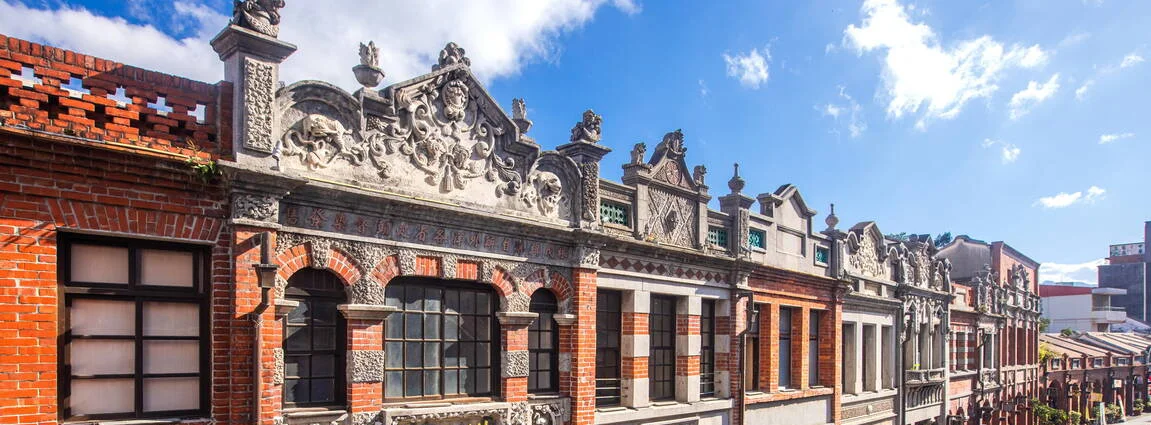
Minquan Street’s façades preserve the relationship between commerce, family identity and the public arcade.
Dyeing and textile experience connects a walk through architecture with a history of local work.
The afternoon visitor and the local child
A visit to Sanxia can begin with shopfronts and continue with a question: who is working to keep everyday life here viable? The Can, founded by Lin Chun-cheng (林峻丞), describes bringing food, craft networks and after-school support together near the old street. The visitor's afternoon and a child's life in the neighbourhood occupy the same town, on very different timescales.
Minquan Street’s red-brick fronts record a commercial town shaped by trade and later street improvements. The goods below them have changed. Compare an old façade with the business operating at street level: preserving a building creates a possibility for continued use, while each new use introduces a different relationship with customers and neighbours.
A bag grows out of a river problem
In a ten-year retrospective, the team described how its first group of children had grown older and how vocational learning had become part of its work. The same account linked regular river clean-ups with a new problem: plastic rubbish kept returning. A project turning unwanted clothes into shared bags brought local sewing work into that response.
Turning unwanted clothes into bags connects an environmental problem with everyday skills. Sorting cloth, cutting and sewing become part of the response; local shops provide places where a bag can be borrowed. The interest lies in that practical chain of work, which links a river seen during a walk with the decisions made at a shop counter.
The old street has a present tense
This gives the old street a present tense. Alongside architecture and food, look for the makers, workshops and public activities that keep relationships going. Choose an advertised visitor experience if you want to participate. A children's support space is not an attraction to enter unannounced; the people who live here set the terms of their own daily life.
Keep the walk manageable: compare two adjoining façades, choose a publicly offered craft activity, and leave time for a meal. A workshop lets you ask about a maker’s choices; an ordinary shop shows how the street earns its living. Together they turn an attractive streetscape into a place where relationships and work are still unfolding.
A continuous street, different front doors
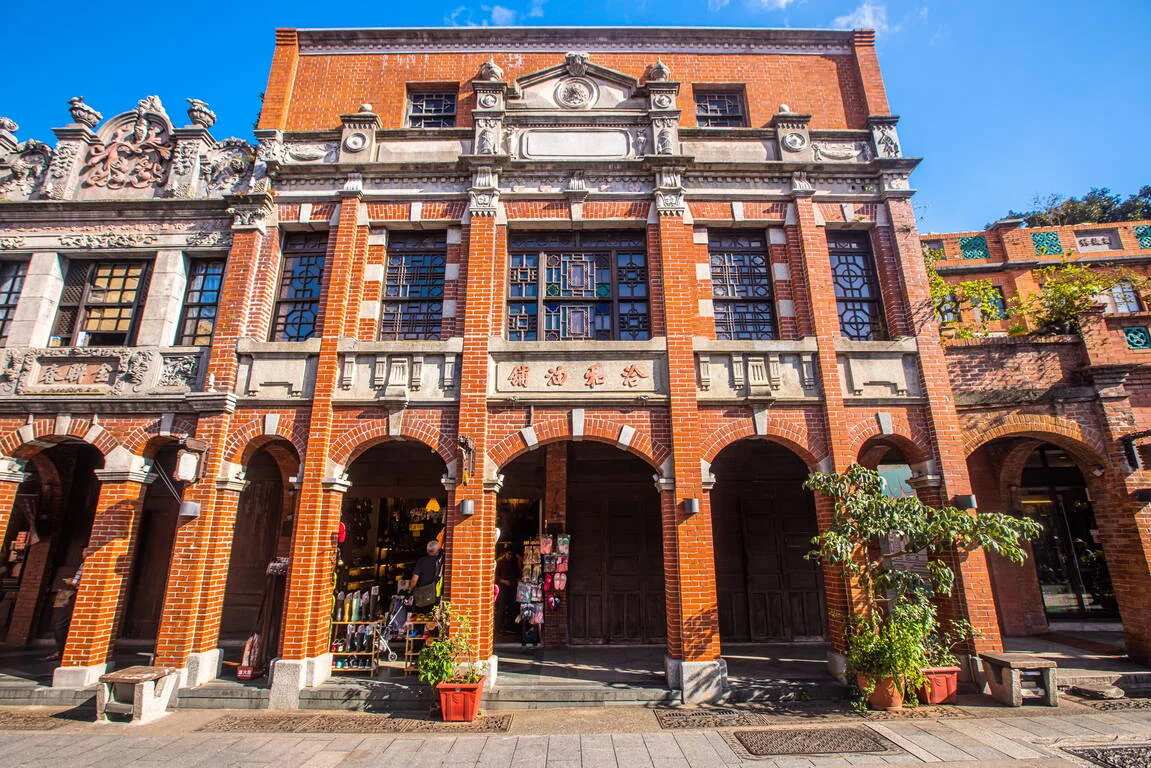
Minquan Street’s continuous brick façades have not survived unchanged since Qing times. Sanxia District Office records the street’s burning by Japanese forces after resistance in 1895, followed by a colonial government-led street improvement in 1916. Uneven shop-houses and roads of differing widths were rebuilt. What now reads as a coherent historic scene also records an intervention in the organisation of the street. Compare two neighbouring fronts: columns and arches below, ornament above. European-derived architectural forms sit beside Japanese family emblems and Han Chinese imagery. The fronts are not identical copies. Notice the shared street scale, then each property’s names and motifs. The result is a street of separate households and businesses, where the workers in the earlier story continue daily life, rather than a single photographic backdrop.
Look closer at the places in the film
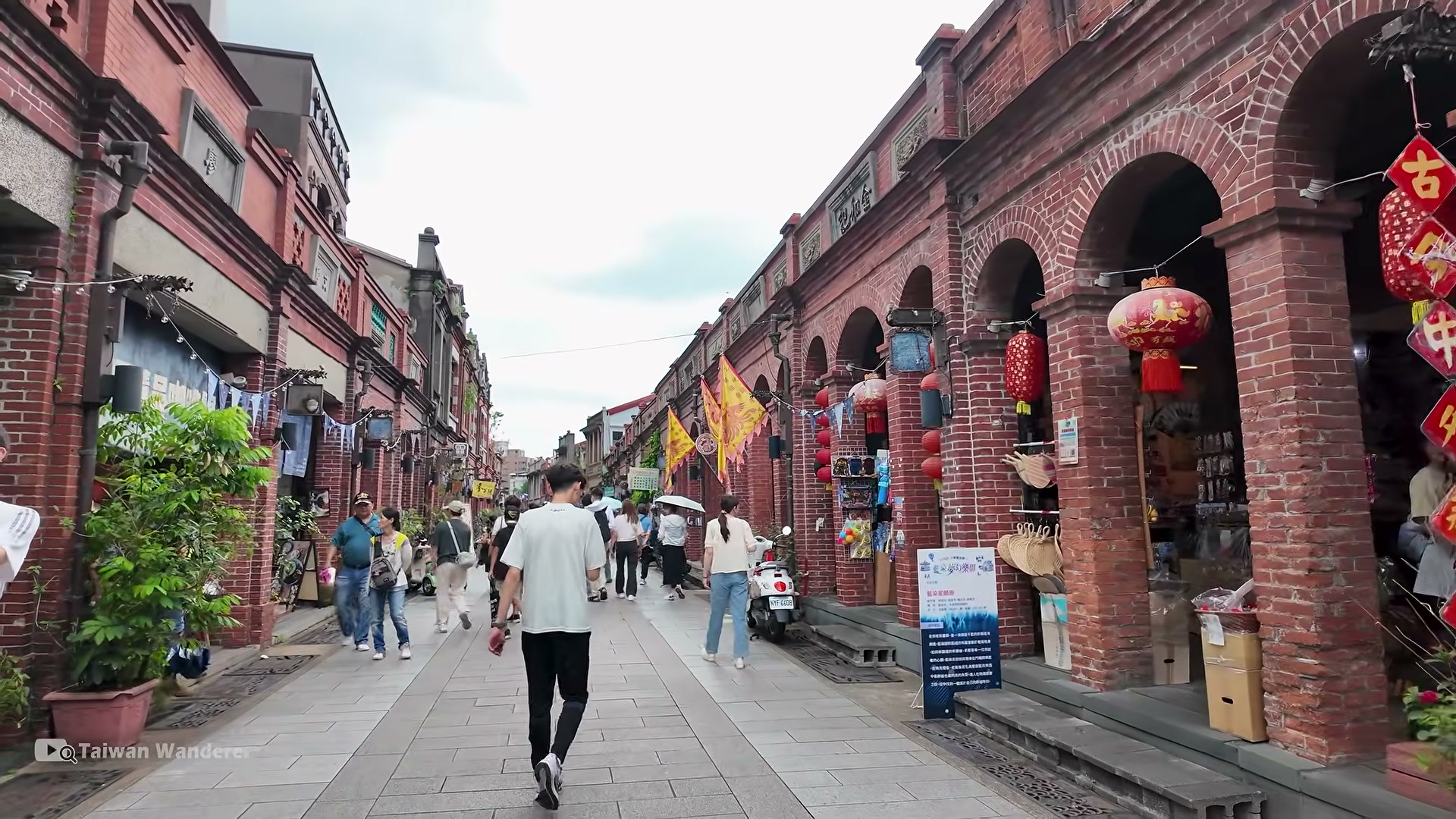
1. Begin with the whole street
Keep Minquan Street’s brick fronts, arches and shop openings in one view. The film begins at the named old-street corner, establishing the turning building and the fronts on both sides before following the public street. This is a walking observation of architecture and everyday use.
The formal article asks about the work that keeps a town going. A visitor’s afternoon overlaps with residents’ much longer lives here. Begin with the scale of the whole street; each doorway and corner then has a place within it.
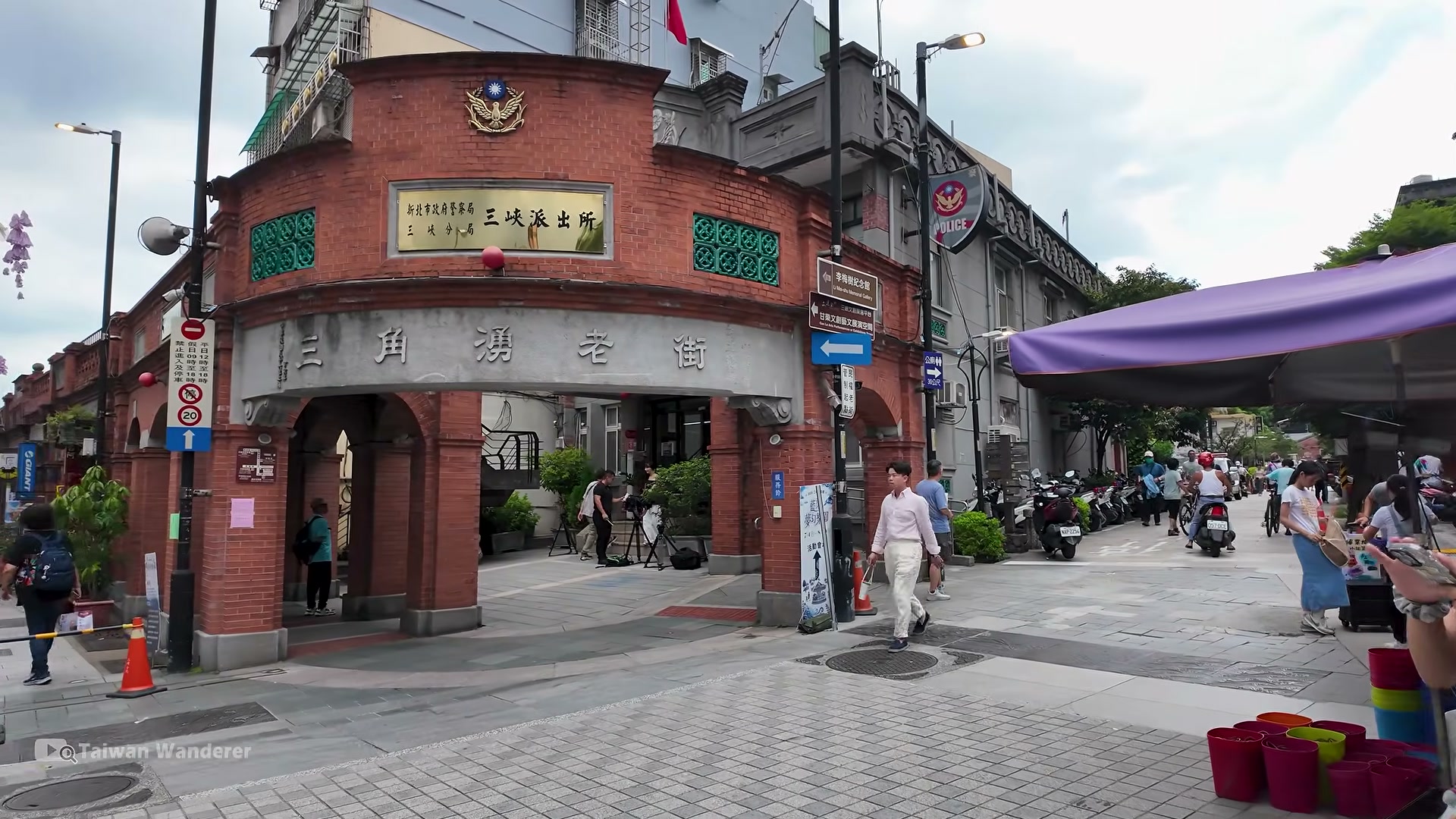
2. Neighbouring fronts, individual names
Repeated columns and arches give the street a shared rhythm. Look higher and the names, ornament and proportions of individual fronts differ. Compare two neighbours to see separate household and commercial identities within a common street scale.
The original article records destruction after the 1895 conflict and a colonial government-led street improvement in 1916. The coherent frontage carries changes in organisation and use. It is not an unchanged scene surviving from Qing times. The footage offers a place to look at the buildings; the historical account remains part of the formal article’s context.
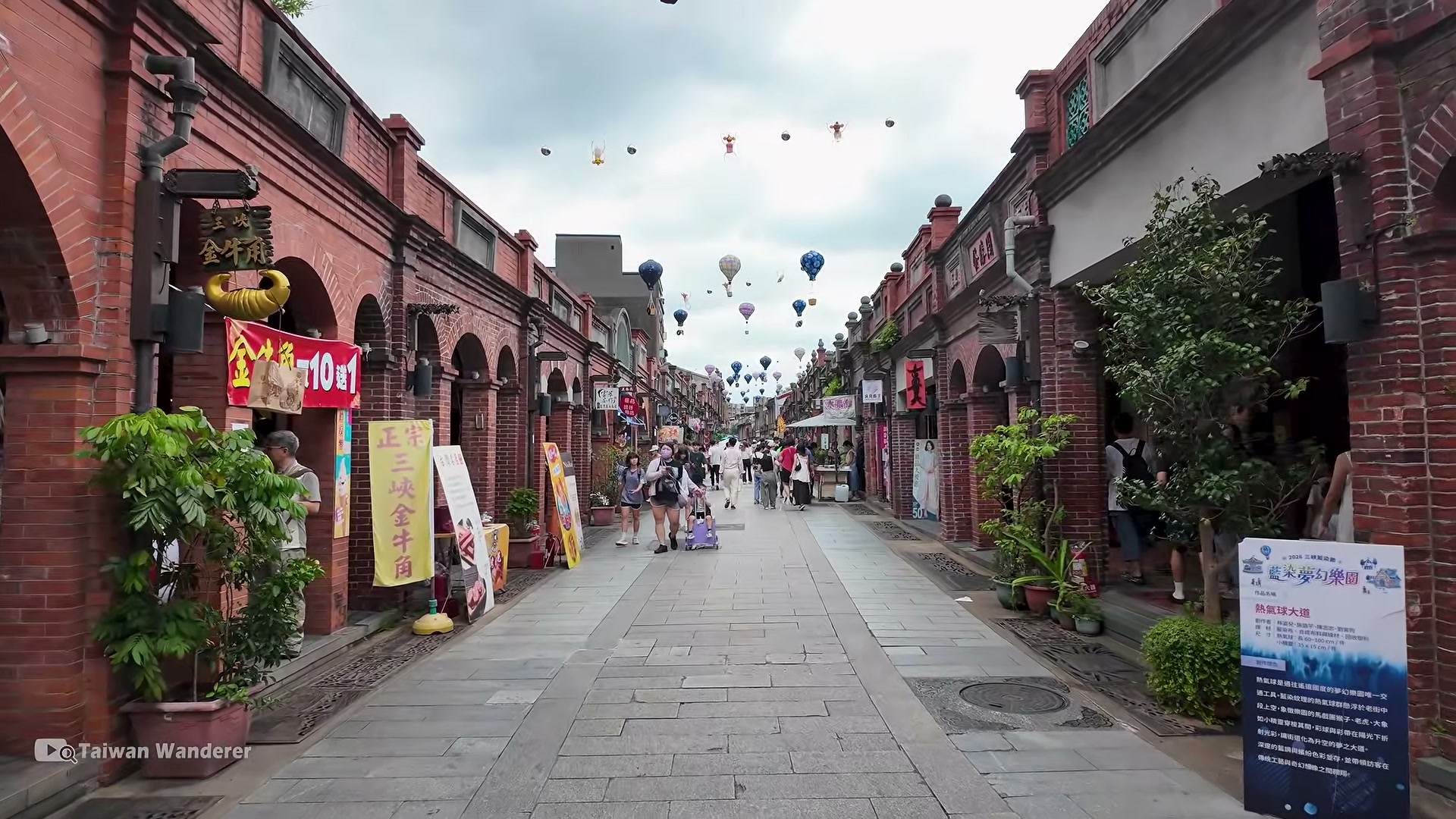
3. Below the facades, shops keep working
Goods, customers and entrances connect preserved buildings with present use. Watch where people pause, how a shop uses the edge of the arcade, and how pedestrians pass through. The street can be understood through these relationships as well as through shopping.
The formal article also introduces The Can, founded by Lin Chun-cheng, and its connections between food, craft networks and after-school support. Its ten-year retrospective links recurring plastic rubbish after river clean-ups with shared bags made from unwanted clothes and local sewing work. Those named actions remain part of the context for understanding local work. The film’s observed scope is Minquan Street’s ordinary shops and public space.
4. An arcade joins shade and movement
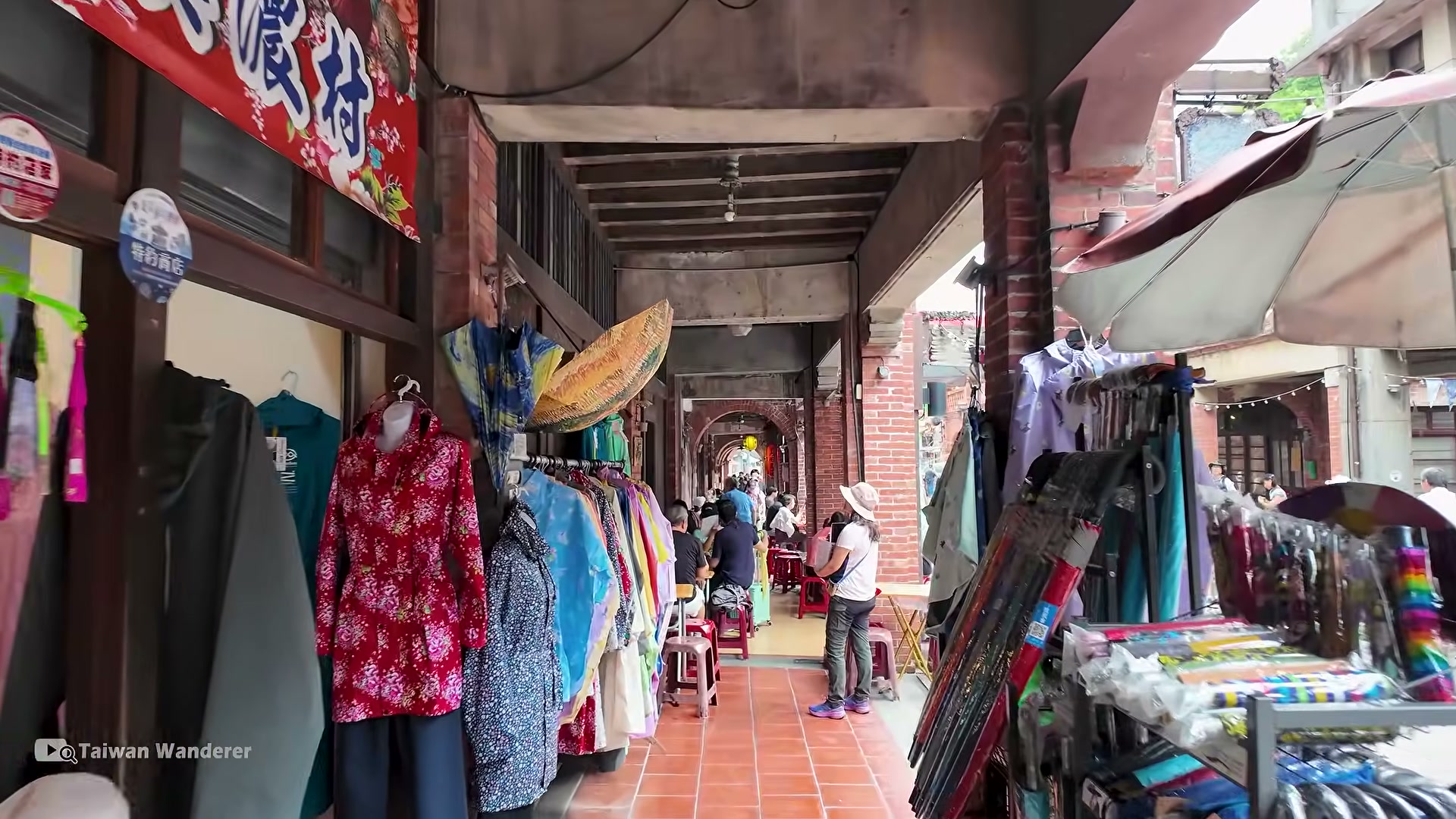
Moving from the street into the arcade reveals the depth of its repeated arches. Shop entrances, columns and pedestrian routes are close together. Pause with room for residents, workers and other visitors to pass. The film moves from the whole street into the arcade, connecting architectural form with the way it is used.
To connect the walk with craft, the original article suggests an advertised, booked dyeing or textile activity. Observe folding, binding, washing and the resulting uncoloured areas. Confirm the arrangements of each workshop, gallery and shop separately; community support spaces follow their own reception arrangements.
5. Reach the junction, then look back
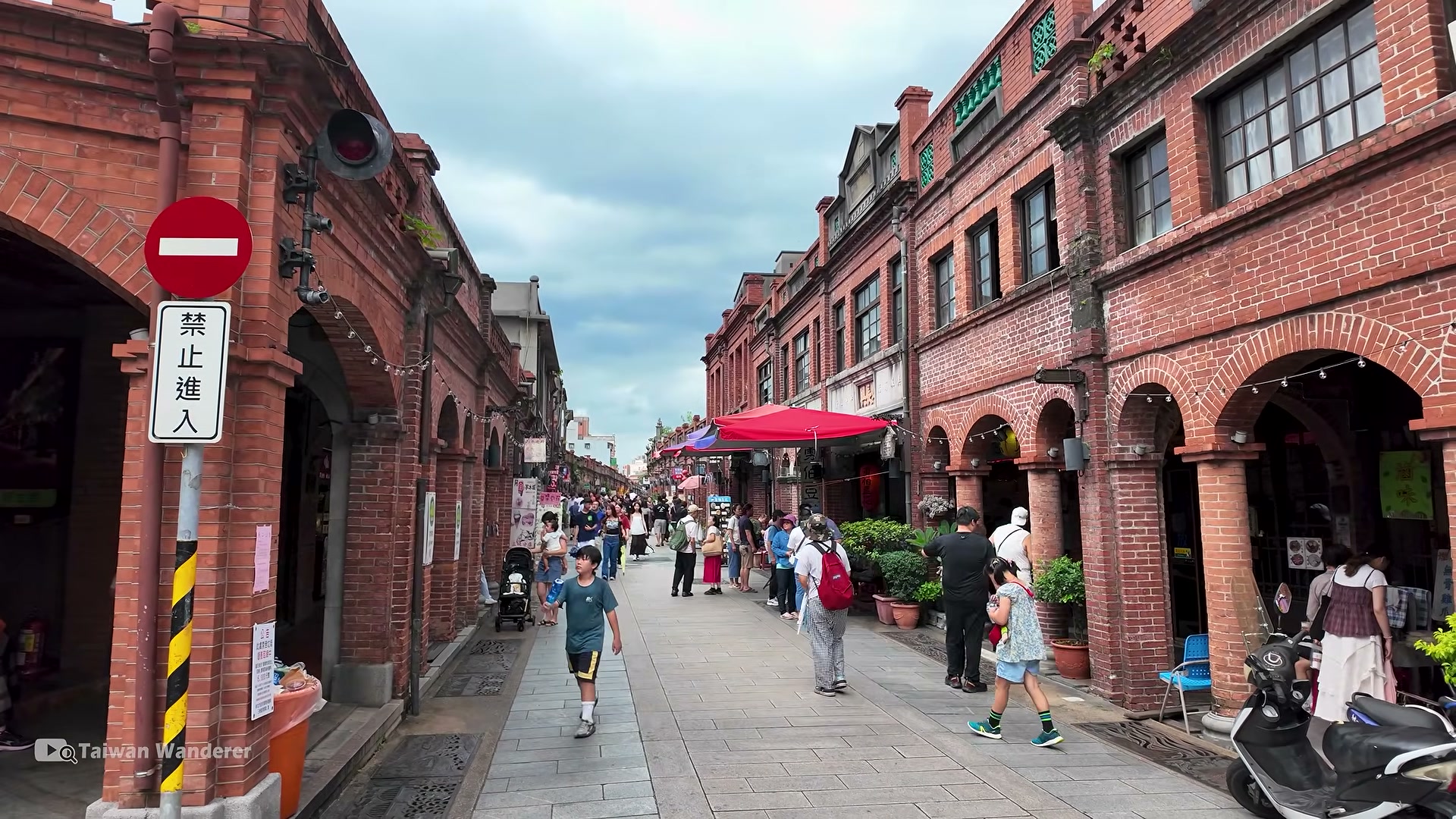
At the end junction, traffic and present-day roads connect the old street with the wider town. Look back to see how the individual fronts, businesses and arcade form a public space together. Leave time to compare two neighbours, browse a shop and join an activity you have confirmed.
The formal article gives 37–147 Minquan Street, Sanxia District, New Taipei. Check Sanying Route 2, formerly 812, towards Sanxia and alight at Sanxia Old Street; check the return direction and branch for MRT Hengxi. The current Greater Taipei Bus route listing includes these stops. Confirm the service for your travel date and the separate opening arrangements of shops and galleries.
The source walk was uploaded on 16 October 2026; the exact filming day is independently unconfirmed. Decorations, businesses and visitor numbers belong to that dated footage. The film retains a readable walking space and ways to observe it.
Film, article and image sources
The film focuses on Minquan Street’s public walking space. The original context of community work, shared bags, architectural change and booked craft experiences is retained in the five chapters and complete original snapshots. Footage was uploaded in October 2026; the filming day is independently unconfirmed, and present shops or decorations are not guaranteed.
- 島嶼年輪:三峽老街:讓地方繼續生活的工作(正式雙語原文)
- Taiwan Wanderer:三峽民權老街公開走訪,2026-10-16上傳
- 大臺北公車:三鶯2線(原812)路線與站序
- 新北市政府交通局:三鶯線接駁路線調整,2026-06-27
1. Original source: https://www.youtube.com/watch?v=sjumM6aXoNg · 2026
2. Original source: https://www.youtube.com/watch?v=sjumM6aXoNg · 2026
3. Original source: https://www.youtube.com/watch?v=sjumM6aXoNg · 2026
4. Original source: https://www.youtube.com/watch?v=sjumM6aXoNg · 2026
5. Original source: https://www.youtube.com/watch?v=sjumM6aXoNg · 2026
Music: 把時間留下 (AI-generated instrumental).
Look closer
Compare the names, dates and ornament on neighbouring façades, then look at how shop openings fit the arcade.
In a booked dyeing session, follow folding, binding and washing, and compare the resulting uncoloured areas.
Visiting information
- Address
- 37–147 Minquan Street, Sanxia District, New Taipei
- Visiting the street
- Begin with Minquan Street. Shops, galleries and bookable workshops each have their own hours; choose daytime for architecture and an activity you have booked.
- Transport and return
- From MRT Hengxi, use Sanying Route 2 (formerly 812) towards Sanxia and alight at Sanxia Old Street. Check the destination display and the return branch to Hengxi; weekday and holiday services differ.