
Cultural place
Look for the painter behind the colours
The colours began with Huang Yung-fu painting where he lived. Reading the village today means following both that life and the changes to its walls.
Rainbow Village, along the painted lanes
90 seconds. English captions are part of the film. Optional Traditional Chinese subtitles are available in the player.
Footage was uploaded in April 2025, with the precise filming day unconfirmed. Not every visible painted surface is attributed to Huang Yung-Fu. Recorded access and surfaces are not guarantees of present conditions.
Read the complete five-chapter article → · 繁體中文
Complete English captions and Traditional Chinese translation
00:00:00,000 --> 00:00:07,000
Rainbow Village, Taichung.
Follow colour between the houses.
臺中彩虹眷村。
沿著色彩,走進房子之間。
00:00:07,000 --> 00:00:13,000
A narrow lane brings
stripes beneath your feet.
走進窄巷,
條紋也延伸到腳下。
00:00:13,000 --> 00:00:19,000
Painted brick walls
open into a small courtyard.
畫滿圖案的磚牆,
通向一方小小的院子。
00:00:19,000 --> 00:00:25,000
Colour reaches the window,
then continues underfoot.
色彩繞過窗邊,
也延續到腳下。
00:00:25,000 --> 00:00:31,000
Faces and animals
fill a low courtyard wall.
人物與動物,
畫滿院子裡的矮牆。
00:00:31,000 --> 00:00:37,000
Colour leads around
each small corner.
跟著色彩,
繞過一個個小轉角。
00:00:37,000 --> 00:00:43,000
The path bends,
and another doorway appears.
通道轉彎,
另一扇門出現在眼前。
00:00:43,000 --> 00:00:49,000
A tree opens a pause
between the painted walls.
彩繪牆之間,
一棵樹留下一處停頓。
00:00:49,000 --> 00:00:55,000
Under the tree,
colour circles the trunk.
走到樹下,
色彩環繞著樹幹。
00:00:55,000 --> 00:01:02,000
See the low house,
not only its painted wall.
看看低矮的房子,
也看見彩繪之外的屋子輪廓。
00:01:02,000 --> 00:01:08,000
Windows, doorways,
and places to leave a wish.
窗戶、門口,
還有留下心願的地方。
00:01:08,000 --> 00:01:14,000
Take the smaller passage
between painted doorframes.
從彩繪門框之間,
走進較窄的通道。
00:01:14,000 --> 00:01:22,000
Painted ground opens
into a wide courtyard.
彩繪地面延伸出去,
通向開闊的院子。
00:01:22,000 --> 00:01:26,000
From a walk shared in 2025.
這段走訪影像於2025年上傳。
00:01:26,000 --> 00:01:30,000
Stay a little longer.
Taiwan, Layer by Layer.
多留一點時間。
島嶼年輪。
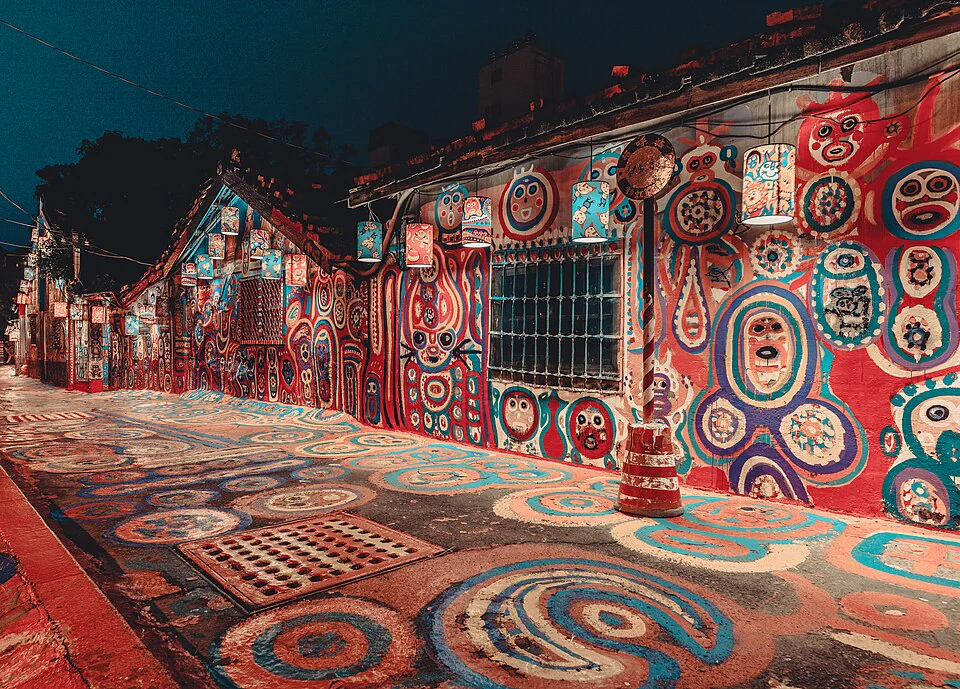
Huang Yung-fu began painting in 2008; his life is the starting point for the visit.
Earlier photographs and later displays belong to different moments in the village’s history.
Painting a place he called home
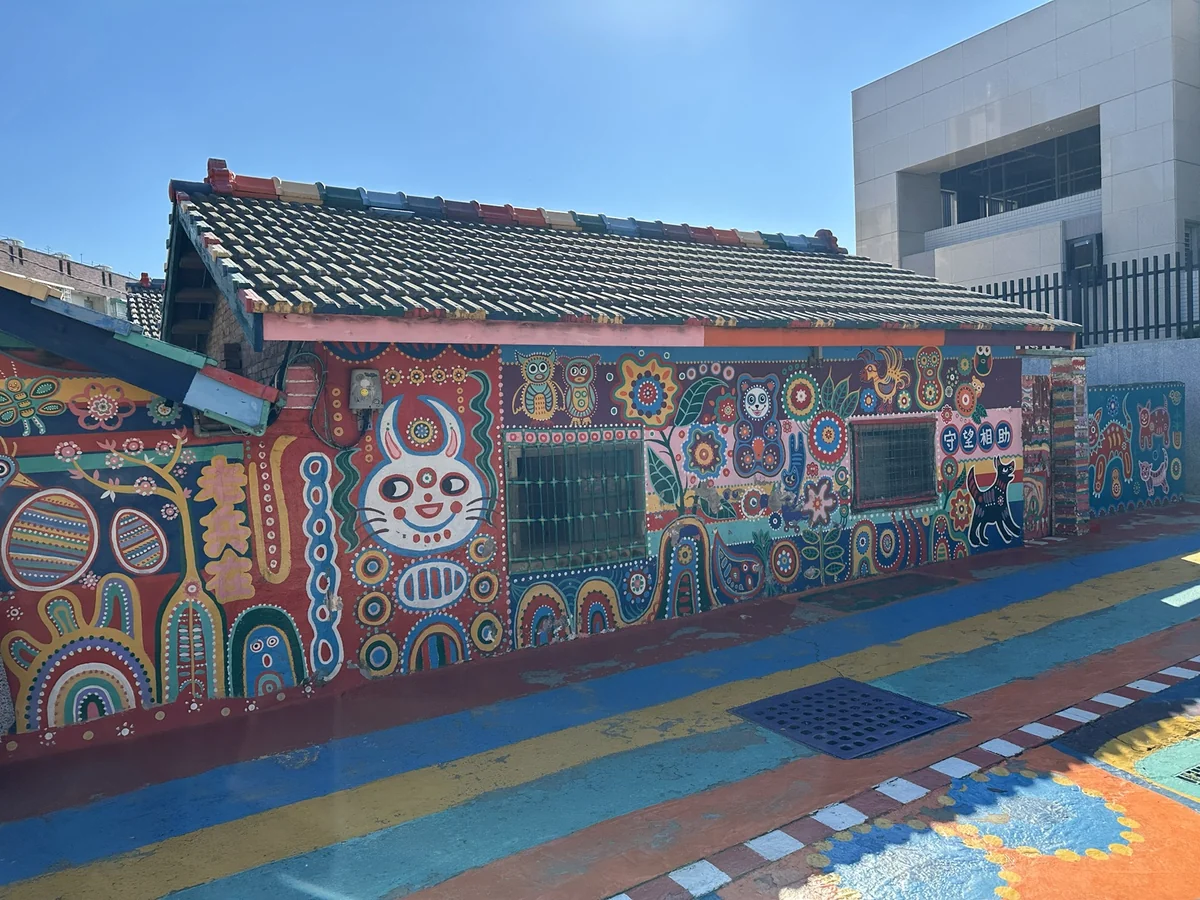
Retired serviceman Huang Yung-fu began painting in his settlement in 2008. A 2017 TIME feature introduced his work to overseas readers and described how public interest helped preserve the place. His modest residential surroundings became known internationally as Rainbow Village.
The scale matters. These are residential walls, doors and narrow passages, not a gallery assembled around separate canvases. Painted figures move across the surfaces people used every day. That close relationship between picture and dwelling helps explain why visitors remember the whole place, rather than a single image detached from its setting.
A wall can hold several moments
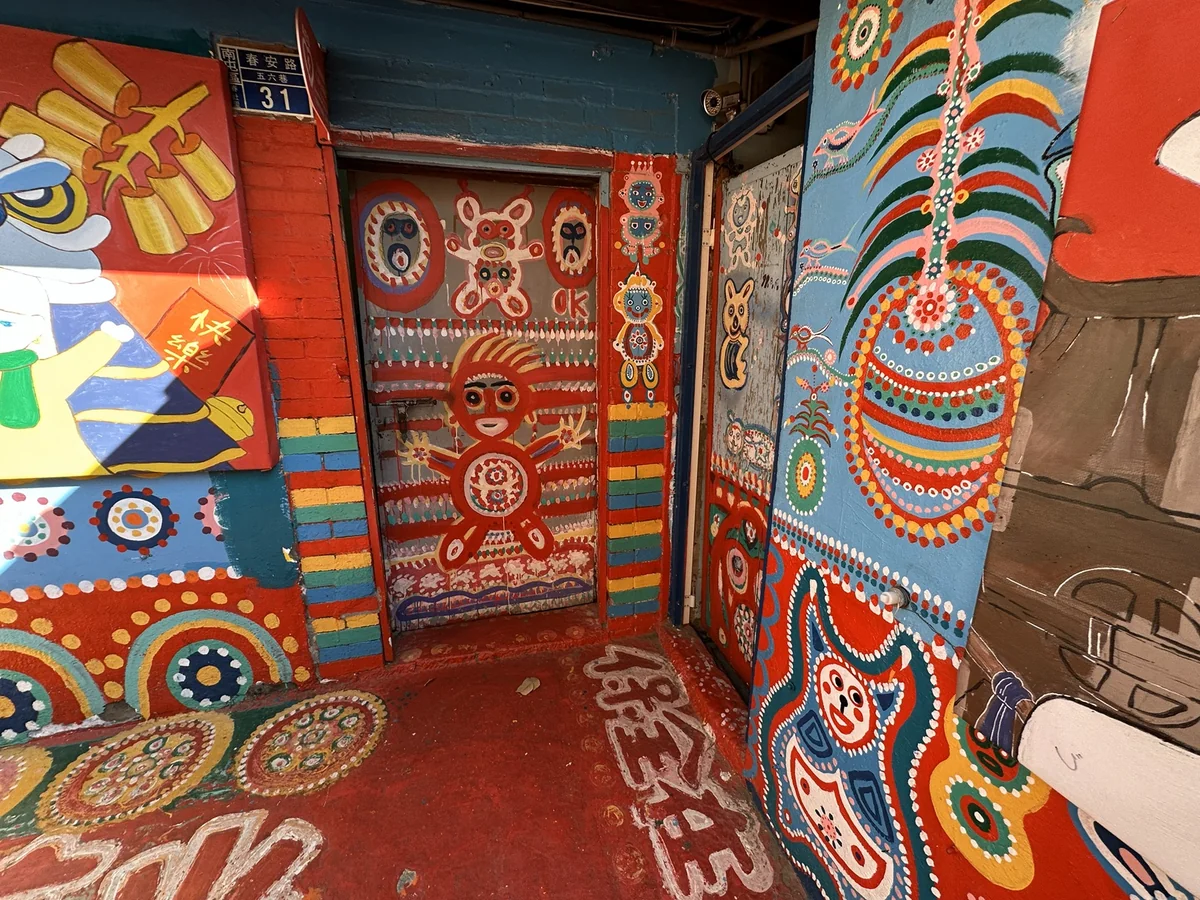
Huang died in January 2024. Later that year, CTS reported that some surfaces had been covered and that citizens’ creations had been introduced. Older travel photographs therefore record a particular moment in the site’s changing history; the presence of bright paint alone cannot identify a work as Huang’s.
A December 2025 visitor’s photographs show brightly painted passages and several kinds of decorative treatment across the buildings. Comparing them with older images is useful precisely because the surfaces have changed. Dates become part of reading the picture: they help separate the painter’s earlier environment from the later public display without flattening both into a timeless postcard.
From a person’s work to public viewing
Rainbow Village became known beyond Taiwan through photographs, reporting and visitors. Its current life also includes public participation, such as the prayer-card painting described in the city’s visitor information. These layers show how a personal act of painting became a shared place, while the question of who made each work remains important.
The present visit starts from the art-park square beside Lingdong South Road. Entering through a managed public gateway is different from approaching a settlement as an accidental discovery. Inside, read the biographical material and work labels before choosing a favourite wall. A photograph becomes more meaningful when it can be connected to a person, a date or a later act of making.
The house beneath the painting
How long a painting survives also depends on the house carrying it. Taichung’s 2022 engineering account records cracks in earthen walls, alongside roof repairs, foundation investigation, emergency reinforcement and monitoring of leaning painted walls. Preservation concerns the supporting building as well as its colour. Read photographs through two questions: who painted the surface, and what supports it? Creation, repainting and structural strengthening have separate records. An intact-looking surface establishes neither untouched fabric nor authorship. The 2022 account explains a conservation problem; it is not a present closure notice or permission to enter every house.
Look closer
Read a work’s label, then notice how it uses a doorway, wall corner or window.
Compare a dated earlier image with today’s surface treatment and arrangement.
Visiting information
- Address and entrance
- 25, Lane 56, Chun’an Road, Nantun District, Taichung. Enter from the Rainbow Art Park square beside Lingdong South Road.
- Opening and admission
- The city tourism listing gives Tuesday–Sunday 09:00–17:00. Check the current management notice for holiday opening, admission arrangements and temporary closures before travelling.
- Visit and return
- Allow about one hour for the lanes and interpretation. When arriving by taxi from HSR Taichung / TRA Xinwuri, use the entrance beside Lingdong South Road as a location reference and agree a permitted nearby boarding point with your driver. Return to the same station hub.
Look closer at the places in the film
1. See the houses before following colour
At Rainbow Village, begin where the roof, windows and courtyard can be seen together. Low houses meet a painted floor, with taller city buildings beyond. The contrast makes the small settlement’s scale visible. The film holds a whole frontage before entering a narrow lane. During a visit, read the spaces between houses before moving close to a favourite wall.
The story begins with Huang Yung-Fu. Taichung’s 2024 memorial account records his painting of homes and walls from 2008 and his death in January 2024. Recognising the maker, then distinguishing later display and maintenance, adds more than a colourful photograph. This film does not show Huang painting, or attribute every visible surface to his original hand.
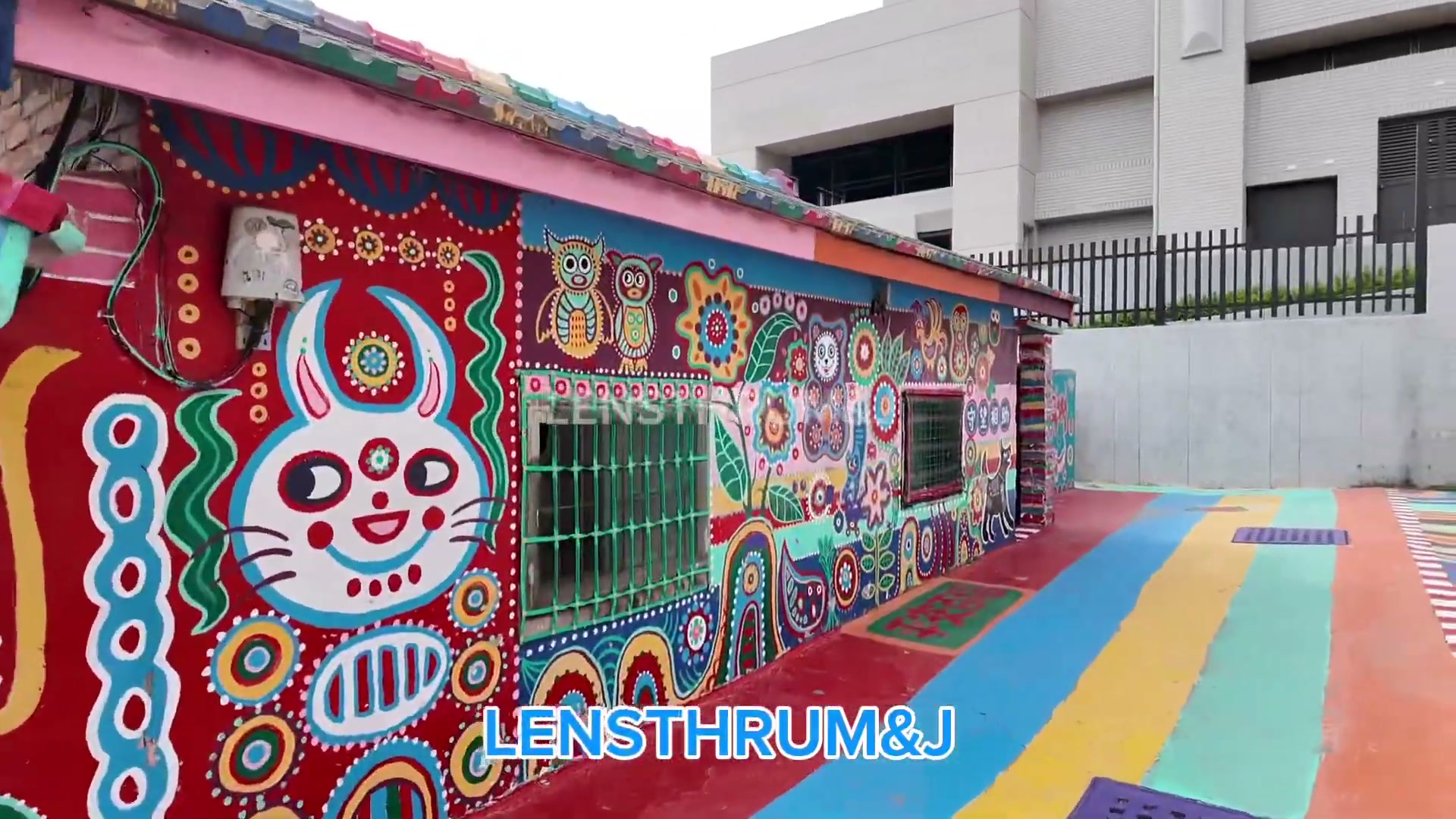
2. The painted ground reveals the lane
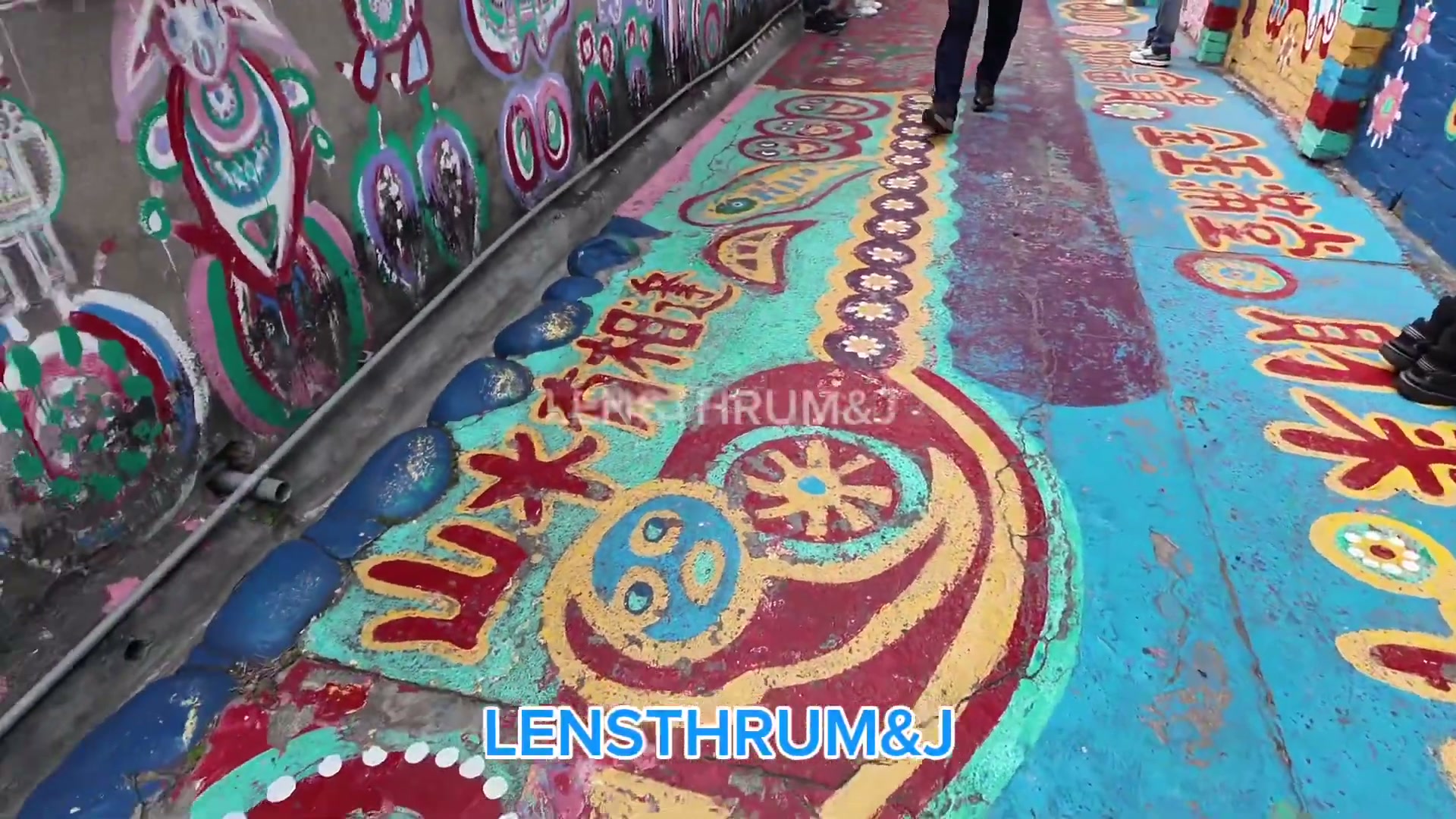
Enter beside a striped wall and colour moves below eye level. Dots, flowers, figures and lettering continue across the ground. At a corner, patterns wrap around doors, windows and projecting brickwork. Wear and patchiness remain visible in the source images. Bright colour alone cannot establish that a work has never been repainted or changed.
Try two directions of looking: follow the animals and faces on a low wall, then look down to see how the passage continues. This is a place where visitors pause, pass and take photographs. Stay in the public passage and wait for room to open ahead. The relationship between a house and its path can be photographed without touching a painted wall or occupying the whole narrow lane.
3. Doorframes, windows and later contributions
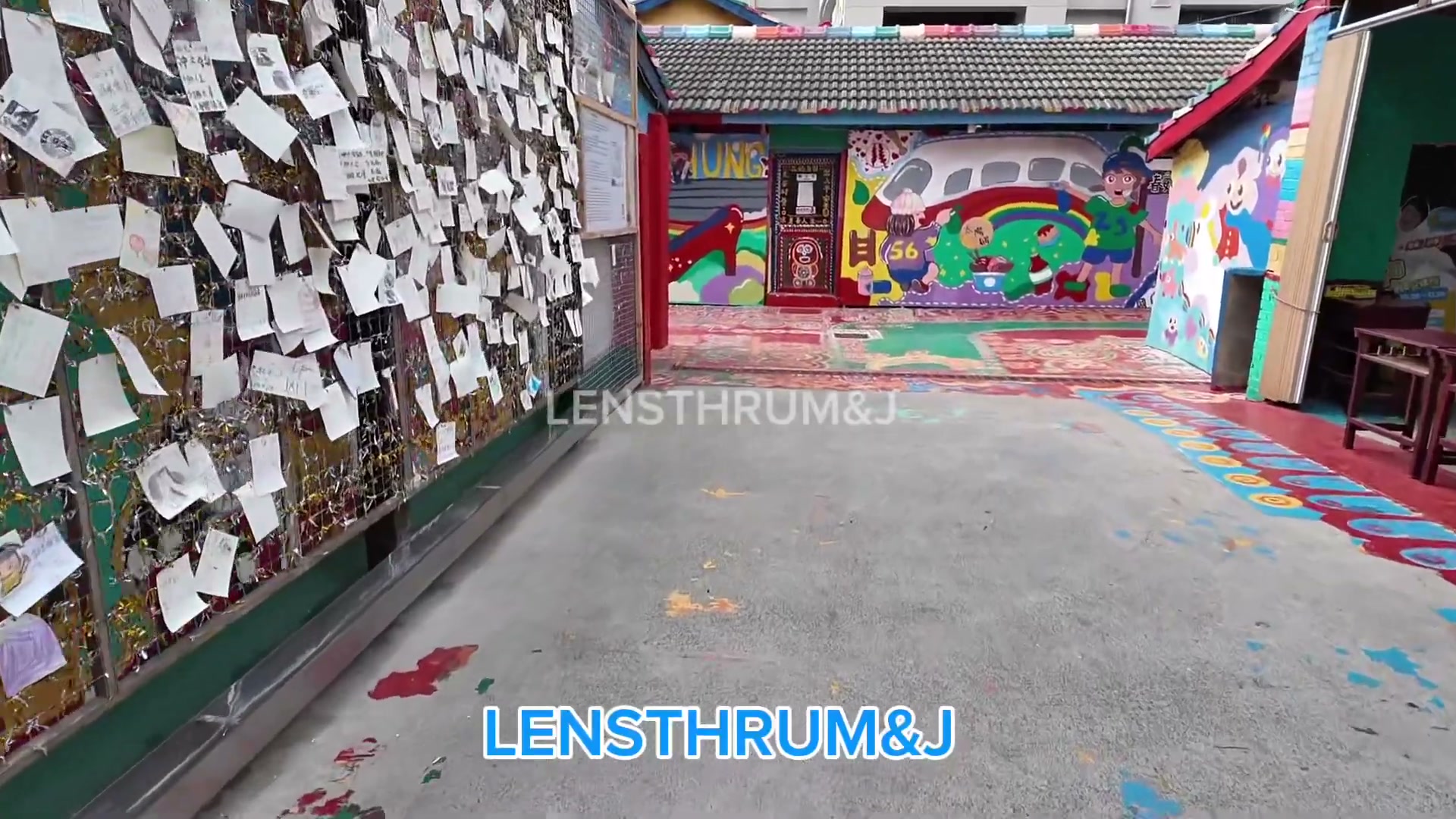
Beyond a small frontage, another painted passage and a wall covered in paper notes appear. Red window frames, seats under the eaves and notices still organise movement and places to pause. Painting has not erased these edges of the buildings. It can invite a second question: which doorway or brick wall does a work use? An opening in the recording does not guarantee that every room can now be entered.
The city’s 2023 reopening account distinguishes Huang’s work from later contributions on protective walls by artists, school groups and residents, including painting and crochet. Read the labels on site to distinguish a work, its maker and its period. Individual authorship of every design in this footage has not been established; later collaborative work is not presented as Huang’s solo creation.
4. Pause under the tree and notice time
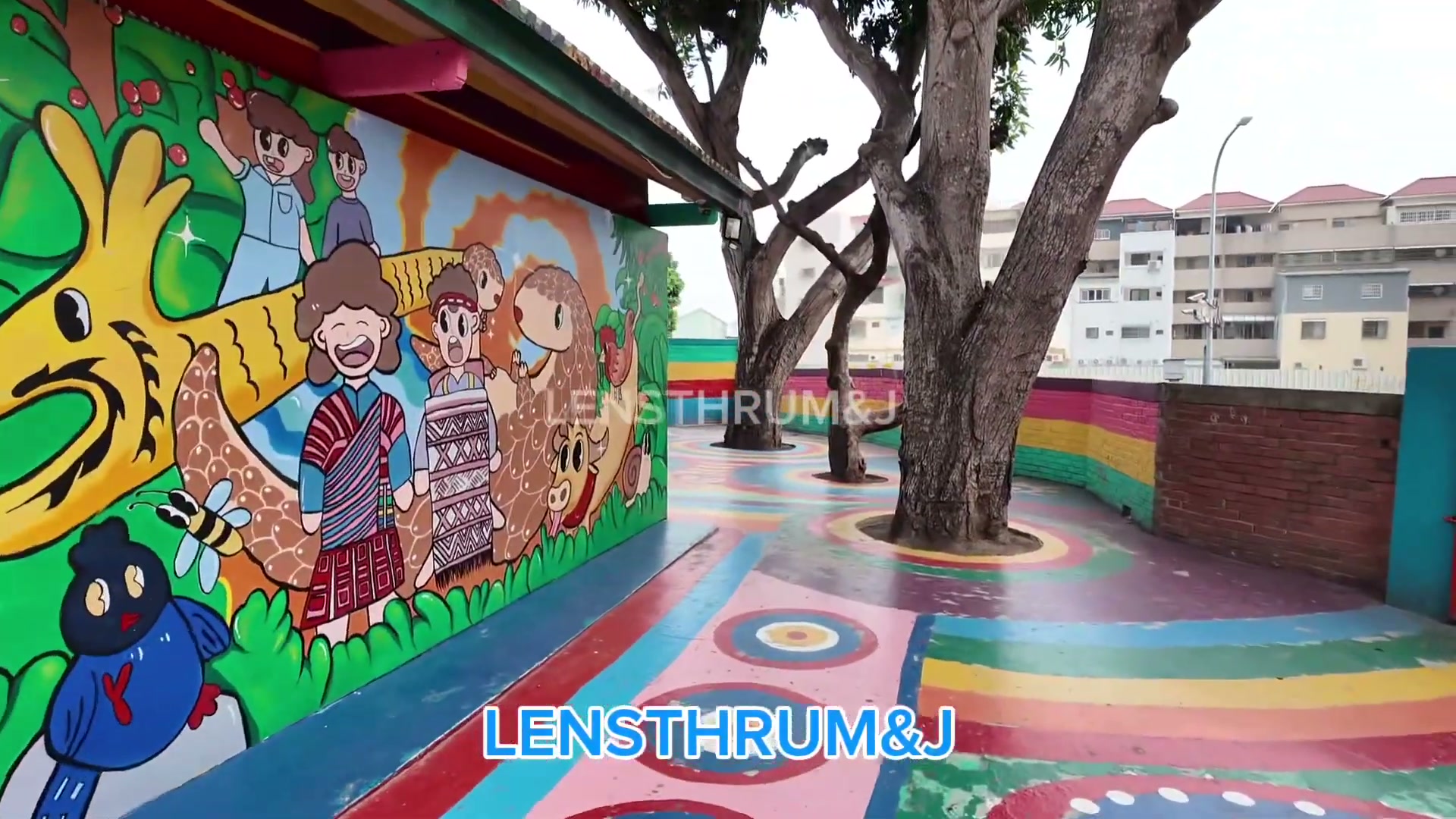
Under the tree, the camera moves from painted figures to bark, a low wall and rings of colour. A pause allows the settlement to be seen as space rather than a succession of details. Looking back towards the low roofs brings painting, buildings and a growing tree into one view. Rainbow Village is more than a single wall for photographs.
Colour also has a maintenance history. A 2025 city notice records collaborative work by Huang and residents on the art park’s boundary walls and a later maintenance project involving public agencies and school art teachers, completed that January. That account concerns park walls; it cannot be assigned to every house surface in this film. Read the different periods before treating making, collaboration and maintenance as the same act.
5. Return to the courtyard before leaving
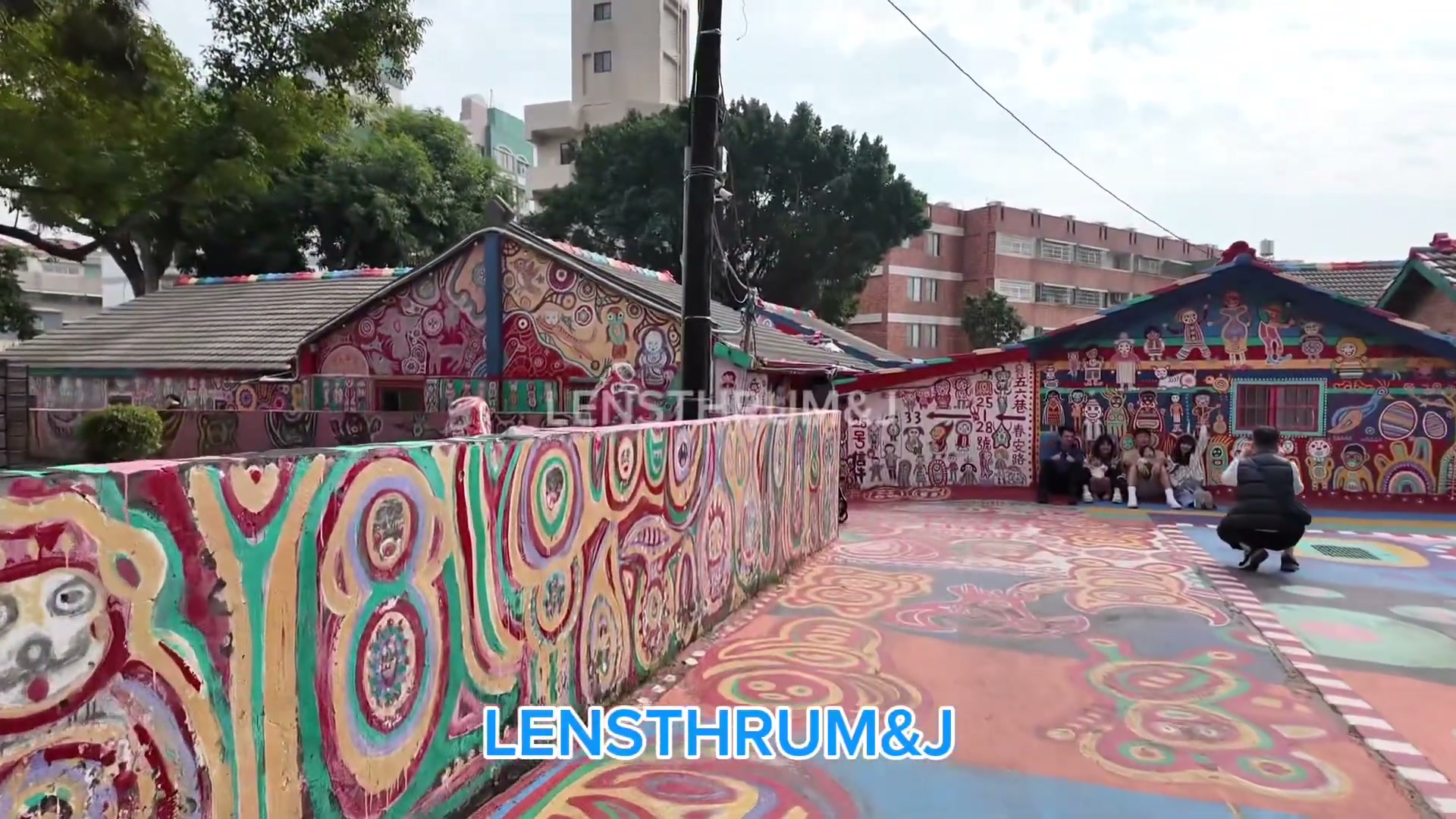
Return to the open courtyard, where low houses and the painted ground enter the frame together. Windows, lanes and low walls now have places in relation to one another. For a photograph, choose an angle that includes the roof and frontage. For a longer memory, read one work’s explanation and connect the image with a person and a time.
The city tourism listing gives entry from the Rainbow Art Park square beside Lingdong South Road, at 25, Lane 56, Chun’an Road in Nantun. It lists free admission, Tuesday–Sunday 09:00–17:00 and around one hour for a visit; check temporary and holiday notices before departure. This walk was uploaded on 28 April 2025. Its precise filming date is unconfirmed, and today’s surfaces, businesses and access may differ.
Film, article and image sources
Footage was uploaded in April 2025, with the precise filming day unconfirmed. Not every visible painted surface is attributed to Huang Yung-Fu. Recorded access and surfaces are not guarantees of present conditions.
- 島嶼年輪:走進彩虹之前,先認識畫畫的人(完整正式中英原文快照)
- LensThruM&J:Rainbow Village Walking Tour in Taichung, Taiwan(2025-04-28上傳)
- 臺中觀光旅遊網:彩虹村(開放、入口與到訪)
- 臺中市政府:敬悼彩虹爺爺黃永阜(2024-01-24)
- 臺中市政府:彩虹村重新開放,原作與居民共創(2023)
- 臺中市政府:彩虹藝術公園圍牆彩繪修復(2025-02-26)
1. Source walking footage: https://www.youtube.com/watch?v=t8Qc21WCAh4 · 2025
2. Source walking footage: https://www.youtube.com/watch?v=t8Qc21WCAh4 · 2025
3. Source walking footage: https://www.youtube.com/watch?v=t8Qc21WCAh4 · 2025
4. Source walking footage: https://www.youtube.com/watch?v=t8Qc21WCAh4 · 2025
5. Source walking footage: https://www.youtube.com/watch?v=t8Qc21WCAh4 · 2025
Music: 把時間留下 (AI-generated instrumental).