
Annual martial-arts gathering
Neimen Songjiang formations: a village learns to move together
A flag changes direction and an entire formation responds. Around Neimen’s Guanyin temples, weapons, lion heads and school lessons keep a demanding communal skill in motion.
Usually around March and April; the host temple and event days vary by year.
Watch how the flag, weapons and lion coordinate, then connect the performance to village training.
Following a flag means watching one another
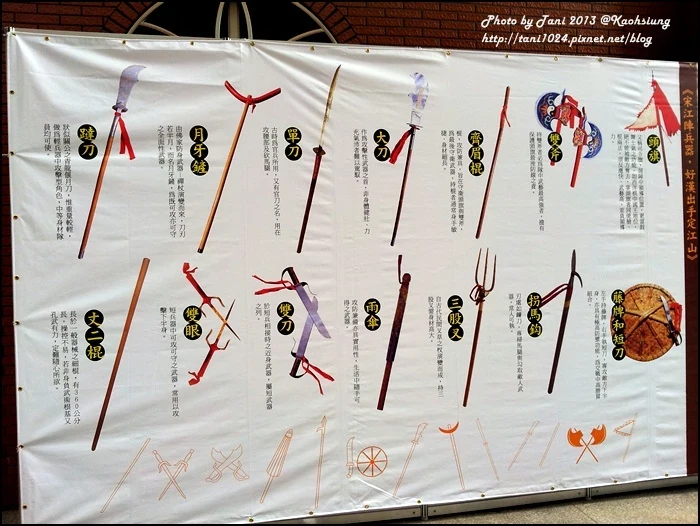
A Songjiang formation turns a group of people into a changing pattern. Long poles, blades and shields require different amounts of room; the circle has to keep moving while pairs prepare to meet. A weapon chart at the 2013 Neimen gathering placed these varied implements side by side. Seen together, they explain why the performance needs timing and spacing as much as individual strength.
Neimen’s troupes do not all use the same sequence. Guanyinting’s Songjiang lion troupe combines group formations with encounters between a lion and armed performers; Hengshan’s repertoire includes the Seven-Star salute and paired weapon routines. Distinct flags and lion-head colours help identify the groups. Each appearance carries a local name into the temple forecourt, allowing neighbouring communities to meet through movements they have practised at home.
A lion pauses at the temple threshold
The gathering belongs to the religious landscape of Luohanmen, the old name associated with Neimen. Guanyin processions bring local troupes out to accompany the deity, while their visits to temple forecourts provide occasions to demonstrate and renew relationships. The annual large-scale event has rotated among local temples. In 2026, Neimen Zizhu Temple hosted the gathering on March 22, March 28–29 and April 4, a set of separate event days around this shared religious life.
A Songjiang lion has more to do than leap. Some Neimen troupes pause at a bridge to let the lion inspect below it, then bring it toward the temple’s stone lions in a greeting-like ritual. In the temple’s photograph of the Zhongputou troupe, a dark lion head leans close to a stone counterpart. The action joins the moving costume to the permanent guardians at the entrance, giving the threshold its own part in the performance.
A meeting between groups has its own vocabulary. The Kaohsiung account describes the host village's formation greeting an arriving group, with the two leading flags moving in acknowledgement, called jieqi, or receiving the flags. If both are lion groups, their lions may bring their necks together in a friendly greeting. These exchanges make the village boundary legible: the formation is entering someone else's place, not merely moving between performance areas.
The village troupe and the competition meet at one gathering
Neimen’s large public gathering combines activities with different purposes. Local troupes accompany Guanyin in the Luohanmen procession, while the modern creative Songjiang competition invites teams from beyond the village. Kaohsiung’s 2025 account records eleven teams drawing on martial arts, dance and even costume performance. These are new stage approaches to a formation tradition, rather than a description of every local troupe’s ritual repertoire. Keeping the two settings distinct makes both the inherited routines and the experiments easier to follow.
Another local profession helps host the crowd. For the 2025 Songjiang banquet, chef Tang Fu-lung, also chair of Neimen Nanhai Zizhu Temple, directed a ten-dish meal including braised pork, grouper and cherry-shrimp sticky rice. Temple organisers, performing teams and banquet cooks contributed different skills to the same occasion. A table of food thus connects the martial-arts gathering to Neimen’s working life, through the hands of cooks whose trade is receiving many guests together.
The next formation begins in school
Keeping a troupe together has become harder as families move away and fewer children enter local schools. In 2025, Neimen Elementary principal Guo Mingke described a school that had fallen from several hundred pupils to fewer than a hundred. The school concentrated its former three performing-arts groups into Songjiang training and brought it into flexible curriculum time. Children begin with the circle: learning where to stand and when to move before a formation can hold together.
Elder practitioner Hong Qingchi worried about the gap between masters growing old and younger people acquiring their skills. That concern changes what it means to watch the festival. The clean turn of a formation is also evidence of rehearsals, teachers and enough people willing to return. After the crowd leaves, the future of the next gathering depends on whether these ordinary sessions continue in the school and the village.
Keeping a group ready also divides responsibility. The guanzhang purchases supplies and prepares costumes and equipment, while the teaching master trains changes of formation, weapons and paired exchanges. In the report, Dapu representative Meng Sheng-nan emphasised instruction handed down within the group rather than hiring outside teachers. That is Dapu's account of its own continuity, not a claim about every Neimen troupe. Ask which group's flag and teaching line you are seeing before treating all formations as interchangeable.
Look closer
Remain outside the formation and keep the temple’s central passage clear.
Compare a troupe’s flag and lion-head colours before following its sequence.
Visiting information
- When
- Usually March–April. The 2026 event days were March 22, March 28–29 and April 4. The listed 2026 festival programme has ended.
- 2026 venue
- Neimen Zizhu Temple, No. 18, Lane 115, Zhongzheng Road, Guanting Village, Neimen District, Kaohsiung.
- Getting there
- From Qishan Bus Transfer Station, take Kaohsiung Bus 8035 toward Neimen/Nanhua, alight at Guanyinting and walk into the temple neighbourhood.
- Return and viewing
- Use the return stop toward Qishan and check the last useful connection before watching. For a late programme, arrange a taxi pickup outside the event closure area.