
Annual event
Miaoli’s dragon festival: from bamboo strip to final flame
Making, awakening, dancing and returning the dragon each require work; the flames occupy only one part of its life.
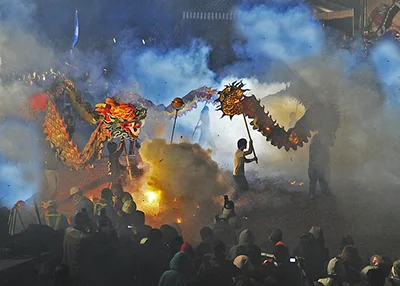
Around the first lunar month and Lantern Festival; eye-opening, parades, firecrackers and the final return take place on different days.
In 2026: eye-opening 25 February, parade 27 February, dragon night 28 February and final burning 5 March. The 2026 edition has ended.
More than a month before the flames
A Miaoli dragon begins with split bamboo: frame-weaving, cloth covering, painting and assembly commonly take more than a month. During a 2013 demonstration, experienced maker Zhong Chunhui described odd numbers such as nine, eleven or fifteen body sections. Their number determines both length and the team required to move it, linking workshop decisions with eventual formations in the street.
Another interviewee, Zhong Banghu, explained that gifts received along the route do not necessarily cover the cost of bringing out a dragon; participants contribute their own resources. This continuing commitment makes dragon-making more than a pre-festival commission. Money and labour must come together before the completed work can become a neighbourhood occasion.
After the eyes open, a team gives movement
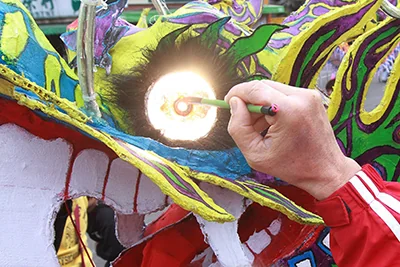
Eye-opening brings the completed form into ritual life. On 25 February 2026, teams gathered outside Miaoli’s Yuqing Temple, followed by dragon-dance competition. The brushstroke is brief, unlike the preceding manufacture and subsequent practice. As the head turns, successive sections must respond so that cloth and bamboo become a seemingly living body.
The parade takes that coordination into the city, where corners, spacing and spectators alter how far the dragon can extend. A photographer’s 2010 account described difficulty focusing through smoke and rapid movement. At the moment a camera loses the subject, team members still have to follow one another: the movement cannot be produced by the head bearer alone.
Watch the pearl in front of the head. The 2020 competition rules describe paying respects to the four directions by having the pearl guide the head around, then towards east, south, west and north. In the movement called crossing the mountain gate, the tail and the next section are raised for the head to pass beneath before the tail turns. What looks like a flowing shape is a sequence of openings made by one player for another.
The same rules describe searching for the pearl: the pearl is hidden or withdrawn while the head searches and the body continues to move. Knowing that small change gives a viewer something more precise than simply following the highest lift. These named movements belong to a historical competition document; they help explain the vocabulary of the craft without prescribing every present-day team’s sequence.
Welcoming a dragon and following it are different acts
The religious-culture account distinguishes welcoming the dragon from following it. Yinglong means receiving the divine visitor at one’s door as well as celebrating the new year through its dance. Tanlong means walking after it, understood within the belief as seeking peace and good fortune. The same moving body can therefore connect people receiving it from a fixed place with people accompanying it along the road.
The account also records gold, silver, blue, green and red dragon categories associated with the five elements. A frame’s light bamboo helps the team move, while its colours carry another set of choices. Watching the construction and the receptions together reveals why the dragon is neither merely a piece of engineering nor only a bright festival image: practical decisions and symbolic meanings meet in an object people agree to welcome.
The musicians are part of that coordination. The 2020 rules counted the drummer, gong and cymbal players as formal team members and assessed how sound supported the dragon’s stillness, movement and changes of pace. For a viewer, listening for a turn or pause offers another way to follow the whole team. It is an explanation of that edition’s design, not a current recruitment limit or a claim that every ritual uses the same ensemble.
Firecrackers and the final departure
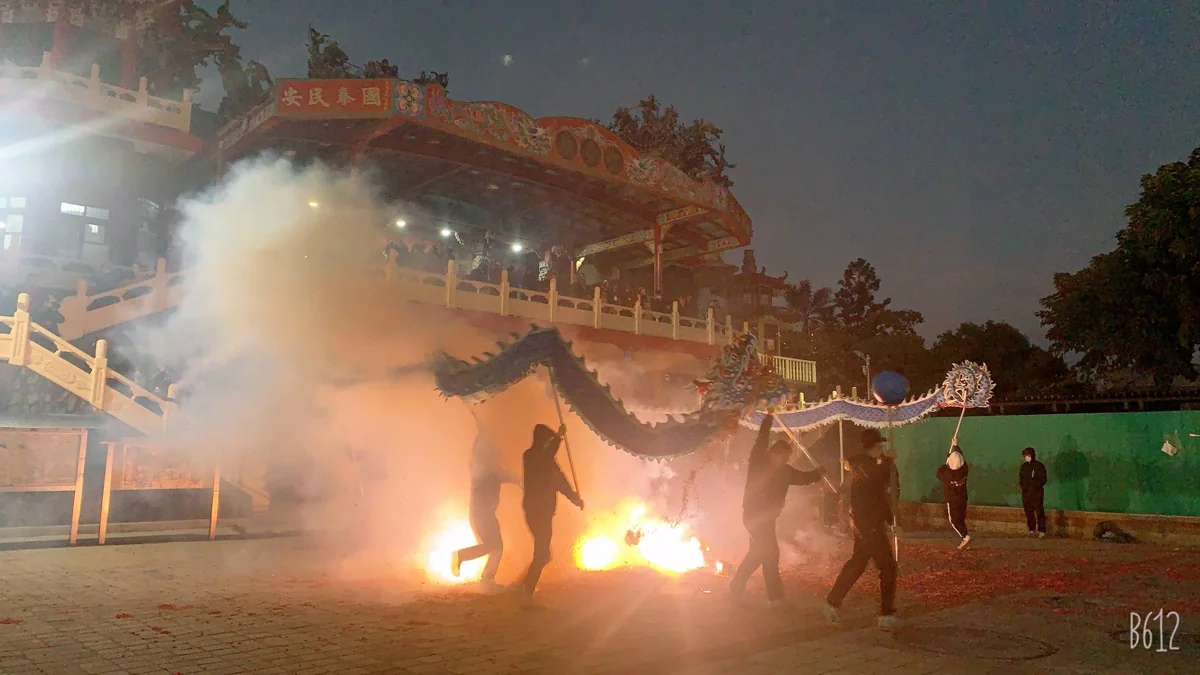
On dragon night, successive firecrackers create the smoke and flashes through which the teams move. The main 2026 event on 28 February took place at Jingguo Road Riverside Park, offering a different setting from the previous day’s parade. Spectators see a dragon appear and disappear through light and smoke; the team must maintain direction and rhythm within that environment.
On 5 March the cycle concluded at Miaoli’s Xishan Shengdi Temple with the dragon’s return to heaven. Burning here is an act of sending back, rather than merely disposing of a performance prop. Through making, welcoming, dancing and departure, the bamboo frame acquires a significance created by successive collective actions.
Look closer
Observe the frame, joints and paint while the dragon is still, then compare their movement during the dance.
Understand eye-opening and the final burning as the beginning and end of a cycle, with different purposes.
Visiting information
- Dates
- Around the first lunar month and Lantern Festival. In 2026: 25 February eye-opening, 27 February parade, 28 February dragon night and 5 March final return. The 2026 edition has ended.
- Venues
- Eye-opening: Yuqing Temple, 1 Potangxia, Neighbourhood 1, Yuqing Village, Miaoli City. The 2026 parade and dragon night used Jingguo Road Riverside Park; the final ritual was at Xishan Shengdi Temple.
- Stay
- Allow roughly two to three hours per session. Use designated public viewing areas, protect your hearing during firecrackers and leave room for the teams to work.
- Arrival and return
- Start from Miaoli TRA Station and transfer separately to Yuqing Temple or Jingguo Road Riverside Park; they are different venues. Allow for pickup and dispersing crowds before an onward train after evening events.