
Cultural story
Sanxia indigo: the work behind a blue cloth
A pattern begins before the cloth enters the vat—in plants, patient preparation and a town’s recovered knowledge.
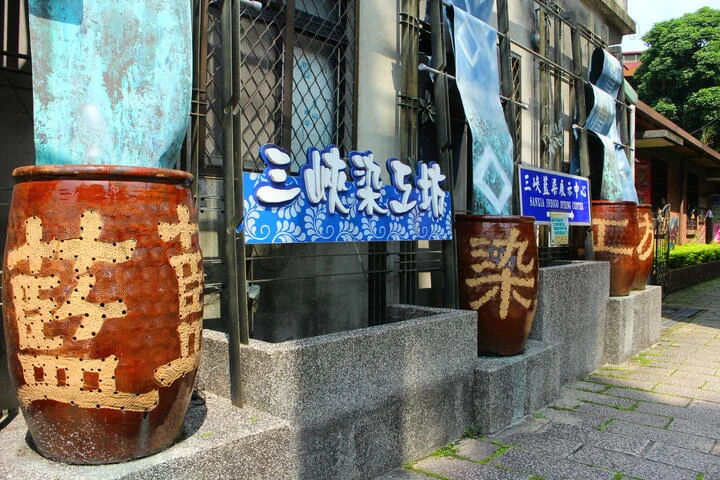
Look for reserved white areas, folds and layers of blue.
The story follows material preparation and the recovery of Sanxia’s dyeing knowledge.
The white parts tell a story too
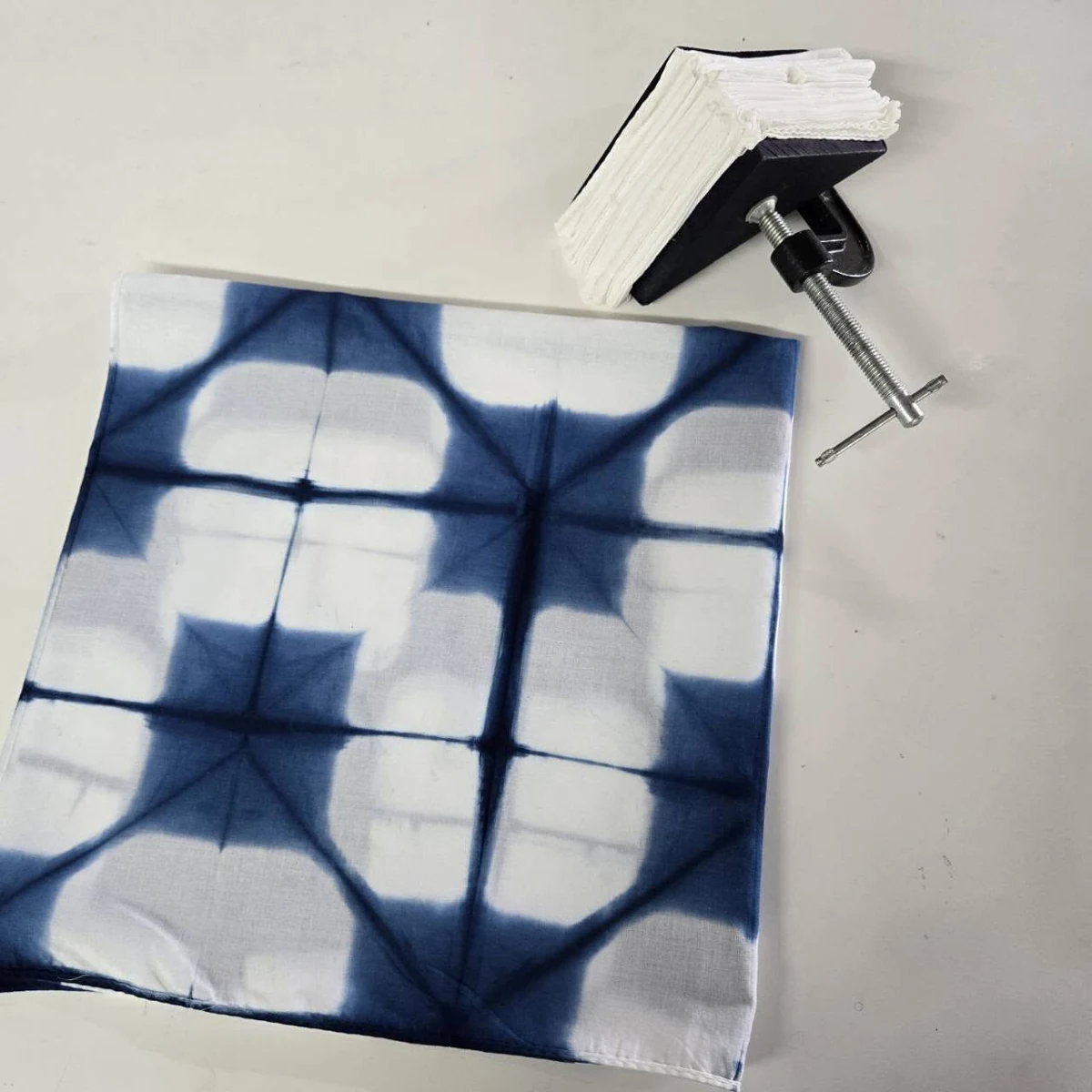
Unfold a dyed cloth and look at the pale lines between the blue. The places held tightly by ties or clamps resist the dye, leaving a record of how the fabric was folded. A finished pattern can be read backwards: each boundary points to a decision made while the cloth was still plain.
Dipping is only one stage. Once lifted, the cloth is opened to the air and the colour develops through oxidation; repeated treatment builds the shade. The number of dips and the handling depend on the workshop’s process. Watch the movement from a bundled object to an open surface: colour requires both immersion and exposure.
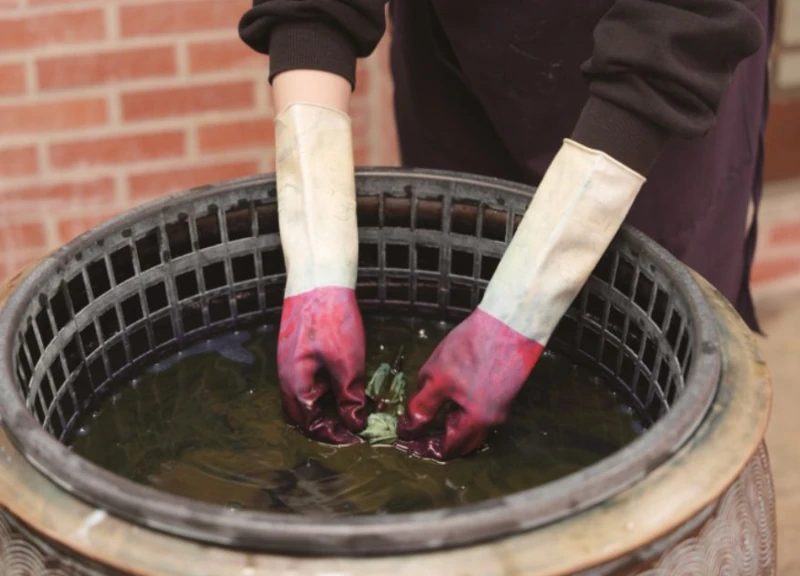
The close view of gloved hands makes the work easier to follow: the cloth is held within the vat, before it can be opened to the air. Seen alongside the finished patterns, this is another stage of the craft, rather than a before-and-after record of the same piece. The pattern begins with handling, long before the final reveal.
Before cloth, a landscape of work
Sanxia’s older dye industry joined places that a visitor now sees separately. Indigo from the hills travelled along carrying paths to river landings, trading firms and dye workshops. The blue on cloth connected growers, processors, carriers and dyers. Thinking about that journey changes the old street from a row of façades into part of a working network.
By the late 1990s, recovering the craft meant recovering basic knowledge. Textile artist Chen Jing-lin and researcher Ma Fen-mei found that plant recognition and practical dyeing skills had become difficult to locate. Chen’s account places cooperation with the local cultural association in 1999, with plants, pigment preparation, dyeing and teaching forming connected parts of the recovery.
The wider research behind natural dyeing also involved a different collaborator: Chen Ching-lin's wife and fellow artist Ma Yu-hsiu. A 2026 university account records their 1998 commission to test dye plants, eventually selecting 126 plants and making more than 1,500 samples over three years. She is not Ma Fen-mei, the researcher involved in the Sanxia revival described above. Distinguishing the names also distinguishes two connected tasks: recovering a local craft and building a reusable colour reference.
What a short workshop leaves out
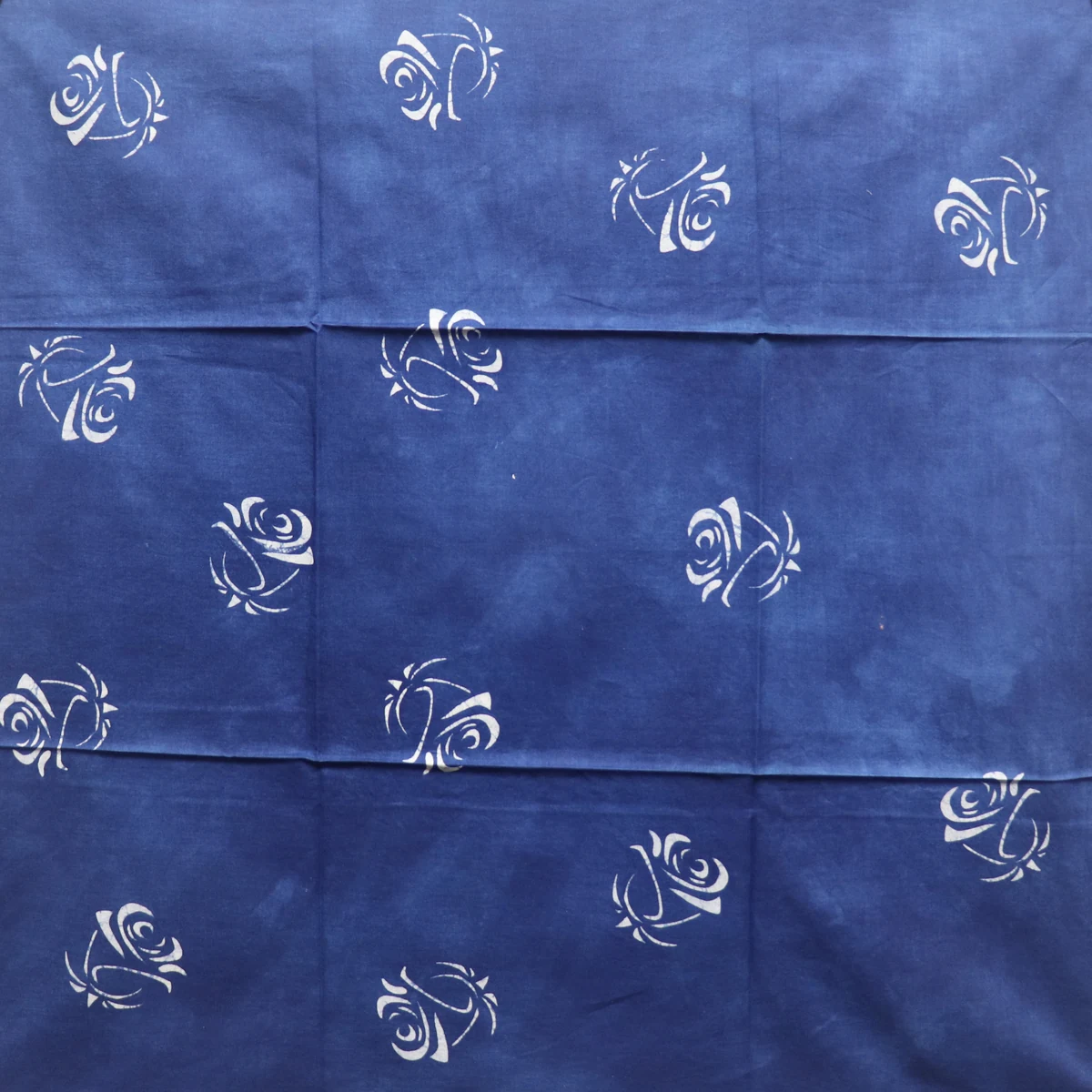
Visitor accounts often linger on the moment the ties come off. Before that reveal, somebody has prepared the material, explained a technique and kept the vat ready for use. Ask to see how the host connects plant, pigment and cloth. The person guiding a small exercise is also translating a much longer process into something a newcomer can understand.
Back on the street, compare the cloth you have seen with the story of its making. An old trade has returned through research, teaching and new uses for dyed fabric. A scarf or bag does more than repeat an old pattern: it gives the recovered knowledge another occasion to be practised, explained and carried away.
In the same account, Ma Yu-hsiu explains that design drawings helped them manage the patterns for an order of nearly six thousand scarves. A hand process could still use a drawing to communicate an intended result and control repeated making. That offers another question for a workshop: which part comes from a planned fold and which variation remains open to the material? These are their documented working methods, not a claim that Sanxia's workshop uses their patterns or takes orders of that size.
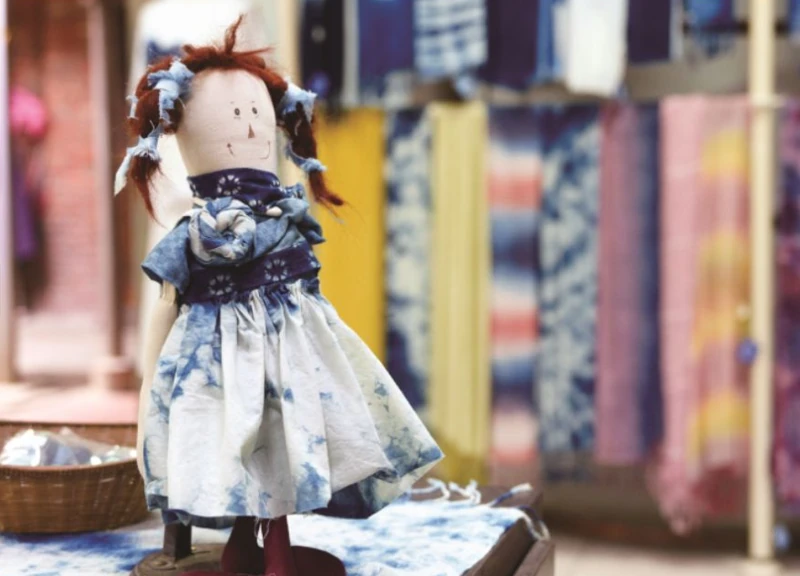
The displayed doll gives the dyed fabric another scale and use. Patterns become part of clothing rather than remaining a hanging sample. Keeping a technique in use involves more than preserving its method: it also means finding things that people still want to make and live with.
Look closer
Compare a tied area, a pale boundary and a dark patch; ask which folding or dipping decision produced each one.
Visiting information
- Place
- Sanxia Indigo Dyeing Workshop and Centre, 3, Lane 20, Zhongshan Road, Sanxia, New Taipei City, beside the historical museum.
- Visit
- The centre introduces local indigo work and offers dyeing experiences. Book a hands-on session with the workshop on 02-8671-3108, stating the date, group size and item you want to make.
- Getting there
- From Yingge railway station, walk to the Guoqing Street bus stop and take bus 702 towards Sanxia. Get off at Sanxia Elementary School and continue to Zhongshan Road and the workshop.
- Return
- Return to the stop for the Yingge-bound service and connect with the railway at Yingge. Leave time after the workshop for packing the cloth and walking back to the bus stop.