
Cultural story
A song for a father, cloth in the air: two paths into contemporary art
Suming Rupi’s Amis songwriting and Yuma Taru’s Atayal fibre work begin with particular relationships. Their work shows how language and technique can carry new expression without losing the people who made that knowledge possible.
Writing in Amis changed Suming’s relationship with his father.
Yuma Taru’s installation moves woven cloth away from the form of clothing.
Contemporary work can include recovery, experimentation and collaboration.
The language teacher was already in the family
Suming Rupi’s father worked in distant-water fishing and spent long periods away. When Suming began writing songs in Amis, finding the right words and rhymes was difficult. He then discovered how much his father knew from reading an Amis Bible at sea. Songwriting created a new reason for the two to talk, and Far Ocean, on the album AMIS, became a song dedicated to his father.
This history changes how a listener might understand the language in the recording. Amis is not an ornamental sound added to a pop arrangement; it is also a conversation across an absence in family life. Suming’s experiments with electronic music ask how the language can be heard in a present-day musical setting, opening another point of contact for younger listeners.
A music video gives distance a visible form
The maker’s account of the Far Ocean music video describes images associated with Suming’s father, the coast at Dulan and the passing of time. Repeated and mirrored imagery becomes a visual way to work with separation and memory. It adds a second set of decisions to the song: what to show, how to connect shots and how an image can answer a sound.
Reading the song and its video together makes collaboration audible and visible. A lyric can depend on family language knowledge, while a finished release also involves arrangement and image-making. The familiar description “Indigenous music” becomes more informative when it leads to these specific contributors and choices, rather than predicting one sound or one kind of performance.
When weaving becomes an installation
Yuma Taru’s Convolution of Life (I), made between 2012 and 2015 and collected by the Kaohsiung Museum of Fine Arts, takes another route. Ramie, wool, synthetic fibres and stainless-steel yarn form suspended woven elements. Cloth is no longer held by a wearer’s body: opening, curvature and distance between the elements become part of the work.
That experiment grew from sustained study of Atayal weaving and learning from her grandmother. Placed beside Suming’s story, it shows two different relationships between inherited knowledge and new work. Neither artist simply repeats a form handed down intact. One develops a language of songwriting through a father’s knowledge; the other tests what a recovered textile technique can say in a gallery.
The linear material has a production history before it enters an installation. In a 2020 workshop with Yuma’s studio, students followed fibre extraction, hand spinning and repeated dyeing, drying and washing. Here a line was not simply bought in its finished colour. Read beside the modern fibres already listed for Convolution of Life, this process reveals a choice available to the artist: how much of a work’s preparation comes from a cultivated plant and how much from another material system. It does not establish the exact source of every thread in that collection work.
A woven passage beside a river
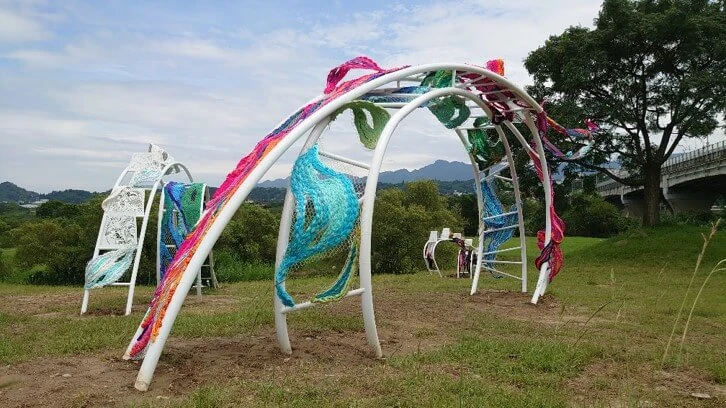
In Ways of Seeing a River, made with Lihang Workshop for the 2022 Taoyuan Land Art Festival, Yuma brought weaving outdoors. Metal frames and weather-resistant fibres formed arches of different sizes. The work drew on the Atayal name L’yung Gogan for the Dahan River and the relationships carried by a waterway and its tributaries.
The installation changed a viewer’s position: a person could move beside or beneath woven surfaces, rather than see them only from across a gallery. Colour, gaps and the surrounding landscape became part of the encounter. From the suspended cloth in Convolution of Life to this outdoor passage, weaving could shape both an object and the space around it.
A different work, Trap of Linear Time, appeared in the 2019 Kaohsiung International Container Arts Festival. Its published statement considers time through observed changes in the sun, moon, living things and surroundings, then questions the friction between that understanding and linear time. Thread becomes a way to pose a question about culture’s changes, rather than simply reproduce a motif. This is a historical artwork and statement, not a current outdoor attraction promised to visitors.
The statement describes culture as something formed, broken apart and remade. That offers a useful connection between the article’s music and weaving: neither a new arrangement nor a new spatial form can be understood by asking only whether it looks unchanged. The more revealing questions concern who made the decision, which knowledge they drew on, and what a new listener or viewer is now able to encounter.
Look closer
Listen for how language and arrangement work together, without reducing a song to its genre label.
For fibre art, look at the spaces and curves as well as the weave.
Visiting information
- Museum
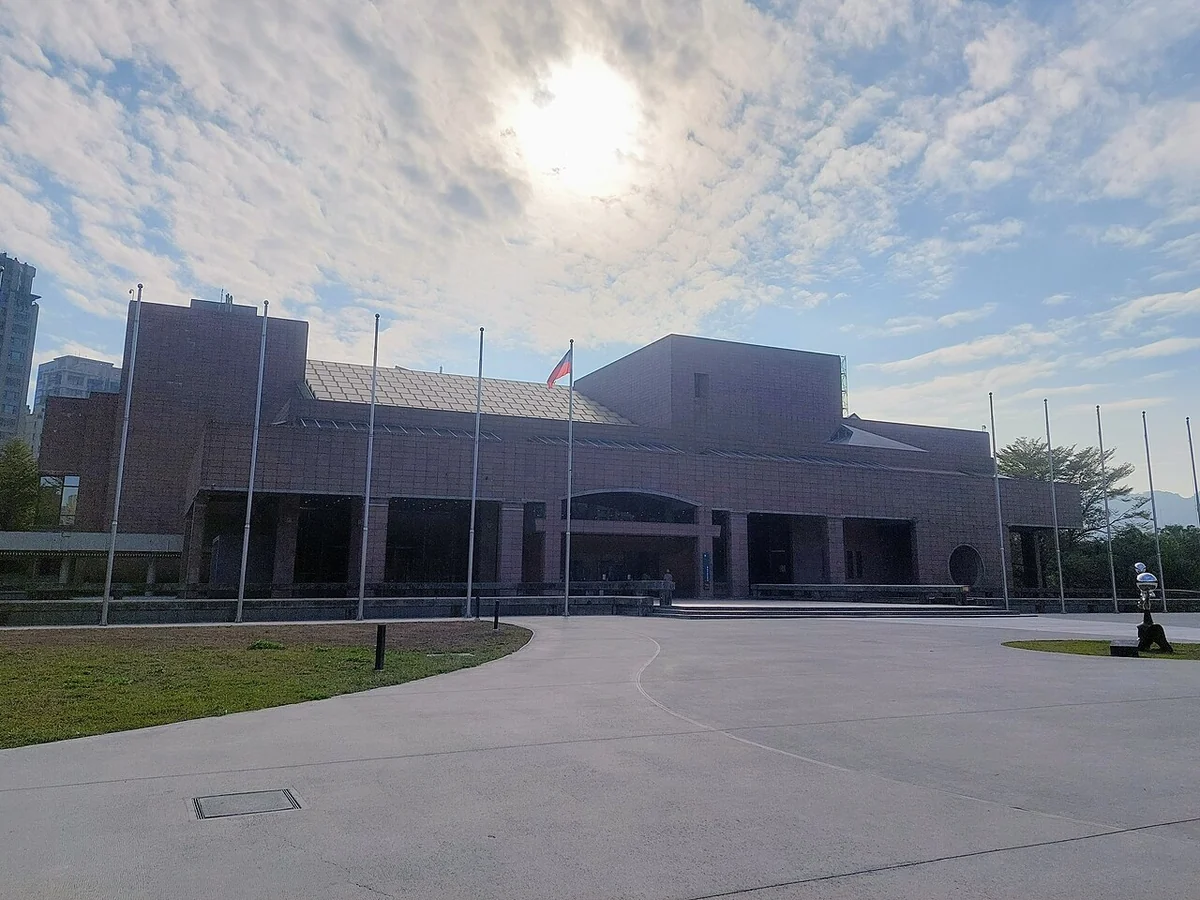
- Kaohsiung Museum of Fine Arts, No. 80, Meishuguan Road, Gushan District, Kaohsiung.
- Visit
- Use the museum’s current exhibitions to explore contemporary art. Convolution of Life (I) is a collection work; its display depends on the exhibition programme.
- Opening hours
- Tuesday–Sunday 09:30–17:30; ticket sales end at 17:00. Closed Mondays and Lunar New Year’s Eve.
- Admission
- General admission NT$90; concession NT$45.
- Travel and return
- Take the Kaohsiung light rail to C21 Museum of Fine Arts station, follow the park path to the museum and return to the same station.