
Traditional festival
Hengchun’s climbing festival: teamwork beyond the East Gate
An evening of remembrance becomes a test of cooperation, with the town’s gate and offering ground as its setting.
Hengchun: Higher, Together
90 seconds. English captions are part of the film. Optional Traditional Chinese subtitles are available in the player.
From a 2024 Hengchun festival record uploaded on 26 August 2024, not a current event notice. A contest overview precedes the earlier arrival, followed by the climb and gestures of thanks. A separate instrumental score replaces the original audio.
Read the complete five-chapter article → · 繁體中文
Complete English captions and Traditional Chinese translation
00:00:00,000 --> 00:00:06,000
Hengchun
Higher, together
恆春豎孤棚
把彼此托高
00:00:06,000 --> 00:00:12,000
At Ghost Month,
the town gathers.
農曆七月,
街鎮先聚在一起。
00:00:12,000 --> 00:00:17,000
The procession brings
colour into the street.
進場的隊伍,
讓街道添上色彩。
00:00:17,000 --> 00:00:23,000
A moment of prayer
before the contest.
比賽之前,
先有一段祈願。
00:00:23,000 --> 00:00:28,000
Then the night
opens above the crowd.
接著,煙火在
人群上方展開。
00:00:28,000 --> 00:00:34,000
Look beyond the height.
Notice the people below.
除了高度,
也看看下方的人。
00:00:34,000 --> 00:00:39,000
No one gets there
entirely alone.
沒有人能
完全獨自向上。
00:00:39,000 --> 00:00:45,000
Watch the hands.
Then follow the next move.
先看雙手,
再跟著下一個移動。
00:00:45,000 --> 00:00:51,000
A shoulder becomes
a place to stand.
隊友的肩膀,
成了向上的立足處。
00:00:51,000 --> 00:00:57,000
Each move depends
on someone else.
每一次移動,
都連著另一個人。
00:00:57,000 --> 00:01:03,000
Keep watching
until the platform is close.
繼續仰望,
直到棚頂逐漸靠近。
00:01:03,000 --> 00:01:09,000
At the top,
the climb meets the platform.
到了上方,
攀登的人終於接近平臺。
00:01:09,000 --> 00:01:15,000
The finishing gong
waits on the platform.
終點的鑼,
設在上方平臺。
00:01:15,000 --> 00:01:21,000
Returning includes
a gesture of thanks.
回到地面之前,
還有向孤柱致謝的動作。
00:01:21,000 --> 00:01:26,000
Hengchun, Pingtung
2024 festival record
屏東恆春
2024年祭典紀錄
00:01:26,000 --> 00:01:30,000
Taiwan, Layer by Layer
From story to place
島嶼年輪
從故事認識臺灣,再走進現場
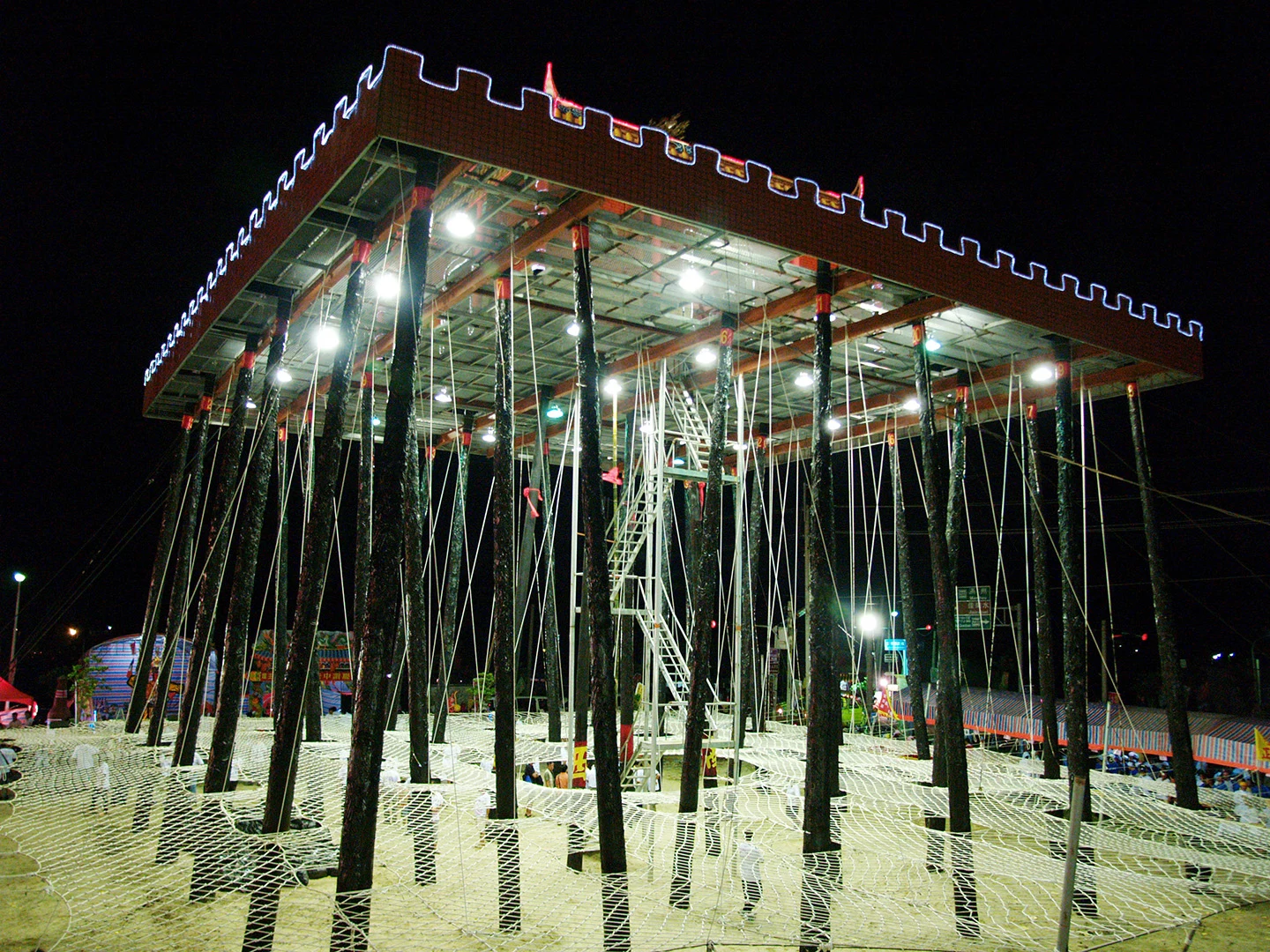
The fifteenth day of the seventh lunar month; 2026 event 27 August. The 2026 event has ended.
Outside the East Gate, follow how climbers support one another; plan an overnight stay or pickup for the evening event.
From sharing offerings to a public contest
On the fifteenth day of the seventh lunar month, Hengchun’s rites remember the dead through offerings and then bring people together around their distribution. The word gu refers to offerings for unattended spirits. Over time, the climbing of a raised structure developed into a regulated contest, while the temple rites continued to give the evening its purpose.
The event moved through several sites before settling outside the East Gate in 2003. Its earlier four-column form expanded to 36 columns in 2007, allowing more teams to participate. Place and scale have changed with the town’s needs. Standing beside the gate, the structure connects the present competition with the ordinary streets through which residents approach the rites.
The person above depends on those below
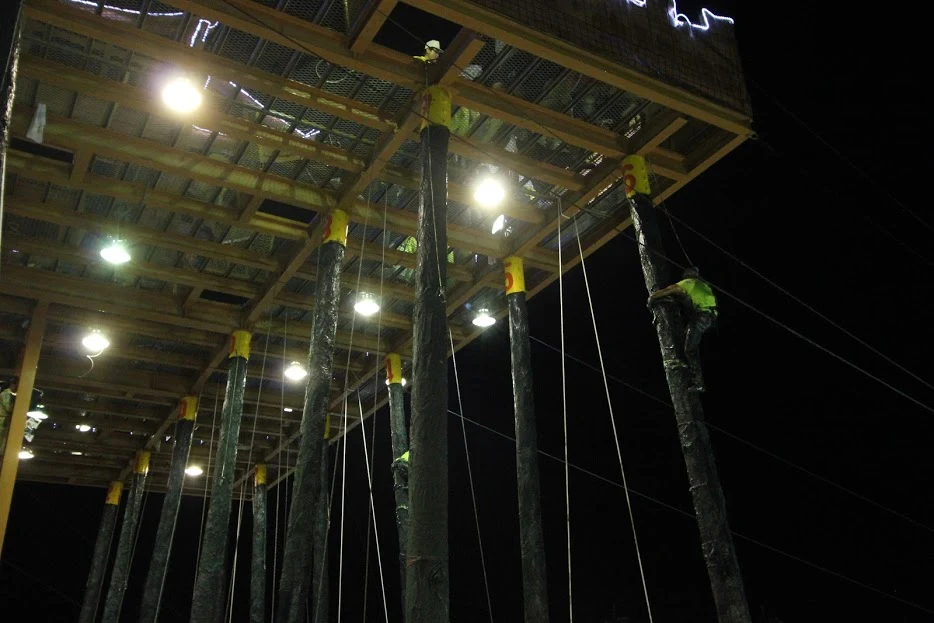
Climbing is a team undertaking. A competitor’s progress depends on support below, coordination around the column and the ability to change roles as the climb develops. The crowd may follow the person nearest the top, but the effort is distributed through the whole group. Rules and controlled access separate the competition from spectators and make cooperation visible as the central skill.
The 2026 contest took place on 27 August and drew 17 teams, including visitors from Yilan. With Toucheng’s own formal contest paused that year, a Toucheng team travelled south and won. Skills learned in one local tradition thus entered another town’s arena, linking the two places through practice rather than making their ceremonies identical.
Local researcher Chang Shun-hsing connected climbing skills with work outside the festival. In the paper presented at a 2012 conference, he described Dehe and Sigou competitors' construction work and the knot-tying experience of fishing communities around Nanwan and Daguang. His account helps explain why strength alone cannot describe the contest: handling a loop of cloth around a greasy pole also draws on learned skills. These were observations of particular teams, not a rule that determines later winners.
A town rebuilt above the offerings
Hengchun’s platform carries more than a finishing flag. The Interior Ministry’s account describes an upper structure representing the old town’s four gates, with offerings arranged around it. The real East Gate stands beside a temporary image of the fortified town. Reading the two together helps explain why this is a local ritual space as well as an athletic arena: the competitors climb towards a shape that refers back to the town hosting them.
Another part of the same account concerns the distribution below. To avoid damage and disputes over physical offerings, organisers moved to slips attached to sweets, which could be exchanged for goods. Collecting an offering and climbing the high structure are therefore separate activities. The small piece of paper preserves a link between worship and sharing, while changing how the object reaches the recipient; none of these historical arrangements replaces the rules announced for a particular edition.
The same record places a bamboo-framed, paper-covered Pudu Gong at the ritual's centre. Identified locally with the Great Lord who supervises offerings to wandering spirits, the figure has a small Guanyin above its head. Its eyes are covered before consecration and uncovered when it is installed. Reading the figure alongside the flags and offerings restores the religious sequence around the climb; the paper does not present its historical timetable as a future visitor programme.
The gate after the crowd leaves
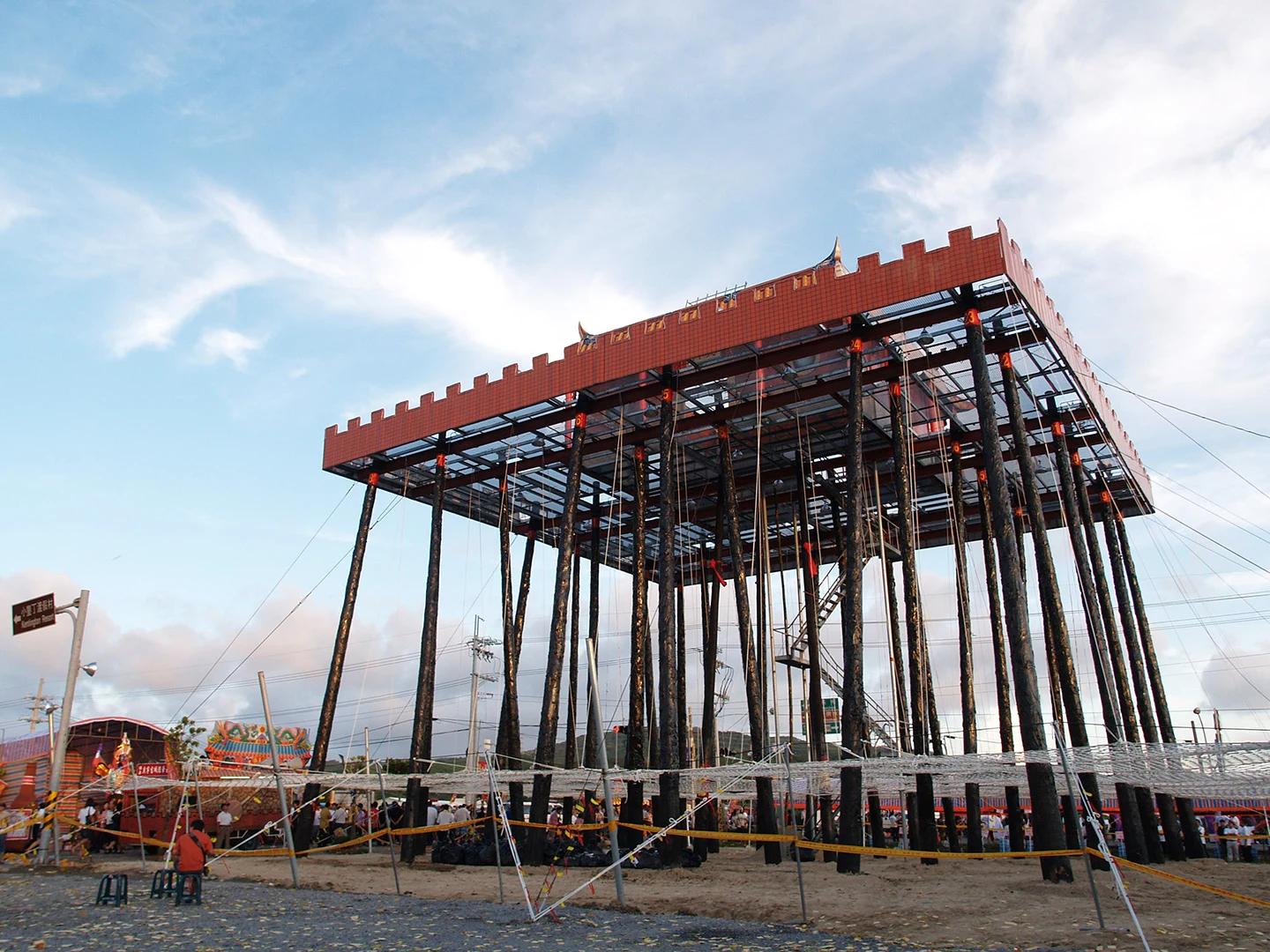
The East Gate gives the festival a recognisable setting even outside the event season. Its passage and adjoining wall belong to the town’s older defensive layout; the open area beyond it becomes a gathering place during Ghost Month. Visiting by day reveals the relationship between narrow streets, the gate and the larger space needed for a public event.
An evening visit needs a different return plan from a daytime walk. The bus station connects Hengchun with Fangliao and Zuoying, while the ceremony continues on its own rhythm. Planning accommodation or a pickup before joining the crowd leaves room to watch the work that matters: people learning when to push forward, when to hold and how to trust the person beside them.
Look closer at the places in the film
First the whole structure, then one climber
Begin with the long poles, platform, protective net and people on the ground in one view. The scale matters: movement high above depends on people below. The film opens with a contest overview before returning to the earlier arrival and preparation.
The existing article connects the festival ground beyond Hengchun’s East Gate with offerings, local memory and teamwork. This companion follows visible moments from a 2024 record. Team names, results and dates from other editions are kept separate.
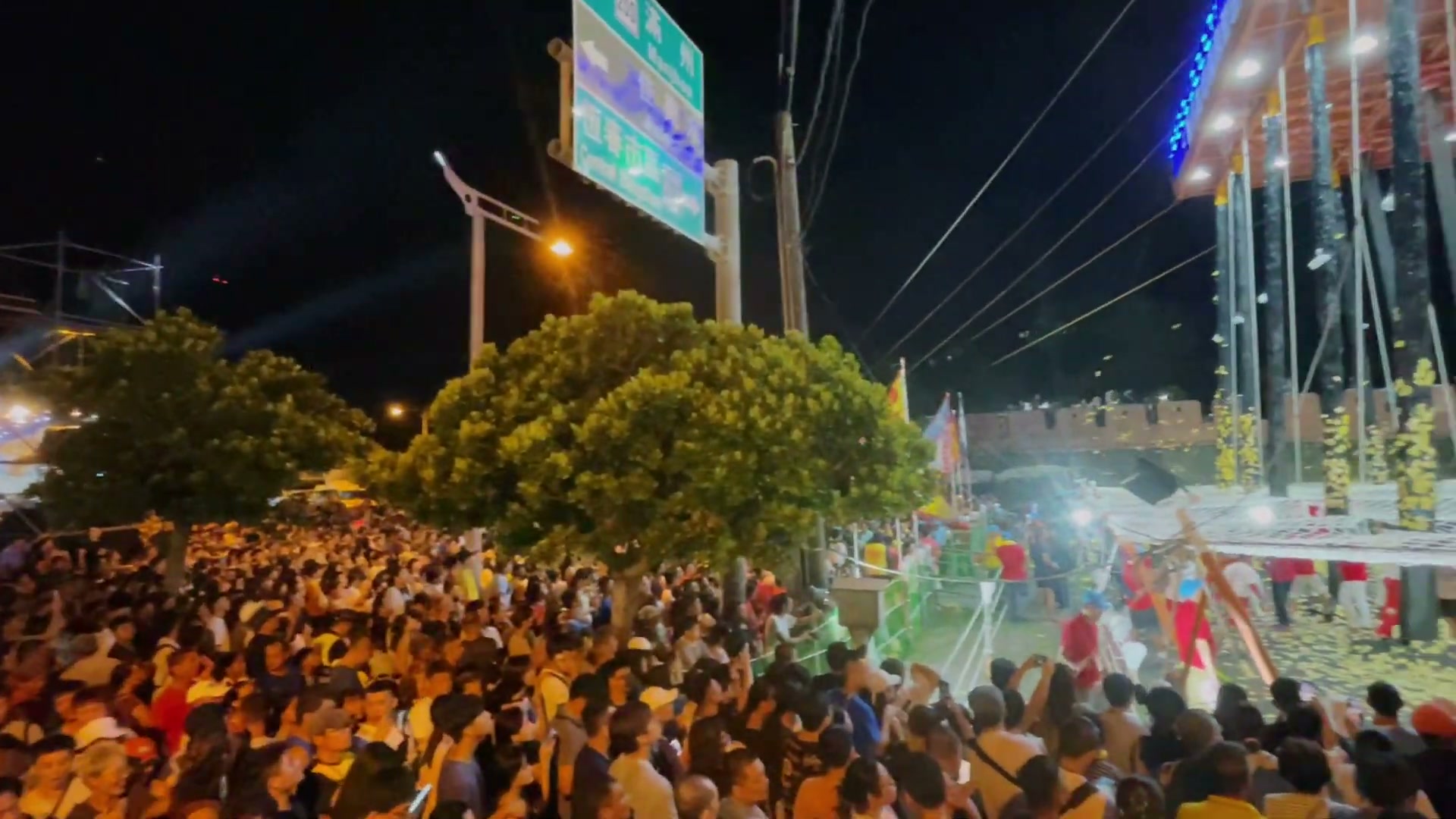
The town gathers before the climb
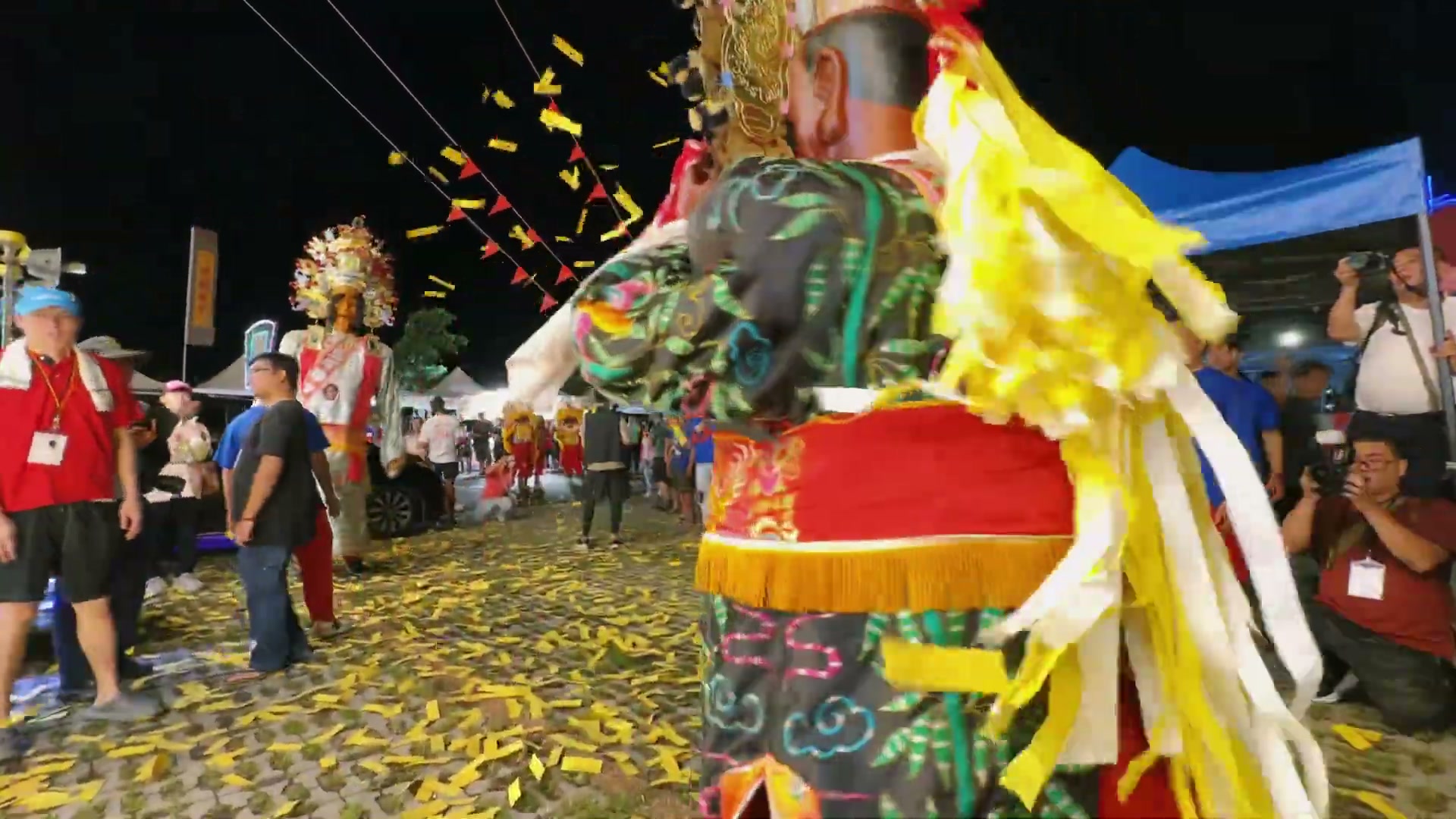
The evening begins with an arriving procession, costumed ceremonial performers and people standing together. Spectators wait while participants enter: a street becomes a shared event space. Notice the guides and the changing pace before following the teams towards the structure.
Hengchun’s climbing festival belongs to the remembrance and offering traditions of the seventh lunar month. Ministry of the Interior documentation connects the religious setting with the climb. The organiser’s arrangements determine the boundaries between competition, worship and viewing areas.
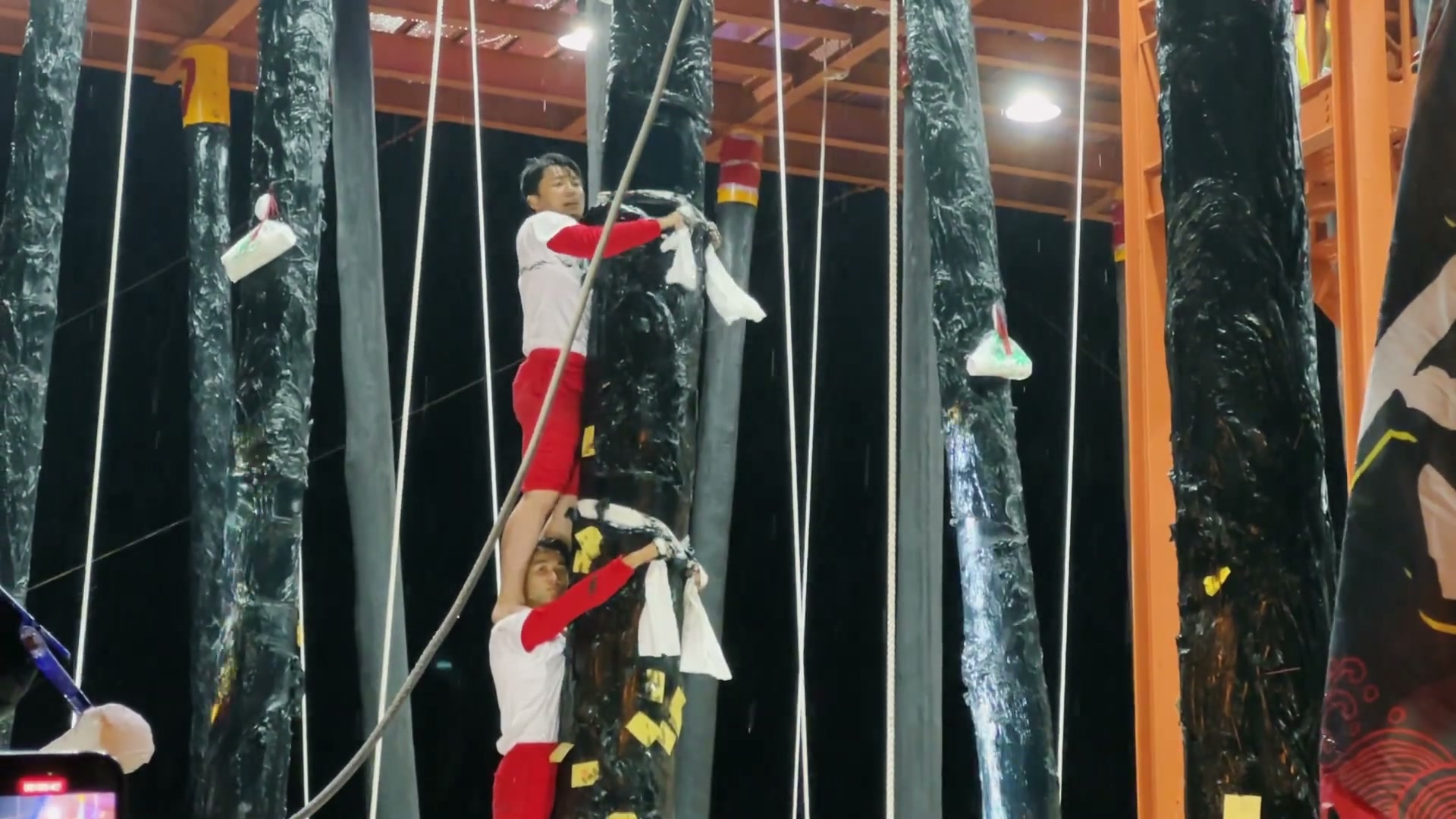
Shoulders and hands give height a human scale
The central idea becomes visible when teammates connect vertically. A climber entrusts their weight to another person; hands, shoulders and feet change position together. The edit keeps the original speed and uses distinct source windows rather than repeating one successful movement.
Cultural-memory records describe teammates standing on shoulders and working together. Local research preserved by the Lanyang Museum relates this cooperation to participants’ lived experience. That evidence helps explain what is seen; it does not establish the occupation of every 2024 competitor or serve as climbing instruction.
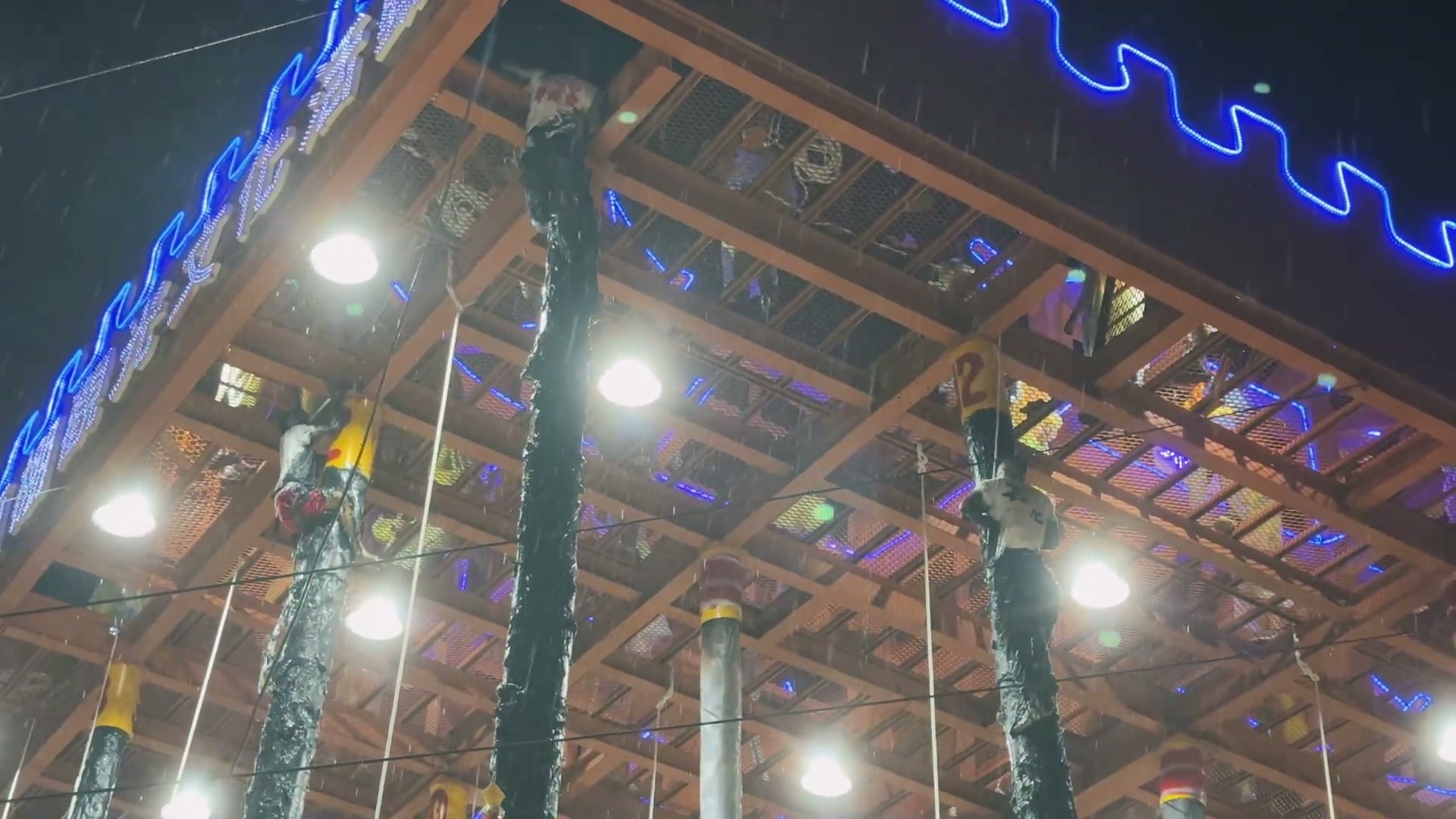
The platform is followed by a return to the crowd
Reaching the platform gives the contest a destination, but the film continues through the platform view, its finishing gong and gestures of thanks to the poles. People gather beneath the net again. Arrival, shared effort and return make the sequence readable as a visit.
The source record briefly changes to a close platform view before returning to ground level. The edit retains that archival change of viewpoint and adds a separate instrumental score. Original interviews, commentary and location music are muted; the soundtrack is not represented as sound recorded at the 2024 event.
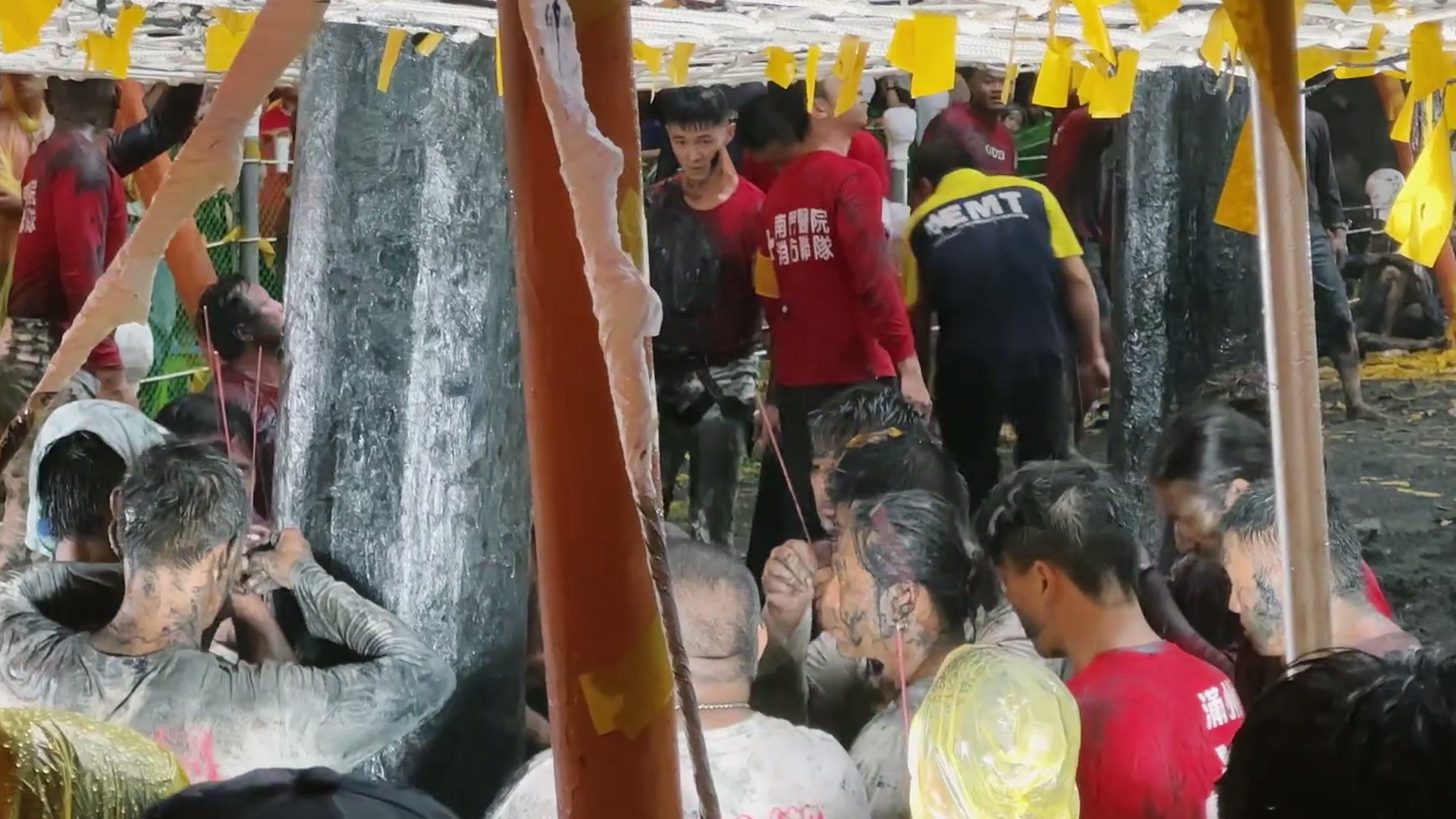
Take a memory of cooperation into Hengchun
A visit can leave more than an impression of height. Remember one supporting hand before walking back into Hengchun’s everyday streets. The festival offers a way to notice how people gather and take care of one another: a story becomes a way of reading a place.
For a future visit, consult the organiser’s current dates, spectator boundaries and traffic controls before choosing a meeting point and return journey. Neither this 2024 footage nor the ended 2026 edition is a timetable for the next festival. An ordinary visit to the old town does not include entry to the competition area. All five photographs are distinct frames from this same 2024 moving-image record.
Film, article and image sources
From a 2024 Hengchun festival record uploaded on 26 August 2024, not a current event notice. A contest overview precedes the earlier arrival, followed by the climb and gestures of thanks. A separate instrumental score replaces the original audio.
1. 橙色的品源 X 記錄在地生活 · 2024
2. 橙色的品源 X 記錄在地生活 · 2024
3. 橙色的品源 X 記錄在地生活 · 2024
4. 橙色的品源 X 記錄在地生活 · 2024
5. 橙色的品源 X 記錄在地生活 · 2024
Music: 跨海的一段路 (AI-generated instrumental).
Look closer
Compare the gate passage with the open festival ground, then follow how team members share the climb.
Visiting information
- Date rule
- The fifteenth day of the seventh lunar month; 2026 event 27 August. The listed 2026 events have ended.
- Place
- Climbing festival grounds outside Hengchun East Gate, Pingtung.
- Transport
- Take 9189 Kenting Express from THSR Zuoying or Fangliao to Hengchun Bus Station, then walk or take a taxi to the East Gate.
- Return and viewing
- Book an overnight stay or pickup for the late event; remain behind the spectator boundary.