
Annual festival
Hanxi Mazu: villages, hospitality and a wooden temple
The annual journey into surrounding villages and the carved structure of Lecheng Temple tell a connected story of care.
Hanxi Mazu: From City Streets to Village Roads
90 seconds. English captions are part of the film. Optional Traditional Chinese subtitles are available in the player.
Re-edited from actual moving coverage of the 2026 pilgrimage, not a live report. That edition has ended; confirm future dates with Lecheng Temple. Ordinary worship is not presented as a filmed return ceremony.
Read the complete five-chapter article → · 繁體中文
Complete English captions and Traditional Chinese translation
00:00:00,000 --> 00:00:04,200
Hanxi Mazu, Taichung.
The 2026 pilgrimage.
旱溪媽祖,台中。
2026年的遶境旅程。
00:00:04,200 --> 00:00:08,300
Before the journey,
horns and drums gather the crowd.
出發之前,
號角與鼓聲,讓人們聚在一起。
00:00:08,300 --> 00:00:14,200
Lions and dragons
fill the temple forecourt.
獅陣與舞龍,
走進廟埕。
00:00:14,200 --> 00:00:19,300
From Lecheng Temple,
the procession enters the city.
從樂成宮出發,
遶境隊伍走進城市。
00:00:19,300 --> 00:00:24,200
The street becomes
a shared ceremonial space.
街道,
成為共同參與儀式的空間。
00:00:24,200 --> 00:00:32,600
Flags move past the rice fields.
The journey reaches beyond the city.
旗隊走過稻田旁。
旅程,也越過城市的邊緣。
00:00:32,600 --> 00:00:41,300
Along the village roads,
bearers carry the palanquin together.
走在庄頭的道路上,
轎班共同抬起神轎。
00:00:41,300 --> 00:00:45,200
At each pause,
a moment of exchange.
每一次停下腳步,
都有一刻交流。
00:00:45,200 --> 00:00:51,700
A welcome is made
with music and careful gestures.
音樂與慎重的動作,
接住一份迎接。
00:00:51,700 --> 00:01:00,300
Another street. Another altar.
The village makes room.
另一條街,另一座香案。
庄頭,為隊伍留出空間。
00:01:00,300 --> 00:01:05,700
The procession links
temples and everyday streets.
遶境,
把宮廟與日常街道連在一起。
00:01:05,700 --> 00:01:11,200
Many hands.
One moving journey.
許多雙手,
共同走完一段旅程。
00:01:11,200 --> 00:01:14,000
Let the procession pass.
Keep its route clear.
讓隊伍先通過,
也為行進動線留出空間。
00:01:14,000 --> 00:01:21,600
Beyond the festival,
Lecheng Temple remains a place to visit.
節慶之外,
樂成宮仍是一個可以走近的地方。
00:01:21,600 --> 00:01:25,200
For the next edition,
check the temple’s announcement.
下一屆活動,
請依樂成宮最新公告安排。
00:01:25,200 --> 00:01:30,000
Taiwan, Layer by Layer.
Keep exploring.
島嶼年輪。
繼續,走近台灣。
The third lunar month; in 2026, 17 April–8 May. The 2026 edition has ended.
At Lecheng Temple, follow how the procession links eighteen settlements with their shared place of worship.
Mazu visits the villages
Lecheng Temple stands in eastern Taichung, but the Hanxi Mazu pilgrimage reaches beyond its own neighbourhood. The saying that Hanxi Mazu protects the outer villages expresses this outward relationship. In 2026, the procession began on 17 April, the first day of the third lunar month, and continued for 22 days before returning on 8 May. Each village reception is part of a longer sequence rather than an isolated street performance.
A local origin story links the pilgrimage to rice pests and a village inviting divine help during the Daoguang era. Its lasting subject is the vulnerability of farming communities and their need for mutual support. Preparations involve receiving the deity, arranging ritual space and welcoming visitors. The temple records an old saying about even pawning bedding to feed guests, a vivid measure of how seriously hospitality was taken.
A timber structure survives through repair
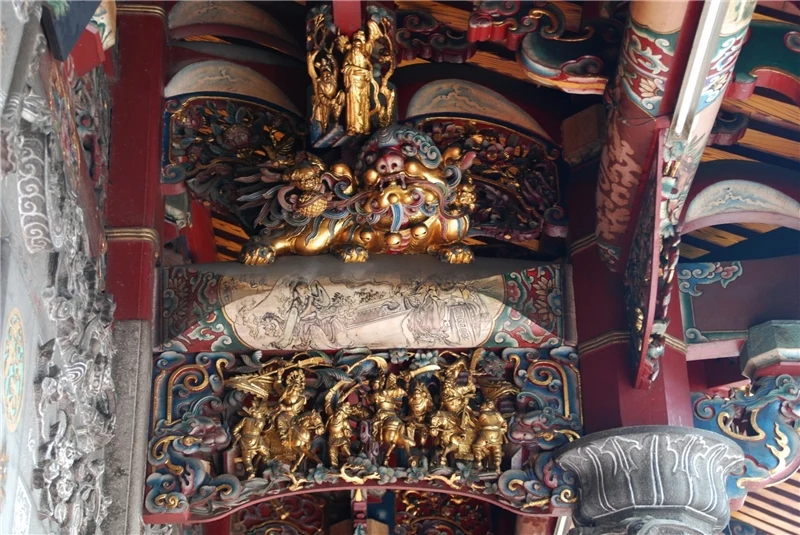
Returning to the temple shifts attention from the route to the hands that built its setting. Master carpenter Chen Yingbin is associated with Lecheng Temple’s major rebuilding in the 1920s. Beneath the roof, bracket sets and carved figures turn the joining of beams into a dense visual composition. The main hall was completed in 1924, giving the present worship space a material history alongside its religious one.
The 1999 earthquake damaged timber joints and roof components. A restoration project ran from February 2003 to March 2004. The building therefore carries more than the achievement of its original makers: it also carries decisions about supporting, repairing and continuing to use it. Looking closely at the woodwork brings this work of maintenance into the same story as the annual procession.
The flag is also a seven-person ensemble
Lecheng Temple’s account explains the saying that Hanxi Mazu travels beneath great flags through the caiqigu ensembles. Each had seven members: a flag bearer, a drum carrier, a drummer and four players of metal percussion. Different drum patterns distinguished one group from another. The tall flags therefore marked both an organisation and a sound: beside a banner, look for who carries the drum and who plays it, rather than assuming every member has the same task.
The same account preserves a practical change in the itinerary. Kali, Shiluotan and Xixinba once rotated their procession days; feasts and troupes sometimes went to the wrong village. The three eventually agreed to hold their circuits on the seventeenth day together. This is a remembered change in local arrangements, not a current route notice. It shows how a long tradition also contains corrections made by people who needed guests, musicians and hosts to meet in the right place.
The temple’s collection includes a palanquin bearing a 1962 date. Its description explains that bamboo carrying poles pass through iron rings on both sides. Openwork scrolls, cloud designs and round coin-patterned side windows combine a decorated shrine with a structure intended to move. This old object helps separate the work of holding a deity from the work of carrying the whole shrine; it should not be identified as the palanquin used in a current procession without further evidence.
An entrance shared by worshippers and visitors
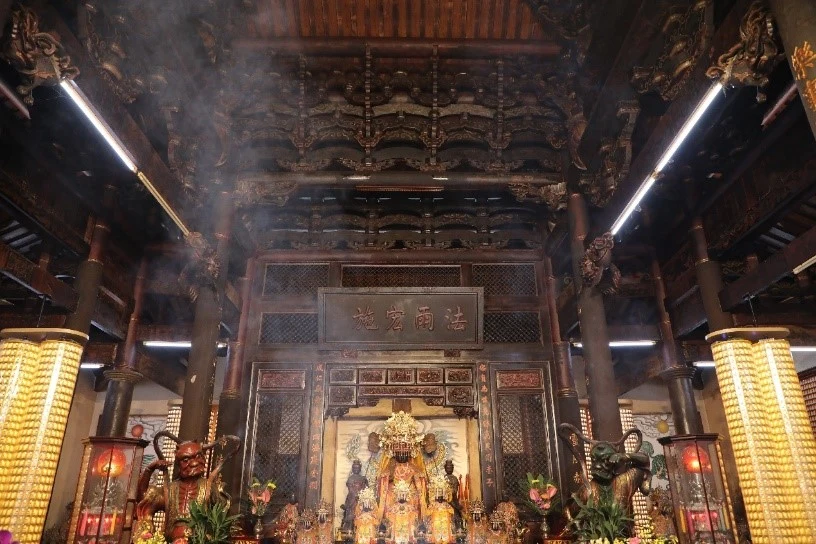
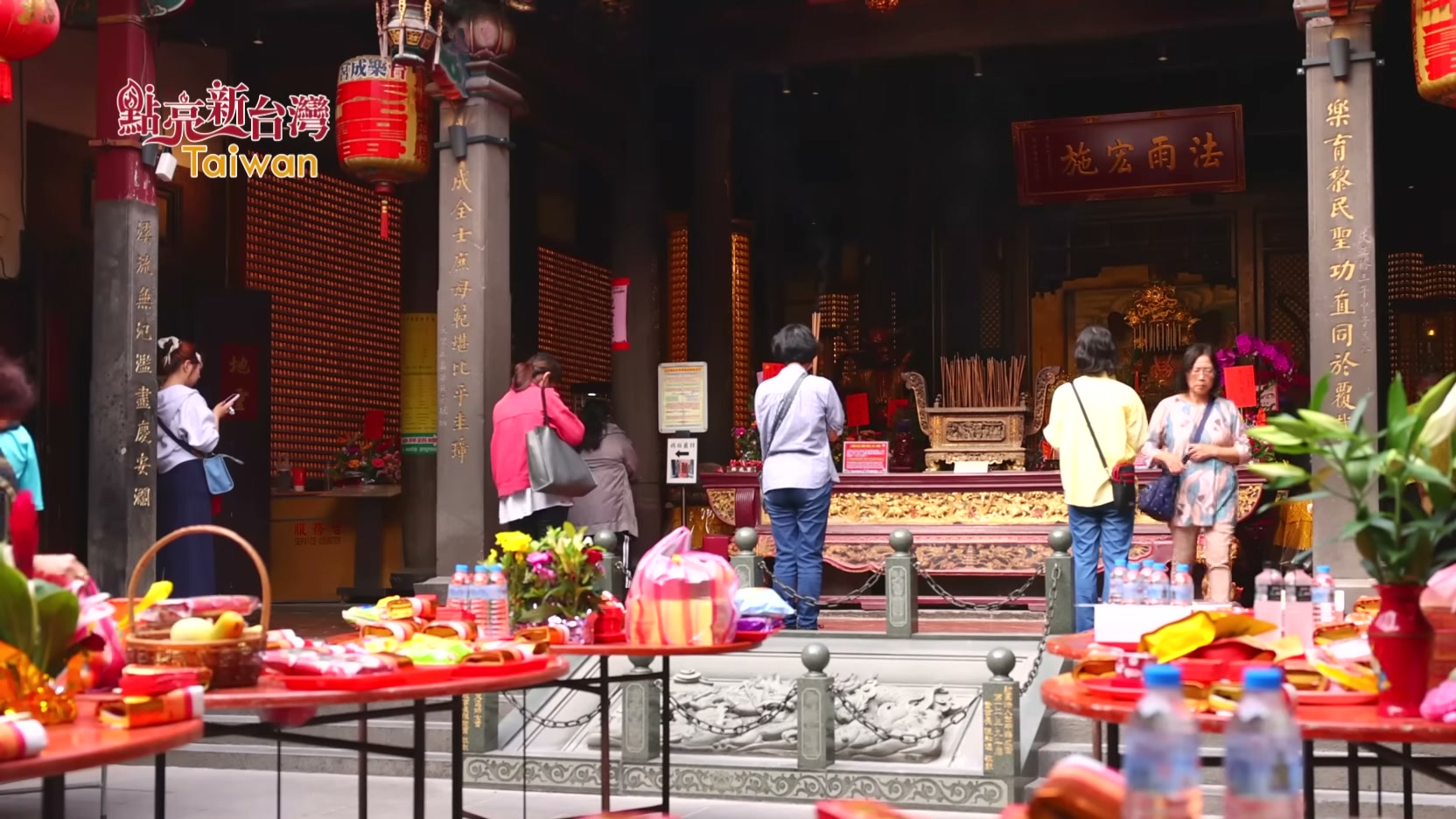
The front hall frames the passage from street to temple. Stone lions stand beside the entrance while the roof and carved brackets draw attention upward. Visitors arrive for ordinary prayers as well as festival occasions, so an architectural visit takes place within an active religious space. Standing to one side allows both the craft and the movement of worshippers to remain visible.
A regular visit can focus on the entrance, main hall and surrounding streets before returning by bus. During the third lunar month, the itinerary gives another way to understand the same temple: as a point connected to many village hosts. The building and the journey support one another, holding together everyday prayer, inherited skills and the work of receiving people.
Another record describes a Japanese-period wooden lot cylinder containing 101 bamboo lots with numbering and cyclical-date characters. The cylinder carries the temple’s name above, then a floral panel and the donor’s address and name below. Alongside the large procession, this small object records individual questions and a donor’s participation. The museum’s announcement gives Wednesday–Sunday visiting sessions, separate from the temple’s longer worship hours; confirm reception before expecting to examine a particular collection object.
Look closer at the places in the film
Begin with the whole forecourt
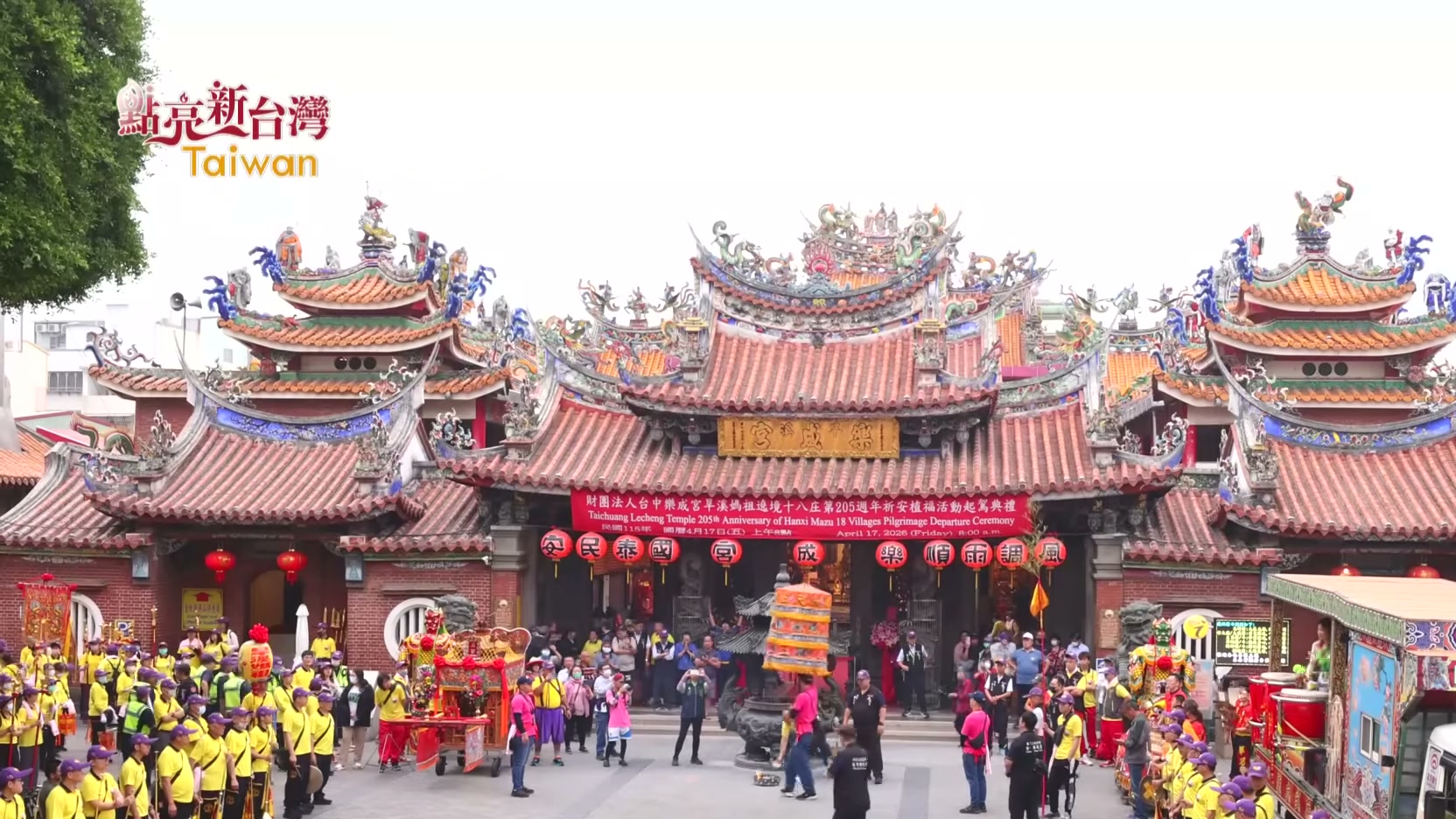
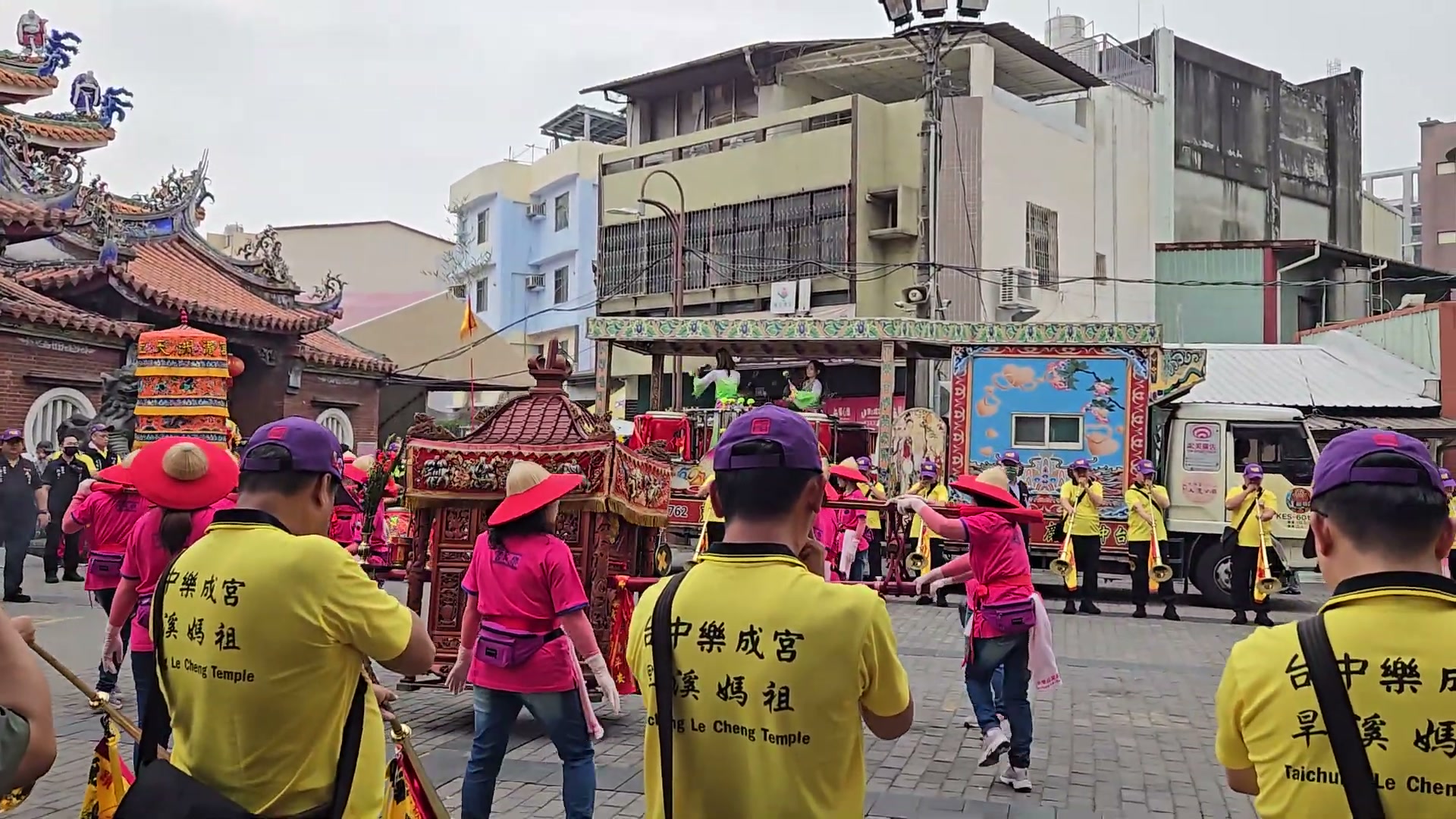
In front of Lecheng Temple, horns rise, drums sound and lion dancers move across the forecourt. A wider view holds the temple, the procession and the people watching within one setting. Hanxi Mazu’s journey involves more than a palanquin. Gathering, taking position and keeping a passage open require many people to work together. The film begins with that whole space before moving closer to the actions.
This 90-second film uses actual moving coverage published in 2026. Moving photographs are not presented as live scenes. Interviews and close views of officials are left out of the procession narrative. The instrumental music is added in editing; it is not the live sound of the ceremonial musicians. Notice how the space is shared before reading the festival simply as a spectacle.
From city streets to the rice fields
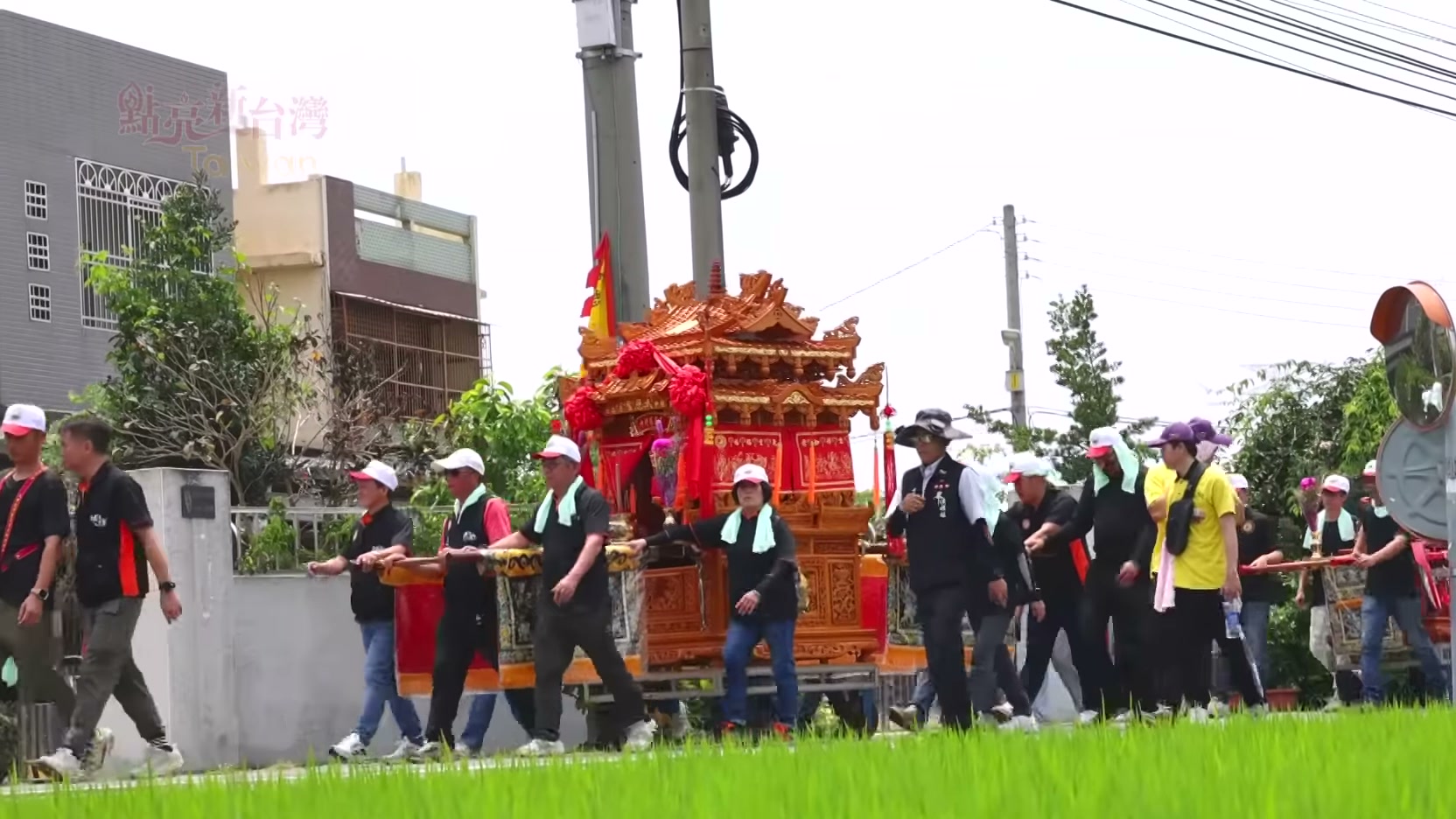
The procession leaves the junction outside the temple and later appears beside rice fields. Flags move beyond the field edge while bearers carry the palanquin along a village road. Connecting these scales shows a journey that reaches beyond the city neighbourhood to meet the villages along its route. The fields are part of the lived setting through which the procession actually passes.
Lecheng Temple’s account of the tradition’s origins connects it with a story of crop pests and villagers inviting Mazu for protection. This belongs to local religious tradition and memory; the film does not establish it as a verified agricultural event. What the moving images do show is concrete: flags advancing, bearers adjusting their steps and other road users continuing alongside them.
A welcome at each pause
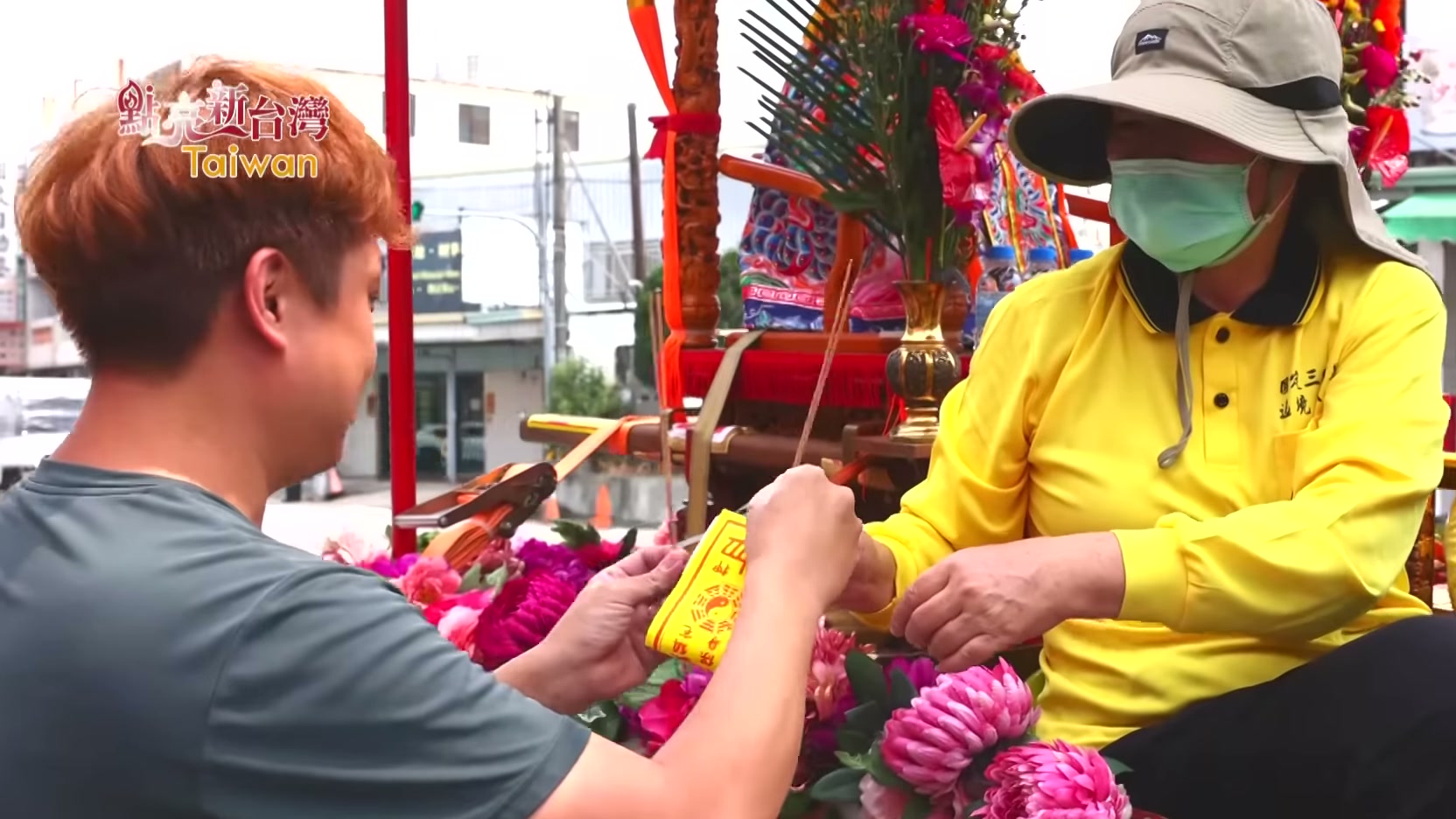
The palanquin pauses. People approach, exchange an object and offer a careful bow. Later, the procession reaches another street and another altar. A welcome is not an interchangeable performance. Someone prepares the objects, someone makes room for worship and others keep space open for the next movement. The relationship between stopping and walking reveals how a long journey is sustained by repeated acts of hospitality.
The film retains broad views of altars and temple interiors along the route, with one brief detail of the deities within a ritual stop. It does not label every interior as Lecheng Temple. When watching or taking photographs, follow the people managing the space and allow worship and carrying movements to finish before choosing a closer position.
Many hands keep the journey moving
The poles rest across shoulders. Bearers adjust their steps together, and the palanquin keeps moving. Later in the film, a broad view across the forecourt shows the cooperation from behind the people watching. Another brief shot lets an embroidered palanquin cover pass the camera. Look beyond decoration to the shared work of lifting, caring for and carrying the palanquins towards the next stop.
Watching requires room for turns, equipment and the people moving alongside the procession. Do not cross an active group for a close photograph or treat every pause as an invitation to join a ritual. A step back can reveal more: the coordination of the bearers, the scale of the street and the way a village receives the journey.
A temple visit beyond the festival
The 2026 Hanxi Mazu pilgrimage departed on 17 April and returned on 8 May, a 22-day period. That edition had ended when this local draft was prepared on 13 November 2026. The film follows selected scenes preserved in published coverage, not all 22 days. Its final images of ordinary worship are not presented as a return ceremony. Confirm future dates and routes with Lecheng Temple’s announcement for that edition.
Lecheng Temple can also be visited outside the festival at 48 Hanxi Street, East District, Taichung. Begin somewhere that leaves the entrance clear, notice how the forecourt is used and follow the guidance on site. A visit for a particular performance or departure requires a current timetable and transport plan. For a closer understanding of the place, the temple and its surrounding streets offer another way in.
Film, article and image sources
Re-edited from actual moving coverage of the 2026 pilgrimage, not a live report. That edition has ended; confirm future dates with Lecheng Temple. Ordinary worship is not presented as a filmed return ceremony.
- 年代《點亮新臺灣》:旱溪媽祖205年無形文化資產傳承(2026-05-23)
- 陳力元:2026台中樂成宮 旱溪媽祖遶境3(2026年4月公開)
- 樂成宮:遶境十八庄與地方記憶
- 內政部臺灣宗教文化地圖:臺中樂成宮與旱溪媽祖遶境十八庄
- 臺中市政府:2026年4月17日起駕公告
- 臺中市政府:2026年5月8日回鑾新聞
1. Hanxi Mazu pilgrimage moving footage,2026 · 2026
2. Hanxi Mazu pilgrimage moving footage,2026 · 2026
3. Hanxi Mazu pilgrimage moving footage,2026 · 2026
4. Hanxi Mazu pilgrimage moving footage,2026 · 2026
5. Hanxi Mazu pilgrimage moving footage,2026 · 2026
Music: 跨海的一段路 (AI-generated instrumental).
Look closer
Look at the carved figures beneath the roof, then follow how the bracket sets meet the beams.
Visiting information
- Season
- The third lunar month; in 2026, 17 April–8 May. The 2026 edition has ended.
- Place and hours
- Lecheng Temple, 48 Hanxi Street, East District, Taichung; 06:30–22:00.
- Transport
- Bus 56 links Xinwuri Station with Lecheng Temple; bus 61 passes Taichung Railway Station and stops at Lecheng Temple (Jinhua Road). Use the return-direction stop for the journey back.
- During worship
- Keep the entrance and ritual route clear; follow on-site staff when the procession arrives.