
Cultural story
Glass beads: an inherited necklace and a present-day flame
Museum necklaces and the glass rods of a Pingtung workshop belong to connected but different histories. Reading them together reveals inheritance, identity and the work of making a living.
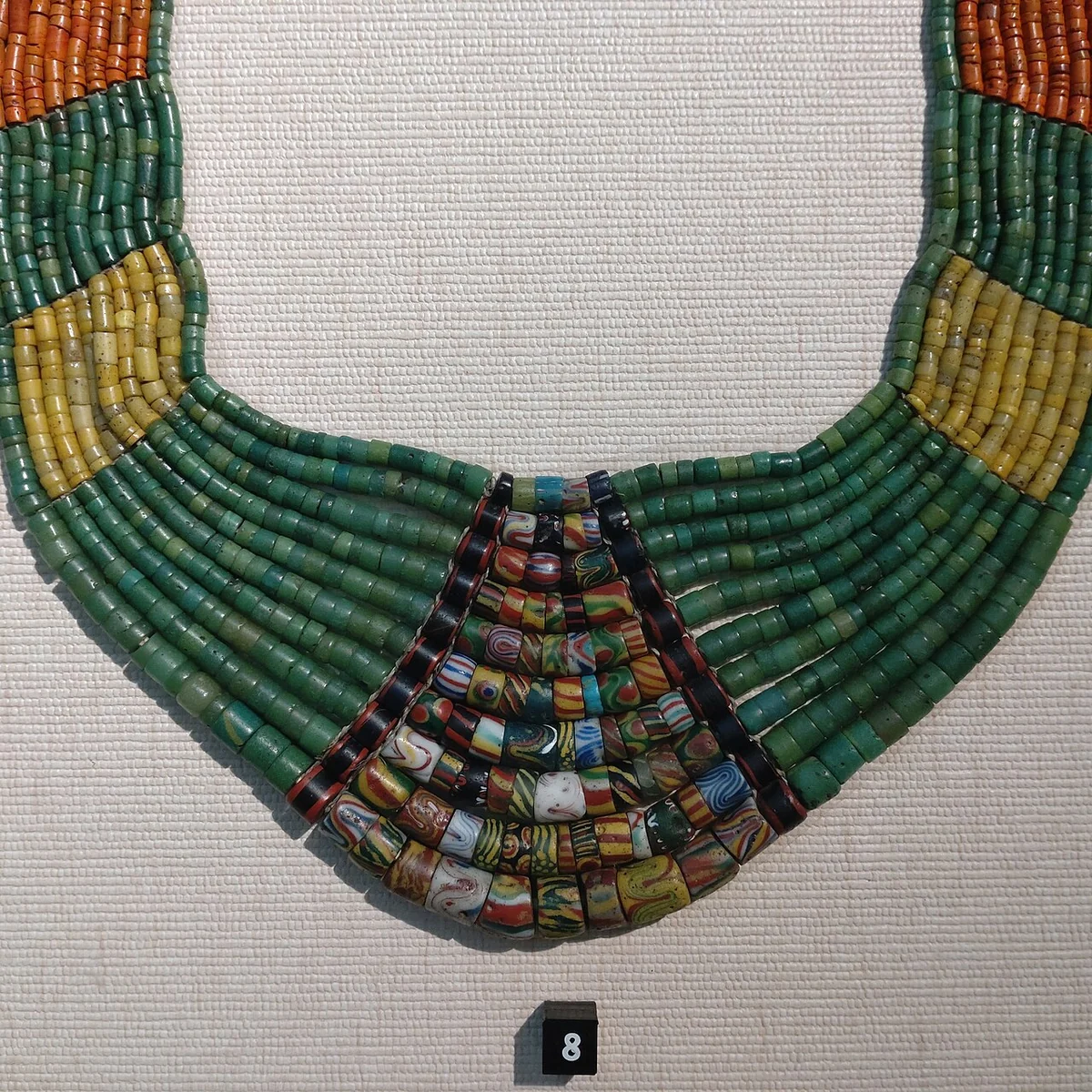
Paiwan and Rukai bead traditions should be read through their own objects and communities.
A bead’s meaning depends on its history, arrangement and relationships.
Contemporary workshops connect glass making, teaching and local employment.
An inherited necklace carries relationships
In Paiwan collections, glass beads appear as valued objects connected with family history, marriage and social relationships. The patterns and names recorded by museums are not a single dictionary that works identically in every community. A bead’s position in a necklace, the story of its transfer and the people entitled to wear it can matter as much as the colour visible in a photograph.
The older beads also open a history of movement. Their origins have been discussed through several trade connections, including India, Europe and Japan; a single simple origin cannot explain every object. Instead of treating all beads as one timeless local product, a collection invites questions about how imported materials became part of a community’s own system of memory and value.
The Kialreba: Return to Wutai exhibition opened at the National Taiwan Museum’s main building in Taipei on 26 June 2023 and ran until 10 March 2024. Wutai’s Rukai museum and local communities were partners in selecting and lending objects. Its discussion of four-row necklaces combining glass beads and shell, with especially valued beads towards the centre, belongs to that Rukai context. It does not describe the Paiwan necklace used as this article’s main photograph.
This does not make a Rukai necklace interchangeable with a Paiwan example. Museum labels, community names and the kind of occasion recorded with an object help retain those distinctions. The useful comparison lies in how each object works within clothing and relationships, rather than gathering every bead tradition under one general image of Indigenous decoration.
Who interprets an object matters as well as who stores it. For Kialreba, community members entered the museum stores to select and explain pieces, and loans came from villages including Shenshan, Wutai, Jiamu and Ali. The exhibition brought those voices into the description of the objects, rather than leaving a necklace to stand only for a museum’s category. Its dates are now historical; that collaboration remains a way to ask whose knowledge a label makes visible.
Glass rods become a patterned surface
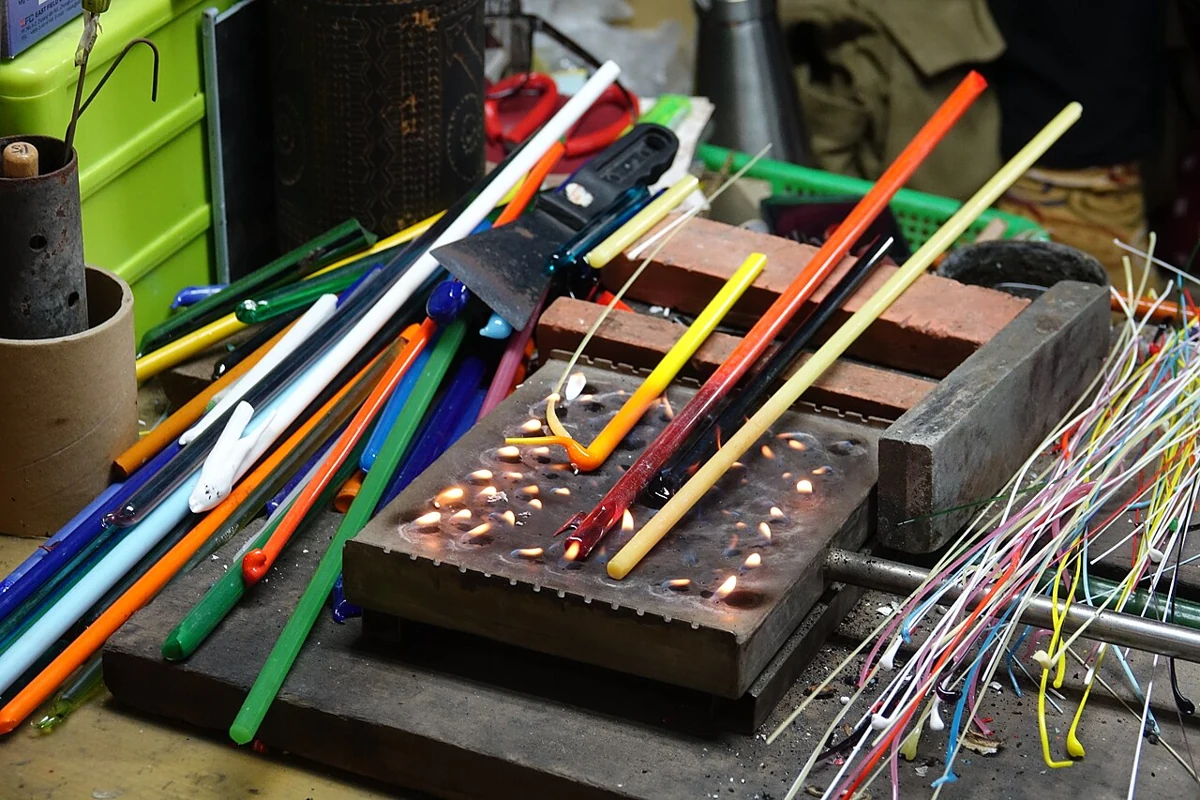
At a contemporary glass-bead bench, coloured rods, a burner and a rotating metal rod form a different scene from the museum case. Heated glass is wound and shaped, and further colours can be added to form a pattern. The changing surface makes timing and hand control visible. Watching this process helps separate a modern making technique from assumptions about how every inherited bead was produced.
A 2026 account of Dragonfly Beads Art Studio records glass beads in table tops, mirror frames, phone straps, chopstick rests and cutlery. The viewing question changes with each use: in a necklace one can read the order of beads, while in a mirror or a table the glass also becomes part of the room’s everyday surroundings. Contemporary designs for everyday objects should still be understood separately from the inheritance and social identity carried by family bead strands.
A workshop links inheritance with present-day work
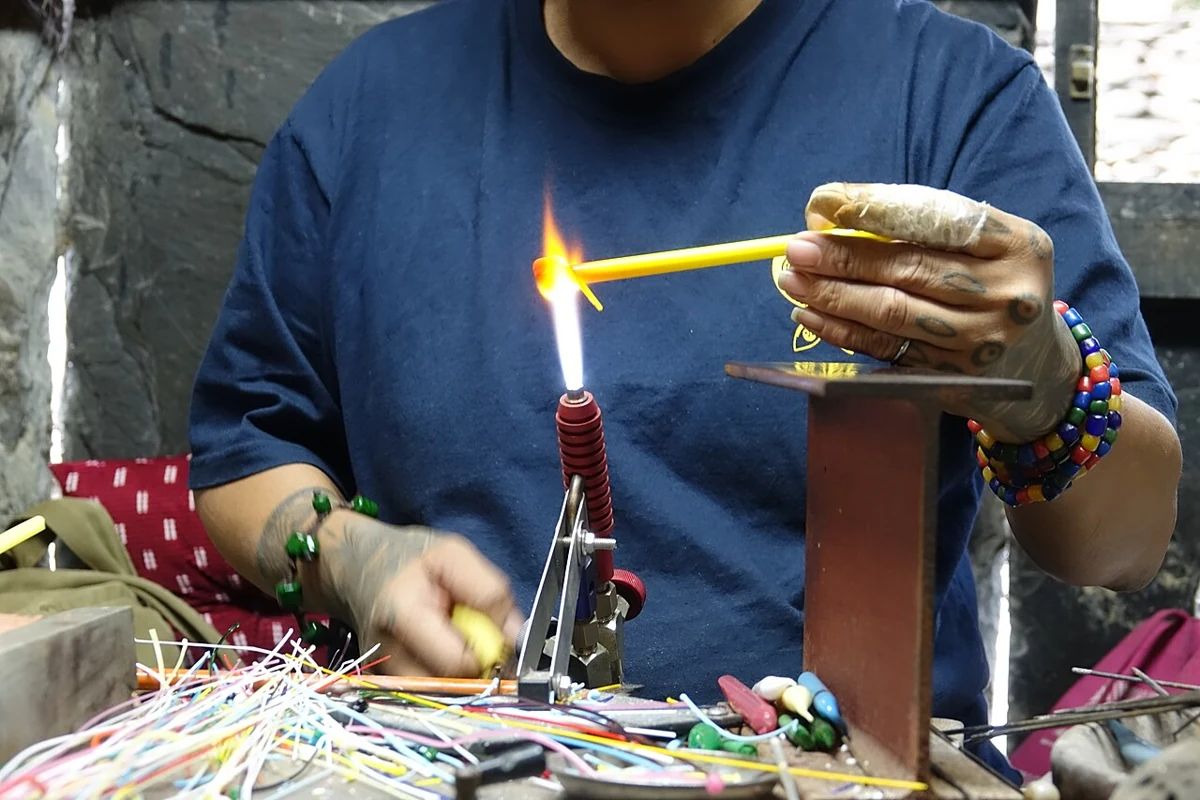
In Sandimen, Shih Hsiu-chu’s Dragonfly Beads Art Studio has connected bead making with exhibitions, classes and women’s work. Its development includes the surge of interest associated with the film Cape No. 7, but the workshop’s value is not exhausted by a film souvenir. Teaching a visitor and filling an order both require people, time and organisation. A bead can therefore carry a cultural story while also supporting a present-day workplace.
Shih founded the studio in 1983. Its work allowed local women to earn close to home while caring for children. A 2026 account introduces Paules, known as Jun-jun, a returning young community member who had joined four years earlier and worked in the visitor-experience area. Her role shows how this workplace needs more than bead makers: explaining the objects and receiving visitors are also ways for another generation to work in the community.
Look closer
Read the whole necklace: number of rows, central elements and relation to clothing.
At a workshop, follow one colour from the glass rod to the bead’s surface.
Visiting information
- Workshop
- Dragonfly Beads Art Studio, No. 9, Section 2, Zhongzheng Road, Sandimen, Pingtung.
- Visiting
- The studio combines displays and bead-making experiences. Reserve a hands-on session with the workshop before travelling; telephone 08-799-2856.
- Visit focus
- Read the collection and community named with each object, then arrange a separate studio visit. The 2023–2024 Kialreba exhibition has ended. A museum collection record does not confirm that its necklace is currently on display, and it is not a walking route between Taipei, Wutai and Sandimen.
- Getting there and back
- From Pingtung railway station, arrange a taxi to Sandimen and a return pickup at the workshop. Keep the return journey with the same booking.
Film & source information
The studio footage was published on 12 November 2018; individual capture dates are not separately verified. It shows contemporary Dragonfly work and products, not the manufacture of every inherited bead or a record of 2026 operations. At 2.7–8.5 seconds the article’s Paiwan collection-necklace photograph is shown, not a Rukai four-row necklace or a promise of a current museum display. No AI-generated pictures or video are used. Music only, using an existing generated instrumental; reserve a hands-on session with the studio before travel.
- Dragonfly studio film · published 12 November 2018 · Original record