
Cultural story
Kavalan banana-fibre weaving: a rain cape, a workshop and the work of return
In Xinshe, banana stems become thread through a chain of skilled work. Yan Yu-ying and her daughter brought that work back into clothing, teaching and the everyday life of a Kavalan community.
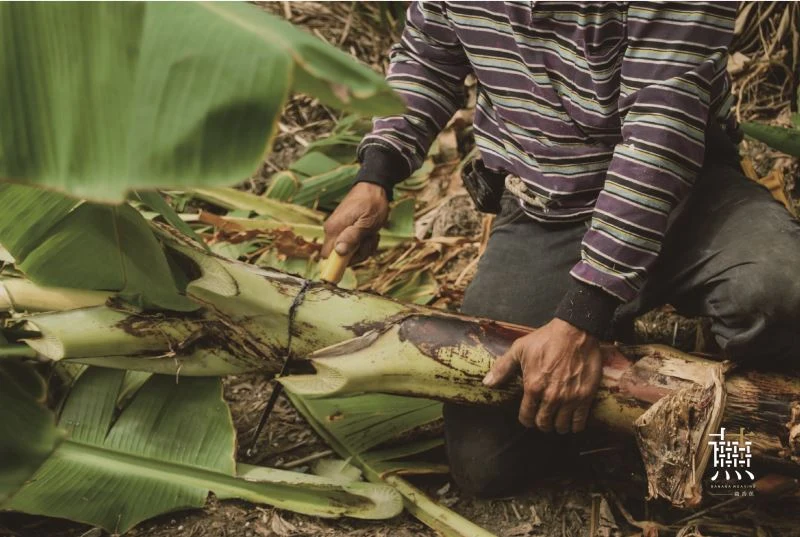
Banana fibre comes from the plant’s layered pseudostem, not its fruit.
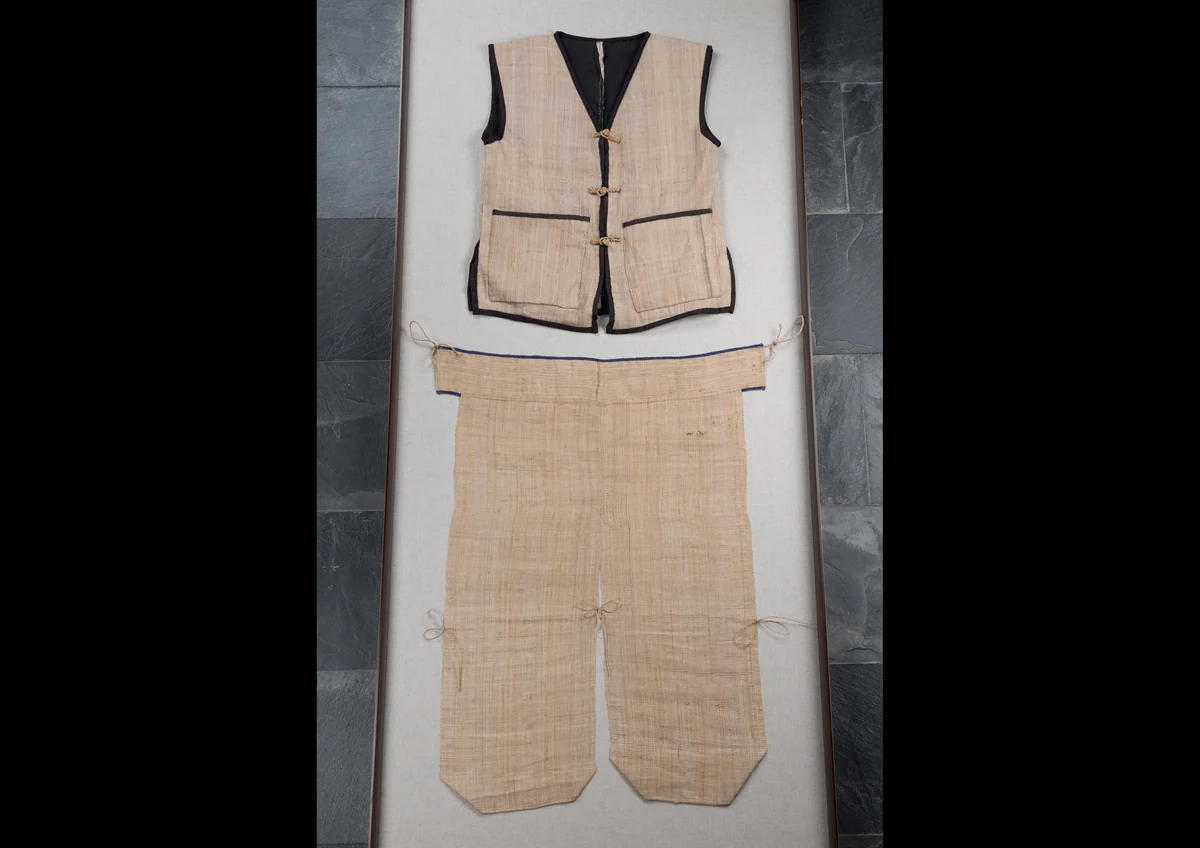
The first pieces woven by Yan and her daughter became a rain cape.
Xinshe’s workshop links making, sales and teaching.
Two pieces of cloth that could be joined
The return of a craft does not always begin with a finished ceremonial garment. Yan Yu-ying remembered the first two pieces of banana-fibre cloth she made with her daughter: they joined them into a rain cape and hung it on the wall. The object kept a practical question in view. Could they again turn a familiar plant into cloth large and sound enough to use?
Yan grew up seeing banana-fibre work, but learning it again required another weaver, Pan Wu-ji, and repeated practice. The craft’s history in Xinshe therefore passes through particular people rather than an unbroken, anonymous tradition. The Lalaban Banana Fibre Workshop, established in 2005, gave these skills a shared place to continue. Clothing could be made and discussed alongside smaller objects that helped the workshop meet visitors and customers.
A thread is already the result of many decisions
Makers choose banana plants before flowering and separate the layers of the pseudostem. The outer and inner layers do not provide identical fibres. Scraping removes soft material while retaining the strands, and the angle and force of the blade matter: too much pressure breaks what the maker is trying to recover. Drying, cleaning and splitting come before a thread reaches the loom.
Short fibres must be joined into a usable length, while the unevenness of a plant material stays visible in the finished surface. A museum vest and a workshop’s cloth can therefore be read at two scales: the cut and fastening of a garment, and the small joins and changes in thickness that carry the labour of making it. Smoothness alone would be a poor measure of the skill involved.
Joining the strands involves selecting which ends meet. The association’s preservation report describes wetting the fibres before tying, so they become more pliable, and balancing the stronger fibre near the base with the weaker upper part. It records both flat knots and a later preference among workshop weavers for a Japanese-style knot. A little join in the cloth can therefore record testing and adaptation, rather than a failure to make a perfectly uniform thread.
Teaching moves the craft into another generation
Yan’s daughter Hsieh Shu-chin has brought banana-fibre teaching into schools and longer learning programmes. A short visitor session introduces the feel of a material; learning to produce dependable thread and cloth takes a different commitment. Keeping both kinds of learning in view explains why a workshop needs time for production as well as time for welcoming people.
Today the workshop offers activities including fibre scraping and small handmade objects. They create different points of entry into the same chain of work. Beginning with a leaf sheath rather than a finished souvenir changes the visit: the object in the shop is no longer just a pattern associated with a people, but the result of material preparation, joining, weaving and the continued work of named makers.
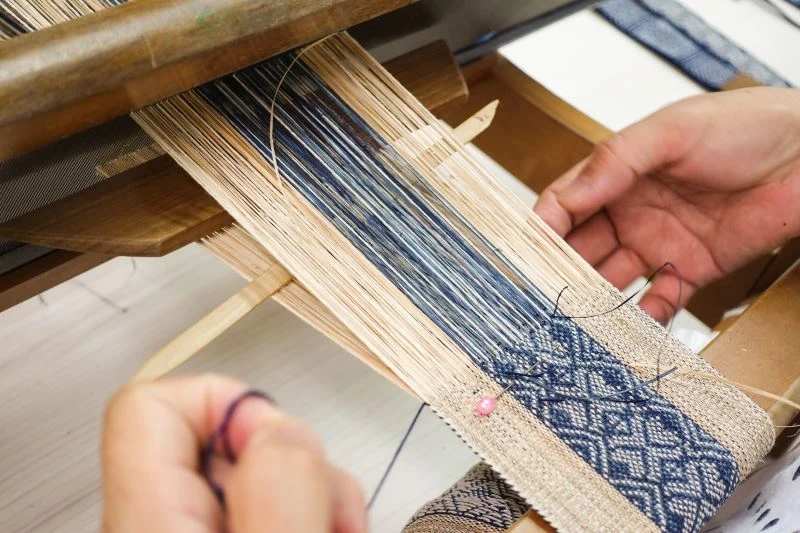
On the horizontal ground loom, the weaver’s body helps keep the threads under tension. A broad belt connects the warp to the waist, the feet brace the bamboo at the far end, and bending and straightening the body help open the shed and tighten the woven row. The report also records table looms and band-weaving equipment, which allow different widths and reduce effort. Transmission includes choosing tools that let people continue working.
Colour needs a time distinction as well. The report describes older cloth drawing variation from the naturally different fibres, while later workshop experiments used plant dyes and sometimes cotton threads to extend pattern and colour. Neither every coloured piece nor every pattern needs to be presented as an ancient tribal emblem. Ask how the maker produced the particular cloth in front of you; a contemporary choice can be part of the craft’s history too.
Look closer
Compare the plant fibre’s thickness with the joins and weave in a finished object.
Ask which maker and process produced the object you are viewing.
Visiting information
- Workshop
- Lalaban Banana Fibre Workshop, No. 42, Neighborhood 2, Xinshe Village, Fengbin Township, Hualien County.
- Arrange a visit
- Reserve with the workshop at 03-8711361 and specify the group size and activity. Its current experience page lists fibre scraping, natural-fibre fish weaving and owl sewing; arrangements require advance telephone confirmation. A short scraping session introduces material preparation and does not cover the full weaving process.
- Travel and return
- Arrange a car from Hualien railway station to Xinshe on the east coast, with the return pickup agreed before the activity.
Film & image information
The native film was uploaded on 11 September 2018; its filming date is not established. The opening grain bag is not Yan Yu-ying and her daughter’s first rain cape. Thirty unique windows play at original elapsed speed: 51.666667 seconds count as live, while 8.333333 seconds of source still/ambiguous object views and workshop context are conservatively excluded. The coastal view gives Xinshe context, not a workshop entrance, field access or continuous route. Arrange a material introduction with Lalaban and call ahead to confirm the activity; this is not a walk-in class guarantee or the complete weaving course. No AI-generated pictures/video or narration; the instrumental is an existing generated track.
- Lalaban native film · uploaded 11 September 2018 · Original record
- Lalaban Banana Fibre Workshop · confirm the activity before travel · Original record