
Annual festival
Dongshi’s new-baby rice cakes: a village shares its good news
Cooked rice dough, bean filling and a wooden mould turn a family’s wish into something the neighbourhood can share.
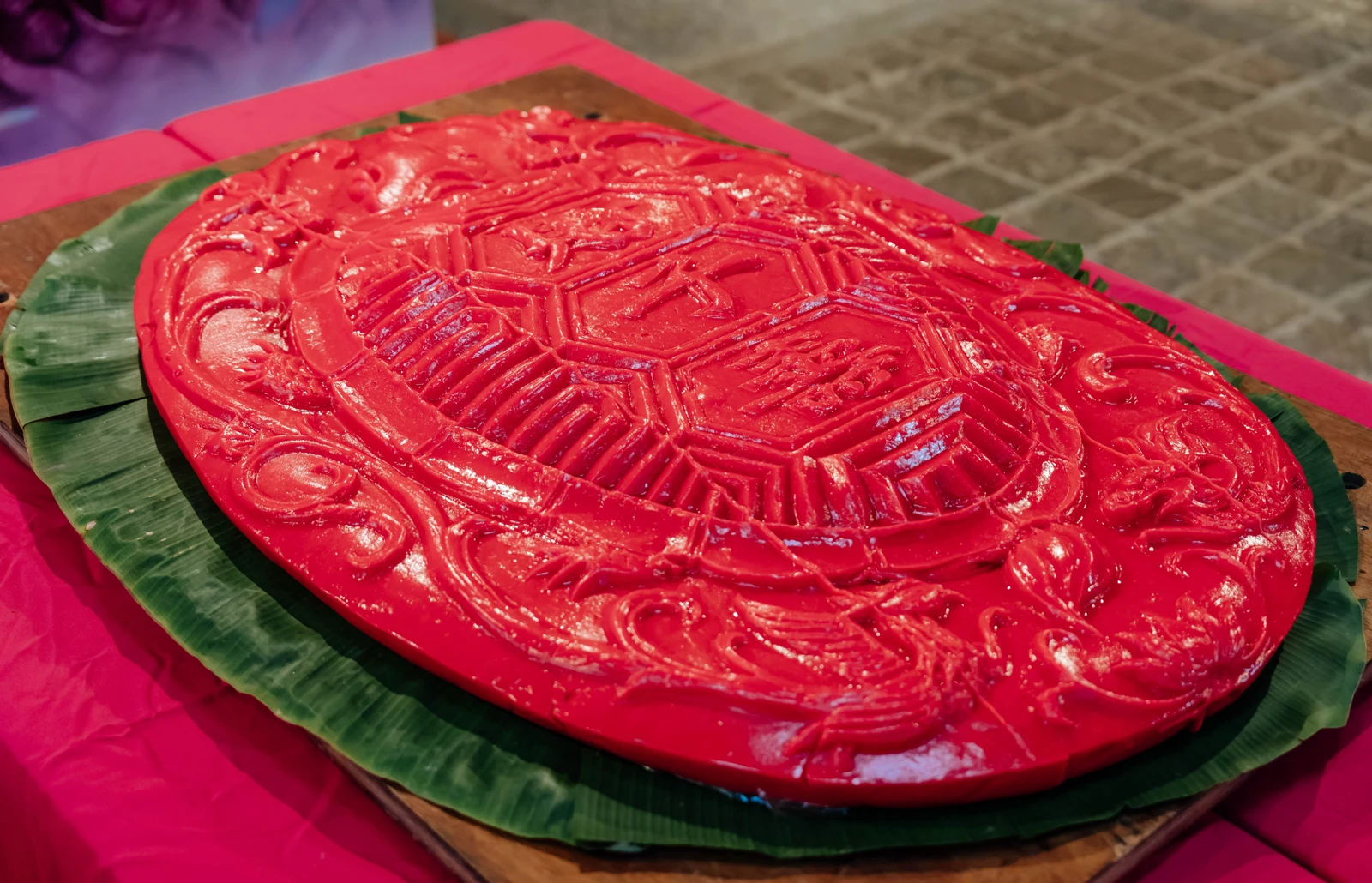
The custom centres on the fifteenth day of the first lunar month.
The former railway-station cultural hall has been closed since 1 June 2026.
A new arrival belongs to the neighbourhood too
Around the Lantern Festival, Dongshi families bring red rice cakes to the local temple to give thanks for a new child. The cakes make private news public: relatives and neighbours learn of the arrival through an offering that can later be shared. Today the celebration includes newborn girls as well as boys, giving the custom a broader meaning of welcoming a new life.
The tradition of competing over cakes—dou ban—also encourages striking size and form. Turtle-shaped cakes carry wishes for a long life, while peach-shaped cakes offer another familiar image of longevity. Their red surfaces are pressed with characters and patterns. What looks like a decoration is part of the blessing, made legible through the mould rather than written on afterwards.
The filling is wrapped after the dough is cooked
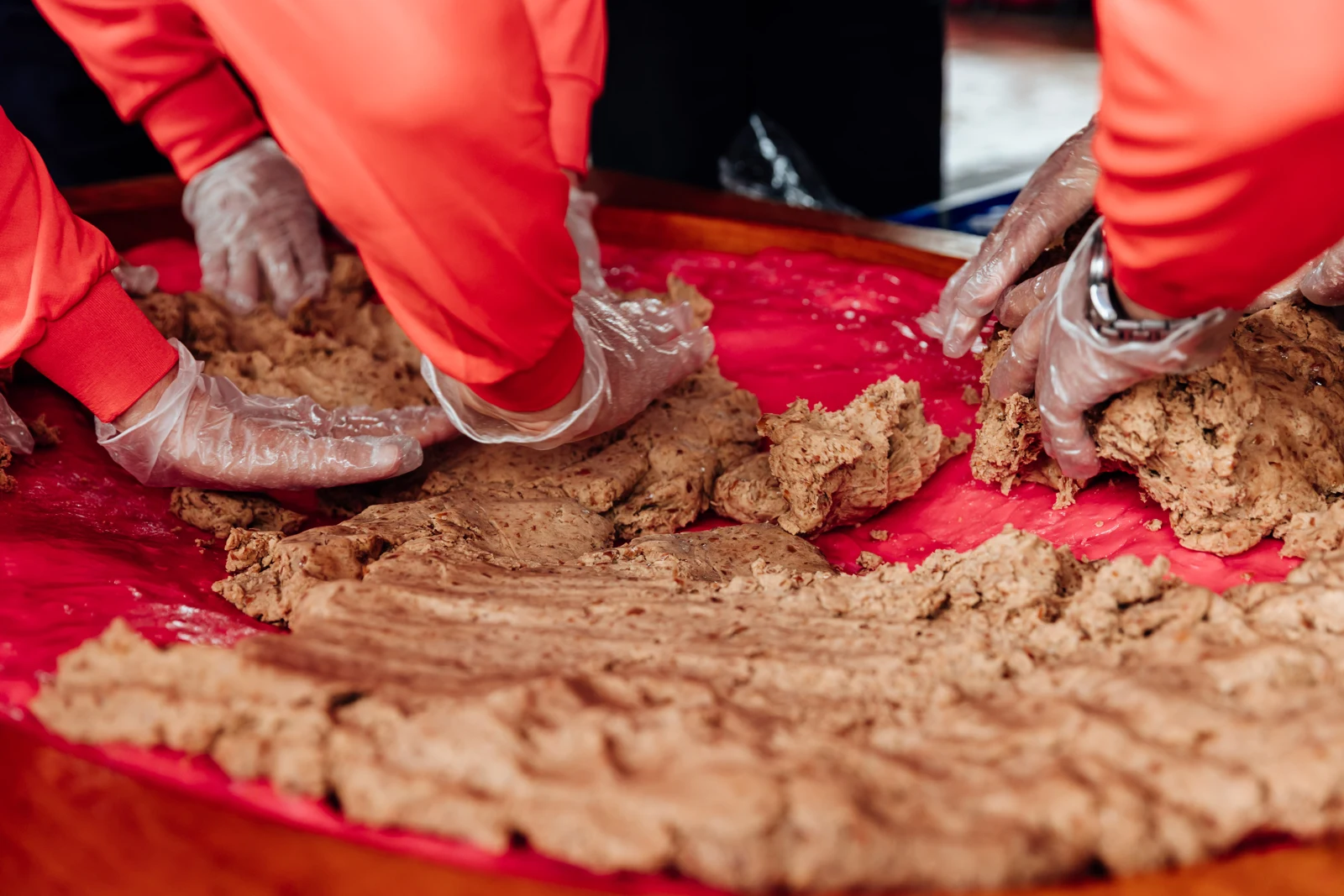
Maker Wu Hsin-fa took up the family craft after military service at twenty-three. Dongshi’s cooked-dough method begins with soaking and grinding glutinous rice, pressing out water, colouring the dough and steaming it before any filling is added. Only after cooling does the dough become the pliable skin used to wrap the beans. The order matters: the maker is shaping a material that has already changed in the steamer.
The bean filling needs its own preparation. Soaked beans are cooked and stirred into a mass that can be spread evenly. For a 120-jin giant cake, Wu uses roughly seventy jin of skin and fifty jin of filling. Several hands distribute the filling across the broad red surface and close the skin. An uneven patch becomes a weak point when such a heavy cake is handled.
The cooked wrapper’s elasticity then becomes a resistance the makers must manage. A 2024 report records Wu Hsin-fa’s team oiling the large mould with peanut oil before stretching and pressing the dough into it. It can spring back when released, leaving recesses incompletely filled. Spreading the wrapper therefore requires more than pouring red dough into a shape: its thickness and contact with the mould matter. The mould in that account weighed about 200 Taiwanese jin, distinct from the finished cake’s 120 jin. Working together means controlling both a heavy tool and a resistant material.
Why did the cakes grow so large?
The local history assembled by Taichung’s Hakka affairs office traces the growing cakes to xindinghui associations formed around temples. Members contributed dues to a common prize fund. Those with a new child or a recent marriage made cakes for other members, and the largest and heaviest received an award. Relatives could add gifts of their own. A bigger cake made room for more sharing, while the prize also encouraged makers to exceed their neighbours: the spectacular size grew within a neighbourhood organisation.
That history also records a later change: formal competition diminished, while temples offered public awards and relatives gave private ones. A 2025 report still found families bringing children to learn the craft, including a grandfather who remembered making cakes for marriage and childbirth but no longer did so at home. Public demonstrations and small hands-on cakes let another generation approach a practice that household routines alone may no longer sustain. The giant cake and a child’s small cake now carry different parts of that continuation.
A large cake needs more than one craft
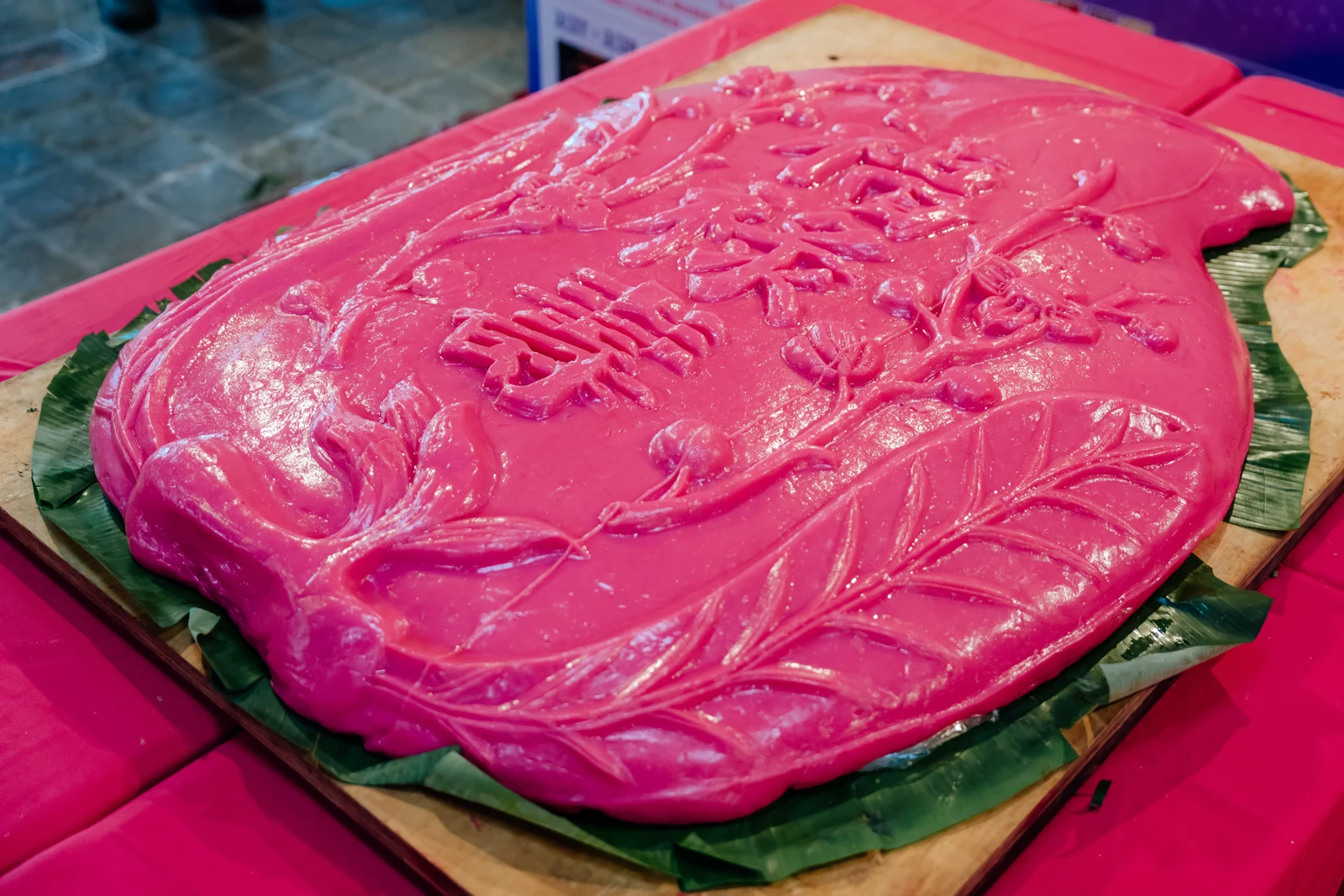
A giant cake also needs a giant wooden mould. Dongshi maker Cheng Yung-pin carves camphor-wood moulds for this work, linking the town’s woodcraft with its rice-food tradition. The mould, the cooked dough and the strength required to turn the finished cake belong to the same process. A clean impression depends on both the carved surface and the people handling it.
The 2026 festival ran from 27 February to 3 March, with the Lantern Festival falling on its final day. Large public programmes gathered around the former railway station and Fifth Cross Street, while temple offerings retained the neighbourhood setting of the custom. Following a cake from its mould to the offering table and then to shared portions reveals the central movement of the festival: a household’s good news becomes food for others.
A cake mould belongs to a wider family of ceremonial tools. A 2021 city exhibition record lists wedding-cake, mooncake, ritual-cake and sugar-tower moulds among Cheng Yung-pin’s collection. Its captions connect peach motifs with a child’s fourth-month celebration and dragon-and-phoenix sugar towers with marriage or a new home. These are recorded examples, rather than a rule for every similar pattern. Ask what food a mould made and when that food was given, then read its incised design. Its shape can carry a particular kind of exchange between people.
The survival of hand carving is also affected by changes in manufacture. The city’s 2021 account describes machine-made moulds and repeated patterns replacing some wooden versions, while hand carvers develop customised designs and finer work to find demand. Cheng’s task thus includes responding to new commissions as well as retaining older forms. Wood grain, incisions and lettering become evidence of decisions: who is the tool for, what wish should it convey, and what size of food must it produce?
A change in scale need not remove the wish. In July 2026, the city recorded another turtle mould hand-carved by Cheng as a gift. It could make a cake of over 30 jin and carried the characters for wealth, children and longevity. It is a different object from the heavy mould used for a 120-jin cake. The scale of sharing and the occasion can change the tool while retaining its lettering. These exhibition and gift records do not promise that the same moulds can be seen today at the closed cultural park.
Look closer
Compare the turtle and peach patterns pressed into the cakes.
During preparation, stay outside the working space around large moulds and trays.
Visiting information
- When
- Lantern Festival, the fifteenth day of the first lunar month; the 2026 programme ran 27 February–3 March. The listed 2026 public festival has ended. The lunar custom does not confirm the next edition’s public programme, venue or workshop bookings; check a new announcement before planning a festival visit.
- Where
- Fifth Cross Street and local temple streets in Dongshi, Taichung. The former festival venue, Dongshi Hakka Cultural Park, is at No.1 Zhongshan Road.
- Current access
- Dongshi Hakka Cultural Park has been closed since 1 June 2026. Plan this visit around the old streets and temple area, rather than an indoor museum stop.
- Arrival and return
- From Fengyuan, buses 90 or 206 reach Dongshi bus station; walk from there into the Fifth Cross Street area. Return to the same station for the connection to Fengyuan Railway Station.
- Participation
- Public viewing and tasting differ from registered cake-making sessions; join a workshop only through its booking arrangement.