
Cultural story · Craft and making
Daxi Spinning-Top Festival: a small toy grows into a town’s skill
From Jian Wu-hsiung’s heavy top to school teams and a festival arena, Daxi’s spinning tops carry a history of making, practice and teaching.
The 2026 festival was held on 1 August at Daxi’s sports ground and covered event space.
The festival is associated with the local season around Guan Sheng Di Jun’s lunar birthday, but has its own announced date.
The large-top competition, school performances and ordinary top play require different skills and spaces.
The toy that became too large for a pocket
A Central News Agency photograph from 1968 records Jian Wu-hsiung and a five-catty spinning top in Daxi. Its size already shifts the familiar childhood game: the maker must consider the body, the tip and the force needed to set the object moving. Daxi’s later giant-top performances grew out of this local willingness to make the toy differently, turning an everyday plaything into a public demonstration of control.
The skill acquired an organisation as well as an audience. Daxi’s spinning-top club was founded on 20 July 1981, and performances took place in front of Furen Temple. The temple forecourt gave a familiar local activity a public setting where people could gather. A much later visitor, writing in 2009 about a performance by A-Hai on the old street, described staying to watch the changing props and balancing feats. That small pause is part of how a street performance becomes a memory of a place.
A performance depends on ordinary practice
Schools gave the craft another route into the next generation. Meihua Elementary School developed spinning tops as a distinctive school activity, and teacher Wu Chien-wu spent years coaching pupils. The work required more than a successful festival appearance: a school needed space to practise, equipment to keep and a way for older pupils’ experience to reach new learners. The top became something taught over time rather than encountered only once on a holiday.
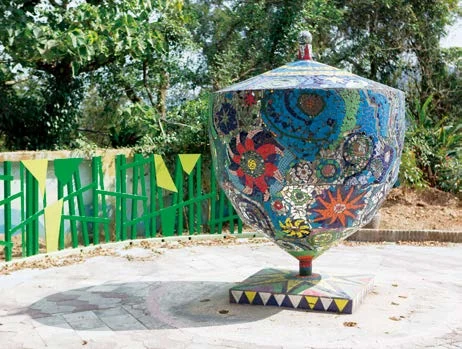
The school’s display space collects different tops and supports teaching. Cooperation with Daxi Junior High also offered a way for pupils to continue after graduating. That connection is important to a physical skill: learning does not stop at the moment a child leaves one campus. A performance team on a festival programme is therefore the visible end of a longer chain of teaching, maintenance and repeated attempts. In 2016, the school community also worked with artist Lily Yeh on a mosaic spinning-top sculpture, giving the skill a permanent form in the school landscape.
A 2012 school interview explains why this activity fitted Meihua. With fifty-eight pupils then, it was difficult to assemble enough children for some team-ball sports; spinning tops allowed a small school to work with a local skill without needing a large squad. This was a choice about the school’s actual size, alongside cultural preservation. The pupil count belongs to that interview and should not be read as today’s enrolment.
A festival gives the skill a shared date
The festival resumed in 2023, and the 2026 edition again brought school performances and competition into a shared public programme. Daxi and Meihua elementary-school teams opened the event, while the competition separated participants into age and gender groups with different top weights. The arrangement made differences in strength and experience part of the event’s structure, rather than treating every spinning top as the same game.
Its local calendar is linked to the season around Puji Temple’s celebration of Guan Sheng Di Jun, whose birthday falls on the twenty-fourth day of the sixth lunar month. The top festival itself uses a separately announced date; in 2026 that was 1 August. For a future visit, select the published festival venue and session rather than assuming an old-street show will happen daily. The old temple square and the festival arena belong to the same history, but offer different encounters with it.
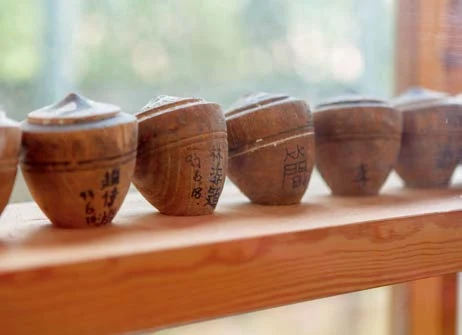
The interview also records three levels of assessment: a basic throw, specified accuracy and height, then trick techniques. More advanced pupils could enter the performance team. Such stages turn a surprising public stunt into learnable steps, giving newcomers something smaller to complete first. The display room also held little tops signed by graduates, so leaving school could leave a named object behind. These were recorded teaching arrangements, not a public invitation to visit an active campus without permission.
Look closer
Compare the size of the top, the winding of the cord and the performer’s preparation before release.
Watch from the designated audience area; keep the performers’ landing and retrieval space clear.
Visiting information
- Latest announced edition
- 1 August 2026, 13:00–17:30, Daxi sports ground and covered event space; this edition has ended.
- Date rule
- Scheduled annually near the local summer celebration season; the festival date is announced separately from the lunar birthday.
- Travel and return
- The sports ground is beside the building at 22 Denglong Road. From Daxi bus terminal, walk along Zhongyang Road towards the market for about 100 metres and enter beside the sports hall. Save the return bus before the last session.
- School visits
- School performances can be watched at the public festival; a visit to a school display space requires a separate arrangement with the school.