
Annual event
Daxi’s lunar June 24: a palanquin connects generations
The birthday of Guan Sheng Dijun connects craftsmanship, rehearsals and the preservation of community objects.
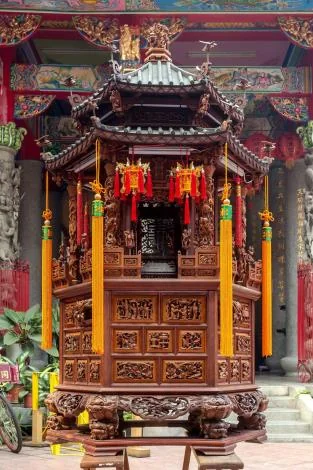
Guan Sheng Dijun’s birthday falls on lunar 6/24, with community processions around that date.
Puji Temple is the religious centre; the Daxi Daxi programme adds exhibitions, performances and activities.
Trade, faith and a gilded palanquin
Tongren Society’s history connects Daxi with camphor and mining businesses. The commercial lives of figures including Jian A-niu, and fundraising promoted by Huang Bingnan, led to the society’s establishment and palanquin-making in 1917. It was not an ad hoc performance team but an organisation built from local relationships, expressed through shared funding and work.
The palanquin carries woodworking into the street. Carver Chen Chaozhi’s figures and fine details belong to an object that must also be lifted and moved; delicacy and structure cannot be separated. An object kept between occasions returns to a walking rhythm on lunar June 24, when its weight becomes the bearers’ shared work.
Before putting on the same colour
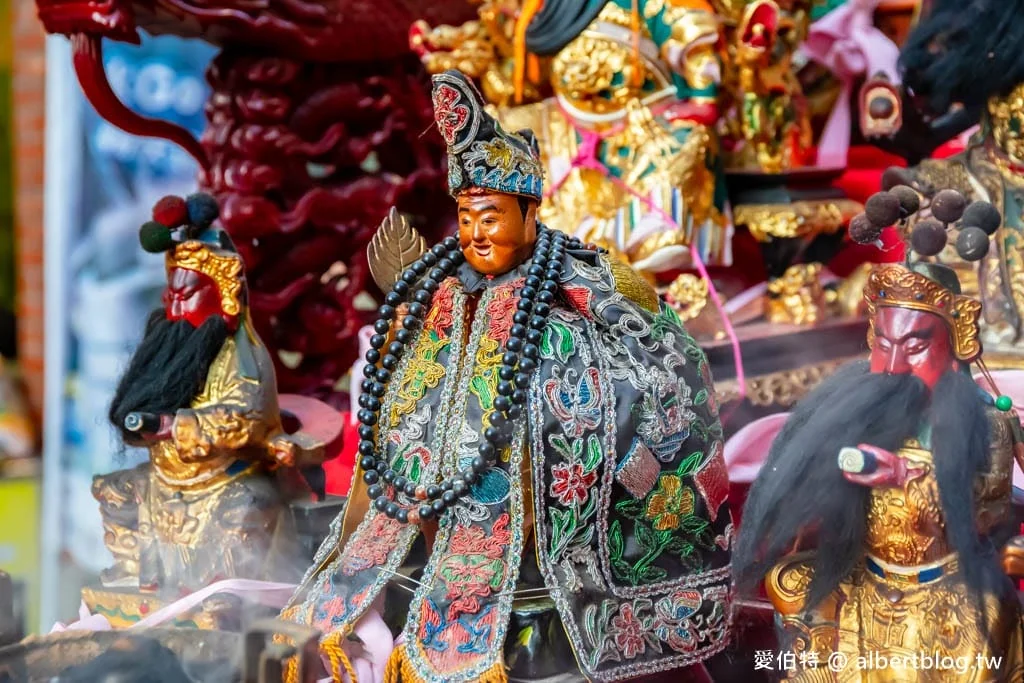
Tongren’s yellow clothing makes the group recognisable, but orderly movement depends on rehearsal. The forecourt of Furen Temple has provided an evening practice space where music, formations and carrying are coordinated repeatedly. People with separate daytime work gather in one place at night, turning dispersed schedules into a shared routine.
The responsibility also passes through families. Member Yu Mingyang worked in banking information systems while devoting time to society affairs, interviews and records. Contact with the Wood Art Ecomuseum encouraged a stronger preservation approach: damaged objects once disposed of ritually could instead be discussed for repair and retention, adding historical care to the practice of renewing things for the deity.
One object makes that choice more concrete. In a lecture on 25 April 2022, Yu Ming-yang singled out Tongren Society’s century-old incense carrier, especially its curved wooden board, as a piece whose craftsmanship deserved attention. He also spoke of letting the old carrier retire and making a replacement. This was a proposal recorded at the time, rather than proof that replacement had already happened.
The proposal separates two responsibilities that a festival can ask of the same object: carrying out its ritual work and preserving the material that records earlier generations. A new carrier could continue the task while an older one receives a different form of care. Looking at the sedan, a flag or an incense carrier with that question in mind makes preservation a decision about use, rather than simply a preference for keeping something old.
Before the procession, someone has to wash the temple
The Wood Art Ecomuseum’s guide separates the yearly temple host, or luzhu, from the societies preparing their own formations. Its explanation places the selection of the next host by divination at the close of the festival. Work then extends from lunar June 1 through the celebration: meetings, notices inviting deities, cleaning the temple, preparing offerings and receiving the guests all precede the most visible procession.
The guide continues through the birthday’s three-offering ceremony, procession and farewell to the invited deities. Returning to an ordinary-looking forecourt is therefore the result of completing a sequence, not simply stopping a performance. Understanding these quieter tasks before watching the palanquins and formations reveals how ceremonial leadership, care of the site and street performance depend on each other—and why someone must accept the responsibility in the preceding year.
Learning to explain the tradition
Yu also designed emblems, clothing and educational cards and shared the tradition in schools. In a 2022 discussion he explained the need to test oral accounts against documents and make his accumulated material available to researchers. The work gives the society ways to explain its history and leaves space for the next generation’s questions.
In 2024, visitors could encounter palanquins outside the temple, processions in the streets and ritual objects displayed in the museum; an outdoor production about Guan Sheng Dijun offered another way into the subject. The 2026 Daxi Daxi programme ran from 18 July to 6 August. The procession retains its lunar-calendar centre, while exhibitions and performances create additional times and ways to encounter the societies.
Look closer
Read a museum label before comparing a displayed object with one in a procession. Ask which piece is still used and which has been retained; do not assume the century-old incense carrier or sedan is currently on display.
Use clothing, flags and spacing to distinguish societies rather than treating the occasion as one undifferentiated procession.
Visiting information
- Dates
- The core observance is lunar 6/24. The 2026 Daxi Daxi series ran 18 July–6 August, with processions around the birthday. The listed 2026 programme has ended.
- Venue
- Puji Temple and the old-town streets of Daxi, including Heping and Zhongshan Roads; museum displays can be combined with the Daxi Wood Art Ecomuseum.
- Stay
- Allow half a day for museums and streets followed by a section of the procession. Roadside viewing is free; individual workshops may require booking.
- Arrival and return
- Take a bus to Daxi and walk into the old town. During processions, stops may shift outside controlled streets; identify the day’s Daxi terminal or temporary stop before returning to your original departure station.
- A visit between festivals
- Liuer-si Story House is at No. 48, Puji Road. The museum lists regular opening Tuesday–Sunday, 09:30–17:00, with Monday and post-holiday closures; check temporary notices. Displays change, and the objects named in a historical account are not guaranteed to be present.