
Cultural story
Cochin ceramics: how a temple wall learns to tell stories
From a fold in a robe to a fired glaze, follow the work that turns clay into a temple’s visible memory.
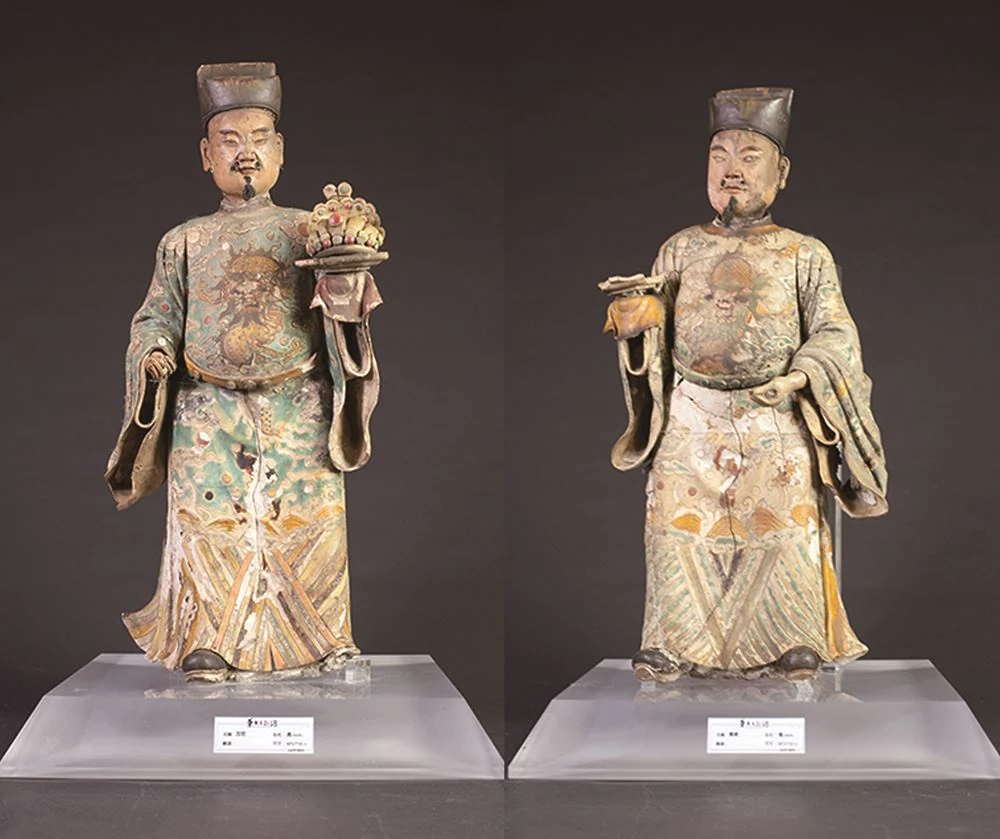
Read the figures’ gestures, then the glaze and their position in the building.
Distinguish sculpted, glazed ceramic pieces from decoration assembled with cut fragments.
A story begins with a gesture
A small figure on a temple wall may be leaning, lifting an object or turning towards a companion. Before searching for a name, follow the gesture. The direction of a hand and the fold of a robe organise the scene, giving a stationary ceramic figure a sense of action. Placed together, figures can turn a section of architecture into a moment from a story.
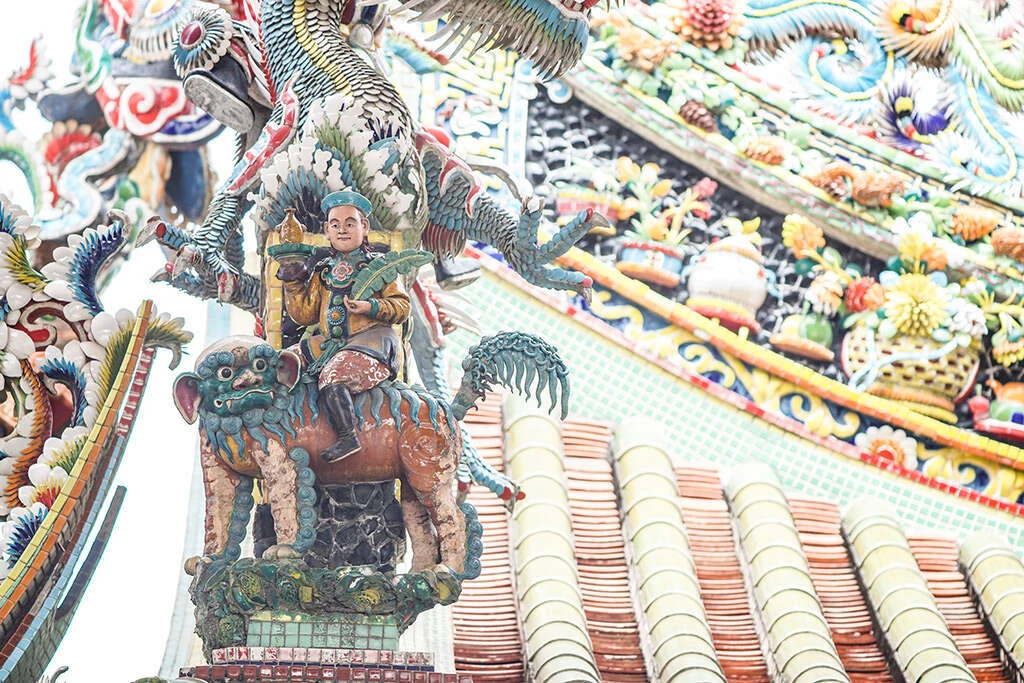
Cochin ceramics, also called jiaozhi pottery, developed as decoration for temples and other traditional buildings. Figures, animals and auspicious objects share the surface with other crafts. Their setting matters: looking upwards from a courtyard and looking closely in a museum offer different information. One reveals how the composition works within the building; the other makes the modelling and finish easier to study.
Try the cover’s Jia Guan and Jin Lu figures, and the gestures acquire specific objects. The science museum’s interpretation identifies a crown held by one figure and a raised tray on the other. A deer formerly stood on the tray; it is missing and is known through earlier photographs. Crown and deer carry wishes for advancement and increased emoluments. The Hejing and Ping’an pair likewise uses a mirror, vase and saddle. Return to the hands after reading the titles, while recognising the empty space left by loss. Knowing the meaning does not make a missing object present today.
Colour has to pass through fire
A ceramic figure is built through more than a painted surface. Clay is modelled, dried and prepared for firing; glaze is applied and fired to develop its final appearance. Hollowing a form helps it shrink more evenly. A finished sleeve or cheek therefore carries choices about thickness and structure as well as shape. The hidden construction is part of what allows the visible gesture to survive.
Compare that continuous ceramic surface with jian-nian decoration, where cut ceramic or glass fragments are assembled onto a shaped base. Both can appear on the same temple, and makers may work across them, but their surfaces record different processes. Looking for joins, edges and the continuity of a glaze is a useful beginning; the object label or a guide can then help identify the work more precisely.
Glaze cannot be understood only as a painter’s mixture of colours. The science museum links the result to ingredients, application thickness, firing time and kiln atmosphere; its demonstration separates a first biscuit firing from a later glaze firing. Makers work with a surface whose final appearance still depends on fire. Read a red robe through modelling, glazing and firing together. A vivid colour alone cannot establish an author or date, and a demonstration is not proof of the precise recipe used for every Ye Wang piece.
Conservation also reveals materials beyond clay. Tainan’s 2024 report identifies the beards of Jia Guan and Jin Lu as twisted fine copper wire, and the vase held by Ping’an as wheel-thrown. What appears to be one group of coloured ceramics brings together different kinds of forming and assembly. Ask separately how a beard, held object or sleeve was made, rather than assuming every detail was pinched from the same lump. These findings depend on professional investigation; they may not be demonstrable to the naked eye. Read the interpretation instead of touching the work to test it.
From a temple commission to a preserved collection
During a nineteenth-century renovation, Xuejia Ciji Temple commissioned Ye Wang to make ceramic decoration for its walls and roof. Later, preservation became a story of loss and return: 56 works were stolen in 1980; 36 were acquired by Chen Yung-tai in 2003 and donated back the following year. Seeing the collection in the cultural museum therefore means seeing objects that people worked to bring home.
Preservation also brings later work into view. Repairs, documented copies and original pieces have different roles in keeping a temple’s artistic history visible. Read the maker and work description before treating every surface as the same moment in time. When you return to the courtyard, the colourful wall can become a record of commissions, skilled labour and continuing care.
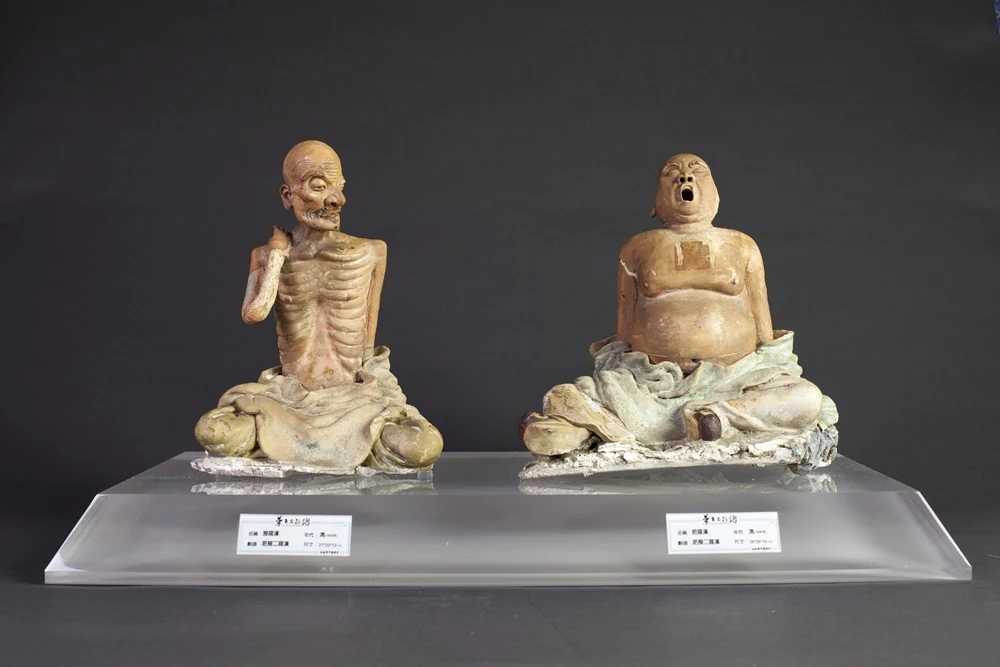
Returning home did not end the need for care. Pollution, breakage, salt damage, weathering and earlier repairs affected the six National Treasures. A team from National Taiwan University of Arts completed conservation in June 2024, after which they returned to the cultural museum. Cleaning can reveal glaze beneath deposits, but a lost glaze may expose clay: those are different outcomes. The city report also notes making traces on the thin luohan, while leaving open whether they are Ye Wang’s fingerprints. Keeping that question open matters. The documented return in 2024 likewise does not replace checking what is on display on the day of a visit.
Look closer
Follow one figure’s hands and clothing, compare glaze with cut-fragment decoration, and read the maker and object label.
Visiting information
- Suggested starting point
- Xuejia Ciji Temple and the adjoining Ye Wang Cochin Ware Cultural Museum in Xuejia, Tainan. Arrange travel to Xuejia as a separate visit.
- Address and contact
- 170 Jisheng Road, Xuejia, Tainan; +886 6 783 6110.
- Travel and return
- From Xinying railway station, take the Brown Main Line towards Xuejia and alight at Xuejia District Office, then walk to the temple. For the return, use the stop in the Xinying direction and check the departure before extending your museum visit.
- Museum visit
- Confirm the cultural museum’s current opening arrangements with Ciji Temple before travelling. Temple access and museum access are separate.
- At the temple
- View from public circulation areas and leave space for worship. Photograph without touching or climbing towards architectural decoration.
Film & source information
The film combines photographs of Xuejia works and Ciji Temple with a modern workshop video published in 2021. The workshop scenes show different objects; they are not a record of making or restoring Ye Wang’s original works, nor a workshop inside the museum. Photograph dates are unlisted. Confirm museum opening and display arrangements before travel.
- 許良維 · 2021-10-30 · Original record
- Existing article photograph · Original record
- Existing article photograph · Original record
- Existing article photograph · Original record


