HISTORIC TRAILS · PEOPLE & MEMORY

Dulishan: The People Who Followed the Steam Train

A brass water pump kept by the Ruan family in Hongnankeng brings Dulishan’s celebrated railway spiral back to railway workers’ daily lives. An older mountain path, later rails and a walking loop built in 1997 reveal different uses of the same hillside in Chiayi County.

Dulishan: The Left-Hand Trail through Railway Hills

From the entrance at Zhangnaoliao, follow the left-hand route through a suspension bridge, steps and pavilions to Dulishan’s wooded summit and hillside station, then return by the same route.

90 seconds · English captions in the film; optional English and Traditional Chinese CC.

Checked 23 November 2026: the approximately 0.65 km right-hand route between Zhangnaoliao and Dulishan Station is closed for works, under a notice dated 18 May 2025–28 February 2027; the left-hand route is open. This film follows the left route out and back. Recheck official trail notices and signs before travelling.

Film sources and complete bilingual captions

Selected from a walk uploaded by 山上加美Lovely Hill on 22 February 2026; the exact filming day is not independently confirmed. This edited visitor introduction is not continuous GPS navigation, footage of 2026 railway patrols or proof of current train services.

Checked 23 November 2026: the approximately 0.65 km right-hand route between Zhangnaoliao and Dulishan Station is closed for works, under a notice dated 18 May 2025–28 February 2027; the left-hand route is open. This film follows the left route out and back. Recheck official trail notices and signs before travelling.

Music: 海風把路打開 · AI-generated instrumental.

00:00:00,000 --> 00:00:05,000
Dulishan Trail
Chiayi County, Taiwan.

獨立山步道
臺灣,嘉義縣。

00:00:05,000 --> 00:00:13,000
On the left-hand route,
farms give way to woodland.

左線穿過農地,
接上林蔭山徑。

00:00:13,000 --> 00:00:20,100
Cross the suspension bridge
over the valley.

走過吊橋,
越過溪谷。

00:00:20,100 --> 00:00:24,300
Wooden spans link
the stone steps.

木橋接起
前後的石階。

00:00:24,300 --> 00:00:29,800
A pavilion offers
a place to pause.

山腰的涼亭,
留下一處歇腳的地方。

00:00:29,800 --> 00:00:34,400
Steps rise between
rock and roots.

石階從岩石
與樹根之間向上。

00:00:34,400 --> 00:00:40,100
Above the slope,
another pavilion appears.

坡面上方,
另一座涼亭出現。

00:00:40,100 --> 00:00:49,700
Look past the trees
to the layered hills.

越過近處的樹木,
看遠山一層層延伸。

00:00:49,700 --> 00:00:54,700
The final climb
returns to the shade.

最後一段上坡,
又回到樹蔭裡。

00:00:54,700 --> 00:00:59,700
Dulishan’s summit
rests beneath the trees.

獨立山的山頭,
藏在樹木包圍之中。

00:00:59,700 --> 00:01:05,300
Leave room
for a quiet view.

留一點時間,
安靜看山。

00:01:05,300 --> 00:01:09,700
Back down the steps,
follow the marked trail.

循階而下,
沿著有指標的步道返回。

00:01:09,700 --> 00:01:15,100
A path with a railing
leads towards the station.

有欄杆的小徑,
帶人走向車站。

00:01:15,100 --> 00:01:19,800
A shelter at the edge
of the forest.

候車的亭舍,
緊鄰著山林。

00:01:19,800 --> 00:01:21,300
Dulishan Station.
獨立山車站。

00:01:21,300 --> 00:01:26,300
Return by the same
left-hand trail.

沿著同一條左線,
踏上回程。

00:01:26,300 --> 00:01:30,000
Forest paths, mountain memories.
Taiwan, Layer by Layer.

山林小徑,沿途記憶。
島嶼年輪。

English SRT · Traditional Chinese SRT
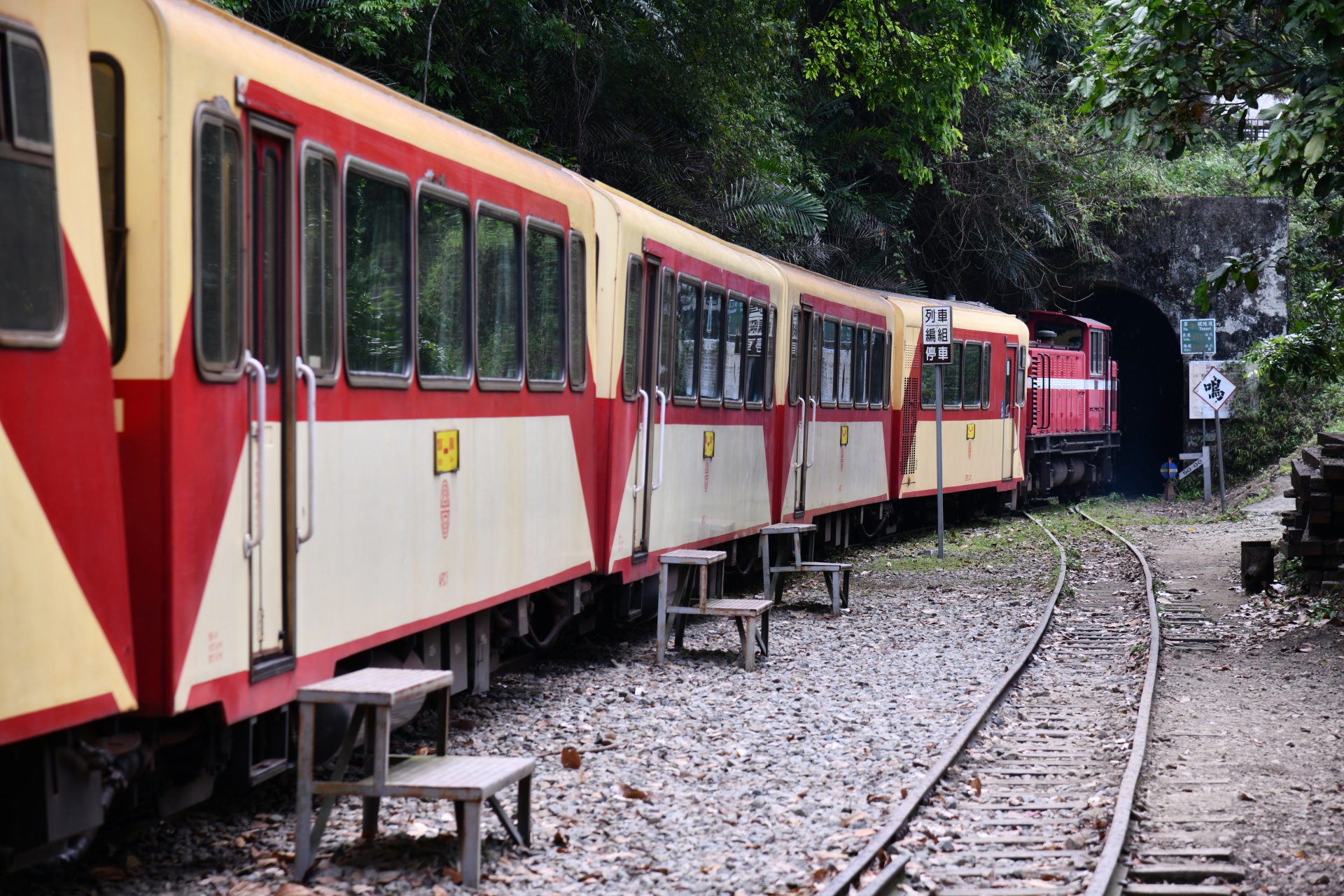
A train beside a tunnel at Dulishan Station, in an official archive image; the capture date is not stated.

Malcolm Koo (Mk2010) · Source / 圖片來源 · CC BY-SA 4.0 · 2014

A family’s brass water pump and the work of preventing steam-train fires

Route surveying in 1903 and construction at Dulishan in 1907

The older path, the 1997 walking loop and today’s closure as different layers

HISTORIC TRAILS · STORY LOCATIONS

Story map & stop guide

1 story locations · not a continuous walking route

Story map

Place the story before planning a visit. These locations are reading references, not a walking sequence.

Approximate locations · select a place to look closer

Stop guide

Select a location to view the map, then follow its story link. These are reading locations, not a walking sequence.

Station-area location only; not an entrance or waiting position.

The station between tunnels 9 and 10 locates the railway and its workers’ story. The point does not authorize walking along tracks or imply that the family’s brass pump is displayed here.

Read this part of the story →

Full story & field notes

A tool for the work behind the train

In a 2025 report for Rural Life, writer Wu Ming-han visited the Ruan family at Hongnankeng. Ruan Wen-an showed a brass water pump inherited from his grandfather. He explained that track workers followed steam trains to extinguish coal sparks before they ignited nearby vegetation or timber inside tunnels.

Visitors often focus on how a train climbs around the mountain. The pump shifts attention to the people who kept its route usable after it passed. Fire prevention and inspection were railway work, and also part of the livelihoods of families living beside the line.

Before the rails, a path for everyday goods

Dulishan stands in Zhuqi, Chiayi County, in southwestern Taiwan. The forestry authority distinguishes an older path running from Songjiao through Zhangnaoliao to Hongnankeng. It carried necessities from the lowlands into mountain communities, before intersecting with a railway built to move forest products.

Zhangnaoliao’s name preserves another occupation. The railway heritage office identifies it as an important former centre for camphor and camphor-oil production and shipment. Paths, settlement and rails together reveal a working landscape of materials, processing and transport.

From a walked route to a surveyed railway

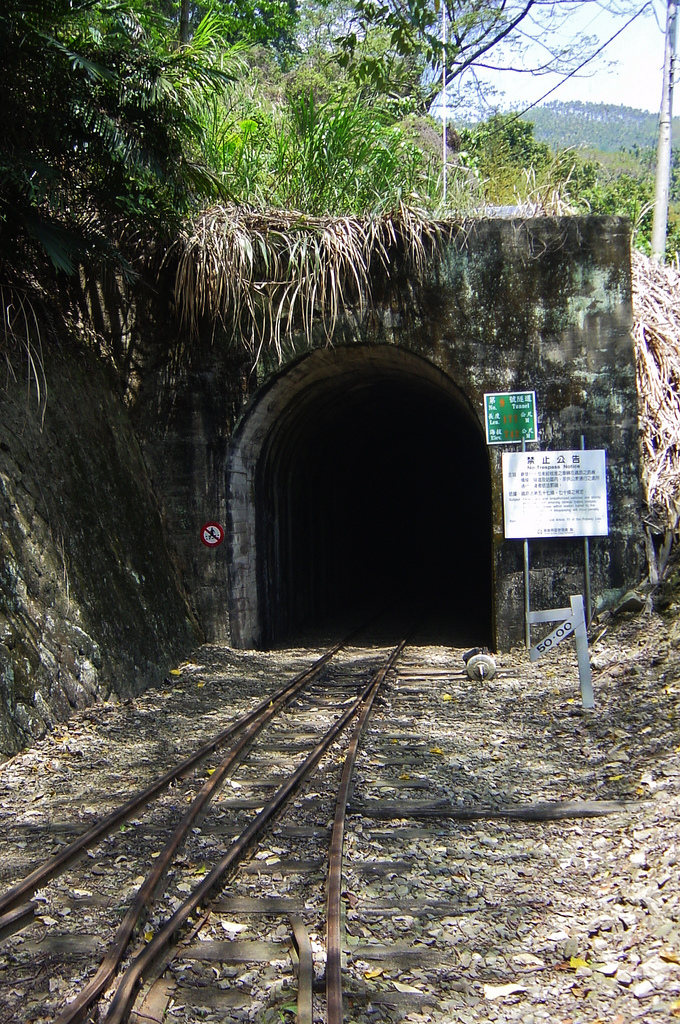
A railway tunnel near Dulishan Station, photographed in 2008; an engineering view, not a walking route.

Railway researcher Su Jau-hsu’s account makes the transition more specific. In 1903, surveyor Kawazu Hidegoro examined a route through Chiayi, Zhuqi, Zhangnaoliao, Dulishan and Hongnankeng. Existing paths informed the survey, but a railway needed its own alignment in response to gradients and construction conditions.

Su describes a proposed zigzag alignment and the spiral proposed by Kawai Shitaro. The latter required precise surveying and tunnelling, with construction of the Dulishan section proceeding in 1907. These decisions explain the railway’s curves more reliably than the familiar tale of inspiration from a snail shell, which remains a legend.

The working hours a family remembered

After construction came recurring maintenance. In Wu’s interview, Ruan Chen-duan recalled her father inspecting the line between Dulishan and Jiaoliping, leaving with a lamp after rising at 2.30 a.m. This is a family recollection, rather than a timetable for every track worker, but it shows a household livelihood shaped by railway duties.

The report also records railway families living in former workers’ housing at Hongnankeng. The trail approaches an inhabited place. Knowing its stories does not make homes freely accessible or turn family possessions into an exhibition available on demand.

A new walking route from 1997

Today’s Dulishan trail brings together routes of different ages. The Songjiao–Zhangnaoliao–Hongnankeng section is older; the loop from Hongnankeng towards the summit was newly built by the forestry administration in 1997. Distinguishing them explains how recreational paths now bring walkers close to the railway without making every modern stairway an old carrying route.

Dulishan Station lies between tunnels 9 and 10, while Zhangnaoliao has a reversing station layout. From permitted public areas, compare the walking path with the space a climbing train requires. Remembering the brass pump adds the work that kept this landscape functioning to its striking engineering forms.

Three distances on one hillside

A railway distance, a trail length and a walk from a bus stop describe different journeys. The railway office’s station-distance table puts Zhangnaoliao and Dulishan 4.10 km apart along the rails. Those curves belong to a train gaining height; they are not a pedestrian distance or permission to follow the track. The railway makes the mountain legible through its long alignment, while a walker has to read the public path separately.

The forestry page lists a 5 km trail, elevations of 543–816 m and a height difference of 273 m. The last figure is the difference between the listed elevations, not accumulated ascent around every rise and descent. Its suggested loop is background route information; closures can interrupt that circuit. Read the numbers as descriptions of the published trail system before deciding what portion is actually available.

A station name does not guarantee a stopping train

The main-line timetable distinguishes trains that call at the two stations from trains that pass them. In the timetable effective from 10 January 2025, uphill train 1 and downhill train 2 have entries for both Zhangnaoliao and Dulishan, while trains 5 and 8 show dashes. A map can put a station beside the trail, but a return journey depends on the actual stopping service and whether trains are running that day.

The forestry approach description also includes a bus to Songjiao followed by a 2.5 km walk to Zhangnaoliao Station. That access leg is outside the mountain walk itself and must be allowed for again on the return. The older description supplies no verified current bus frequency. After any closure is lifted, choose the approach and return first, then fit the permitted walking section between them.

Look closer

Use public station areas and interpretation to locate Zhangnaoliao, Hongnankeng and Dulishan, distinguishing the older path, the 1997 trail and operational railway. The brass pump is a family possession documented in a report, with no promised public display. Respect homes and never use tracks or tunnels as viewpoints.

Visiting information

Access · read 23 November 2026
Read 23 November 2026: the forestry trail page states partial opening. The approximately 0.65 km right-hand route from Zhangnaoliao to Dulishan Station is closed for repairs under a notice for 18 May 2025–28 February 2027; the left-hand route is open. Recheck current notices, weather and signs before travelling. The listed end date does not guarantee reopening.
Transport and return
Compare trains that actually stop with the forestry approach via Songjiao, which includes a 2.5 km walk to Zhangnaoliao Station. Confirm travel-date services, seats and return connections separately. A regular railway timetable does not override temporary suspensions or trail controls.
Stations and settlement
Use only public paths and station areas permitted that day. Operational tracks, tunnels and the closed right-hand trail are not walking alternatives. Hongnankeng is a living settlement; private homes and family objects are not open attractions.