
Annual temple festival
Baosheng Cultural Festival: a temple courtyard keeps the theatre alive
At Dalongdong Baoan Temple, a deity’s birthday brings opera back to the neighbourhood. Family-sponsored performances have grown into a shared stage for professional troupes, students and temple learners.
Baosheng Festival: From Daylight to Firelight
90 seconds. English captions are part of the film. Optional Traditional Chinese subtitles are available in the player.
Re-edited archival coverage identified by the creator as 22 April 2024 and corroborated by the temple’s 2024 programme. This is not a live 2026 report or an announcement of future dates.
Read the complete five-chapter article → · 繁體中文
Complete English captions and Traditional Chinese translation
00:00:00,000 --> 00:00:05,000
Bao’an Temple, Taipei.
2024 Baosheng Festival.
台北,大龍峒保安宮。
2024年保生文化祭。
00:00:05,000 --> 00:00:09,000
The festival honours
Baosheng Dadi.
文化祭,
向保生大帝致敬。
00:00:09,000 --> 00:00:13,500
The forecourt becomes a stage.
廟埕,成為舞台。
00:00:13,500 --> 00:00:19,000
Watch the steps
beneath the towering figures.
看看高大神將底下,
一個個正在移動的腳步。
00:00:19,000 --> 00:00:24,000
Wheels, instruments, many hands.
Each group moves together.
車輪、樂器與許多雙手。
每一隊,都需要共同配合。
00:00:24,000 --> 00:00:28,000
Space opens
for the performers.
為表演者,
留一片空間。
00:00:28,000 --> 00:00:32,500
Craft travels through the streets.
工藝,也走進街道。
00:00:32,500 --> 00:00:37,500
Big figures need
a little space to turn.
高大的神將,
也需要一點轉身的空間。
00:00:37,500 --> 00:00:46,500
Musicians and gong players
share the route.
樂師與鑼手,
共同走過這條路。
00:00:46,500 --> 00:00:56,000
As evening arrives,
the procession keeps moving.
夜色慢慢來到,
隊伍仍在前進。
00:00:56,000 --> 00:01:01,000
At night, a paper lion
waits in the forecourt.
入夜後,
一座紙紮火獅在廟埕等待。
00:01:01,000 --> 00:01:04,500
The first sparks
light up the forecourt.
最初的火光,
照亮了廟埕。
00:01:04,500 --> 00:01:11,000
Fireworks rise
above the temple roofs.
煙火,
升上廟宇屋脊的上方。
00:01:11,000 --> 00:01:23,000
Then the lion itself
catches fire.
接著,
火獅本體也燃起火光。
00:01:23,000 --> 00:01:27,000
For the next festival,
check Bao’an Temple’s announcement.
下一屆文化祭,
請依保安宮最新公告安排。
00:01:27,000 --> 00:01:30,000
Taiwan, Layer by Layer.
Keep exploring.
島嶼年輪。
繼續,走近台灣。
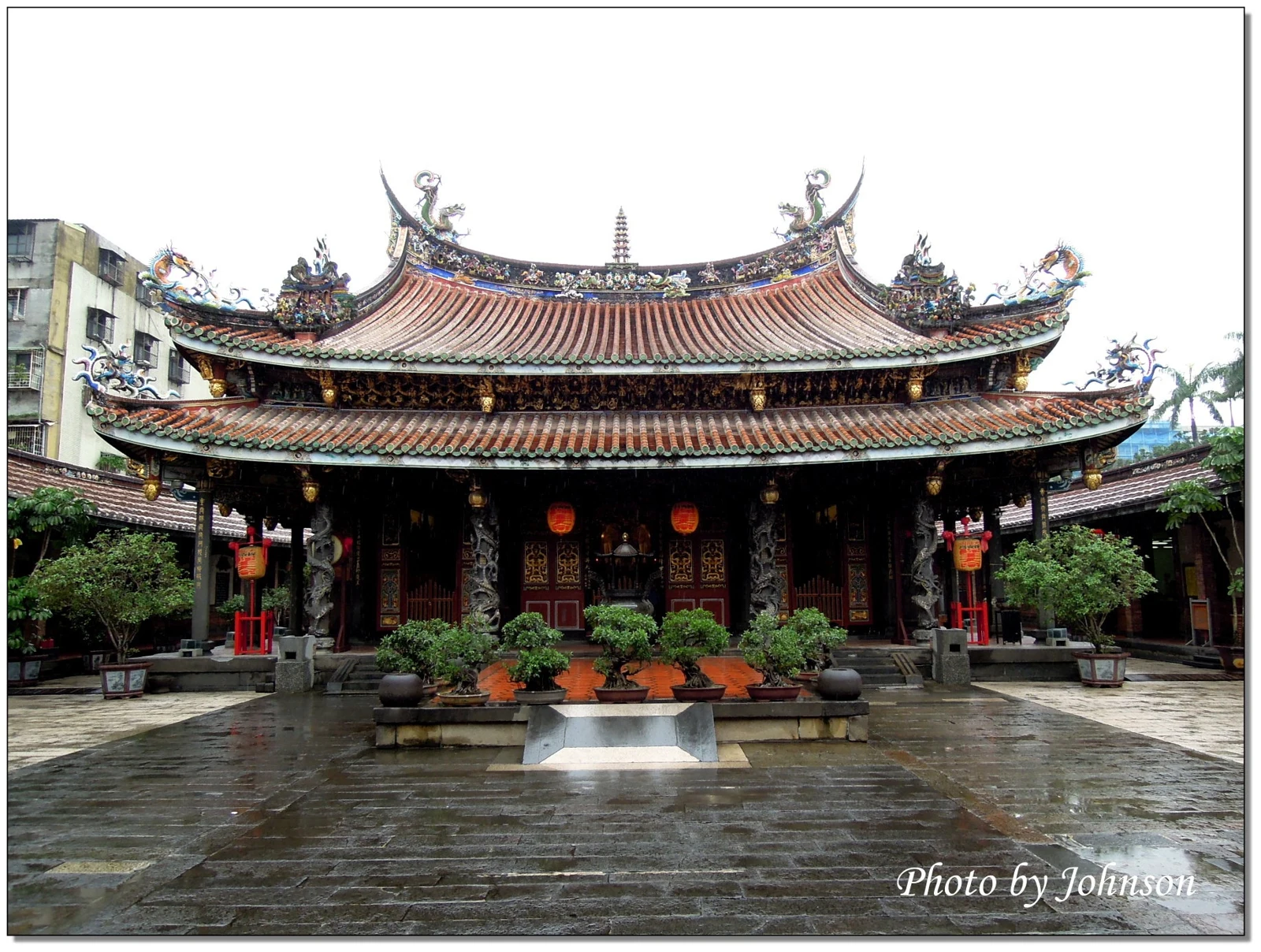
The deity’s birthday falls on lunar March 15; the wider festival is usually held in spring and early summer.
Plan an evening for family-sponsored opera, with time beforehand for the temple’s carved and painted architecture.
When a surname paid for a performance
In Dalongdong, family-sponsored opera once linked a surname group’s resources to a performance offered to Baosheng Dadi. A stage assembled for the deity also gathered neighbours, allowing theatre to become part of the temple calendar. As residents moved away and new households arrived, the old clan-based arrangements changed. Keeping the performances alive required a form of participation that could reach beyond the original surname groups.
The Baosheng Cultural Festival began in 1994, expanding the temple celebration into a programme of performance, heritage and community activity. The family-opera stage now includes professional companies, school groups and performers trained by the temple. In 2026 its selected groups included the National Taiwan College of Performing Arts, Yongle Elementary School and the temple’s own opera and puppet-theatre learners. The name retains the older social memory while the cast of participants continues to widen.
One evening on the stage, several calendars around it
On April 19, 2026, the festival opened with the youth company of Tang Mei-yun Taiwanese Opera presenting Long Feng Qing Yuan. The family-opera programme ran through May 14, within the wider festival ending on June 16. An evening performance gives visitors time to settle into a story through its singing, spoken passages and instrumental accompaniment. For students and younger performers, the same courtyard provides an audience beyond their usual classroom or rehearsal room.
The performances surround a ritual centre: Baosheng Dadi’s birthday on the fifteenth day of the third lunar month. The birthday ceremony proceeds through three successive offerings, while other days bring processions and the fire-lion rite. The lion’s paper-and-bamboo body belongs to the material craft of the festival as well as its wish to dispel illness and protect the community. Opera, ritual and craftsmanship therefore share the season without following an identical daily schedule.
The temple's account of the 2025 celebration names the making behind the fire lion. Paper-sculpture artisan Li Ching-jung was commissioned to shape it, while craftspeople experienced in Yanshui's beehive fireworks designed its pyrotechnic component. Recovering the custom involved reading historical documents and combining different contemporary skills. The recognisable lion and its firing system thus had separate makers; this is not a construction recipe or evidence that the same people make every later edition.
Three offerings require more than three gestures
Baoan Temple’s account begins the birthday ceremony with three rounds of drumming, welcoming the deity and singing a hymn to Baosheng Dadi. Incense and the first offerings follow, with ritual textiles, a wine cup and the reading of a prayer. The second and third offerings then lead toward sending the deity off and watching the ritual burning. The three stages are therefore parts of a longer sequence, each action prepared and announced before the next begins.
Participants also have different roles. The principal, supporting and accompanying officiants make the offerings, while ritual assistants announce, guide and praise. Baoan’s explanation places these practices within transmitted ritual manuals and distinguishes the number of assistants according to the ceremony’s scale. The measured pace seen from the courtyard rests on this division of labour: someone must know the order, lead the movement and make the spoken cues audible, so that a group can express its respect together.
The 2025 record also lets the ceremony's sound and movement be distinguished. Temple volunteers served as ritual assistants; the temple's Chinese orchestra accompanied the service, and the Yunzhong choir sang the hymn. Sixteen Dalong Elementary School pupils formed four rows for the ritual dance, while the prayer reader used a literary Taiwanese reading. Each group carried a different part of the offering. Their documented participation shows a specific year's transmission in practice, not a fixed cast promised to future visitors.
Before the curtain rises, look up
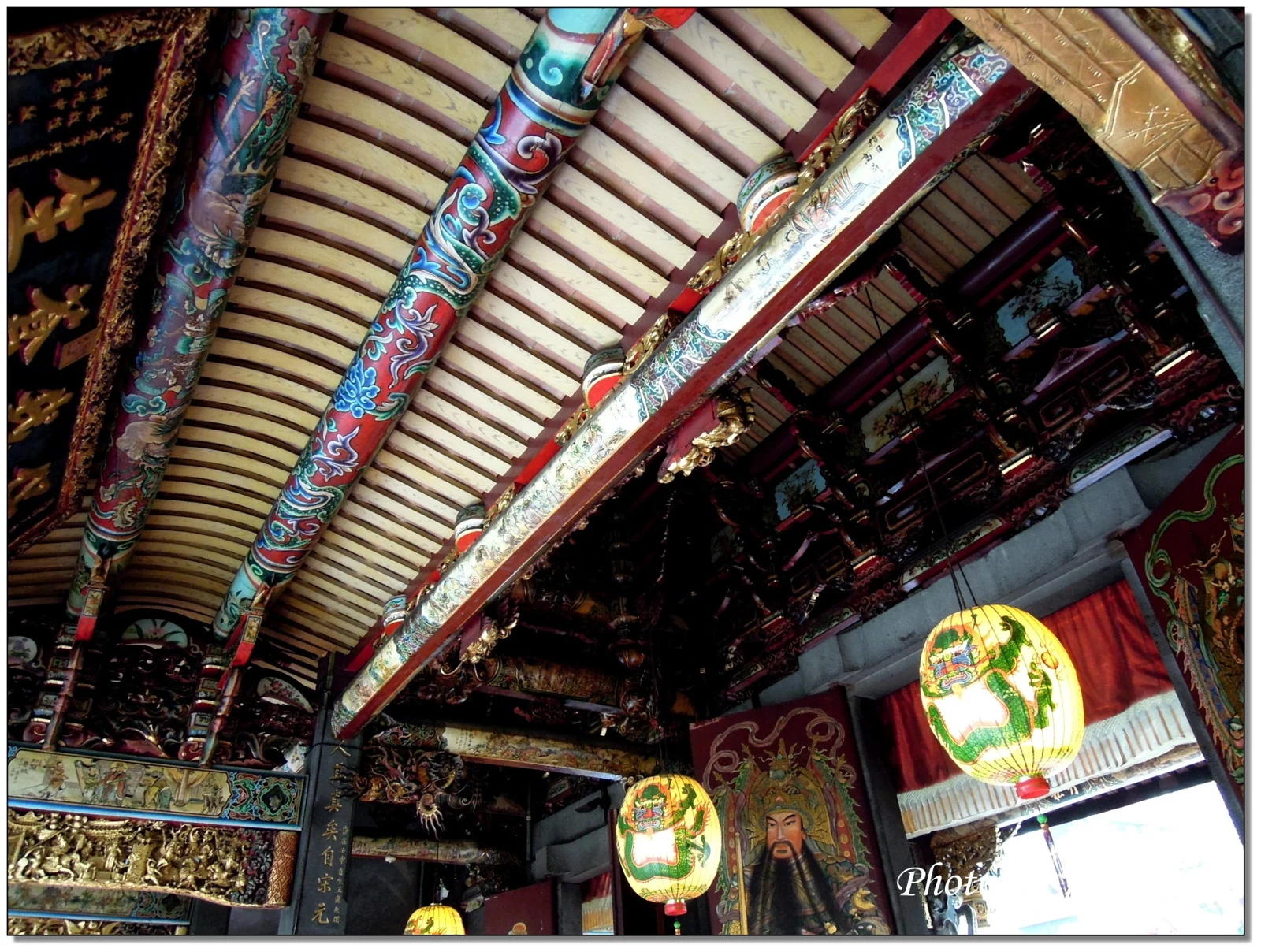
An early arrival makes room for Baoan Temple’s architecture. During the major repair in 1917, master carpenters Chen Yingbin and Guo Ta worked on opposite halves of the main hall. Their side-by-side work leaves a reason to compare rather than glance: how a bracket supports a beam, where carving creates a shadow, and how figures fit into the structure above the worshipper. Painted timber and layered rooflines turn the approach to the hall into a close encounter with making.
The theatre continues this relationship between patient work and public use. Carpenters leave joints and carved details; musicians and actors shape an evening that disappears as it is performed. Both need a place where people will return and pay attention. Moving from the hall to a seat beside the stage lets a visitor experience the temple as a working neighbourhood institution, carrying inherited art into an ordinary city night.
Look closer at the places in the film
Begin with the whole forecourt
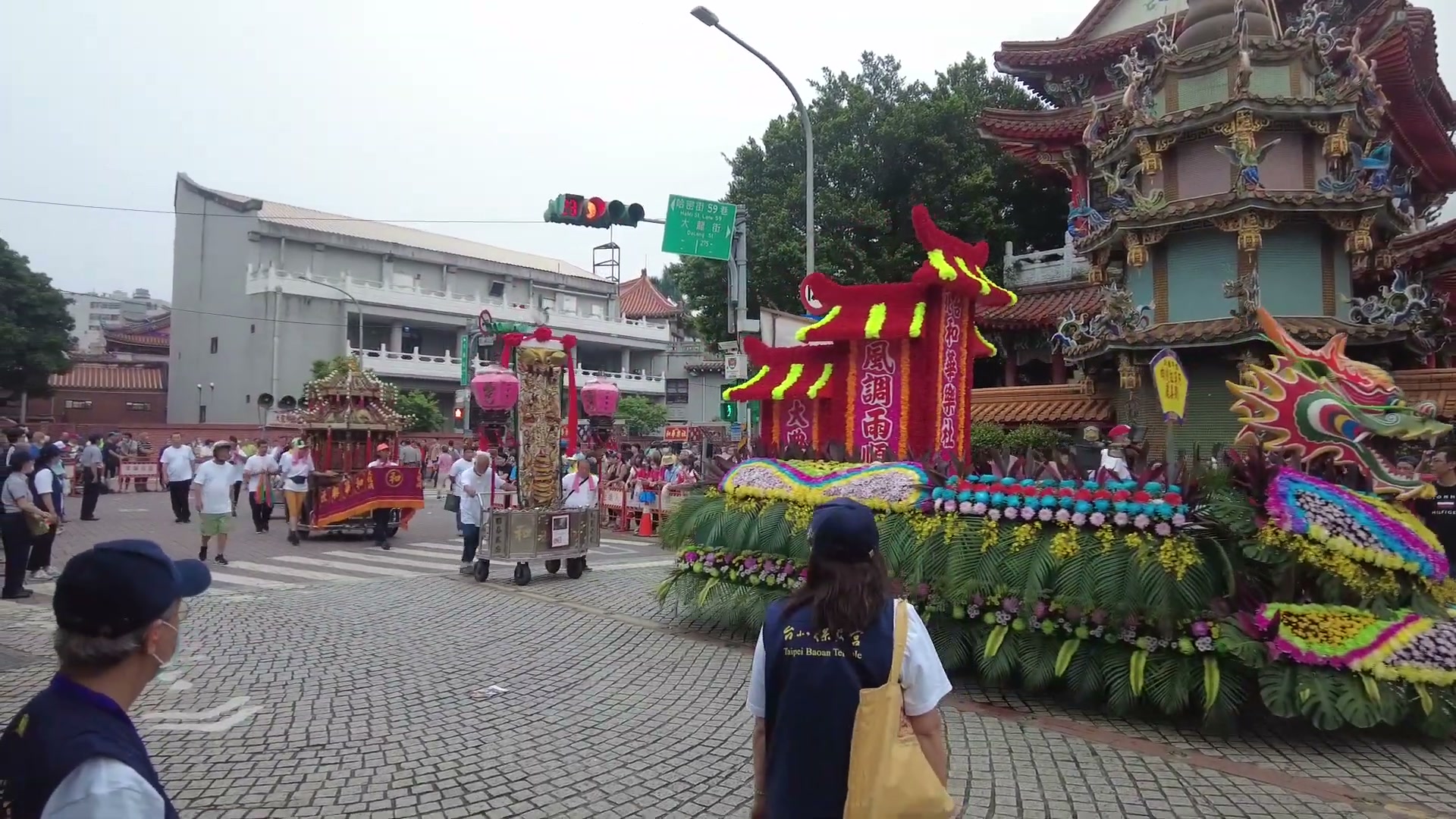
Teams wait to enter the forecourt of Bao’an Temple while spectators find places around its edges. The Baosheng Cultural Festival honours Baosheng Dadi, bringing faith, performing groups, craft and neighbourhood life into one shared place. Begin with the wider view: the temple, the performance space and the audience explain how each group makes its entrance. This 90-second film follows selected scenes from 22 April 2024, moving from the daytime gathering to the night-time fire-lion ceremony.
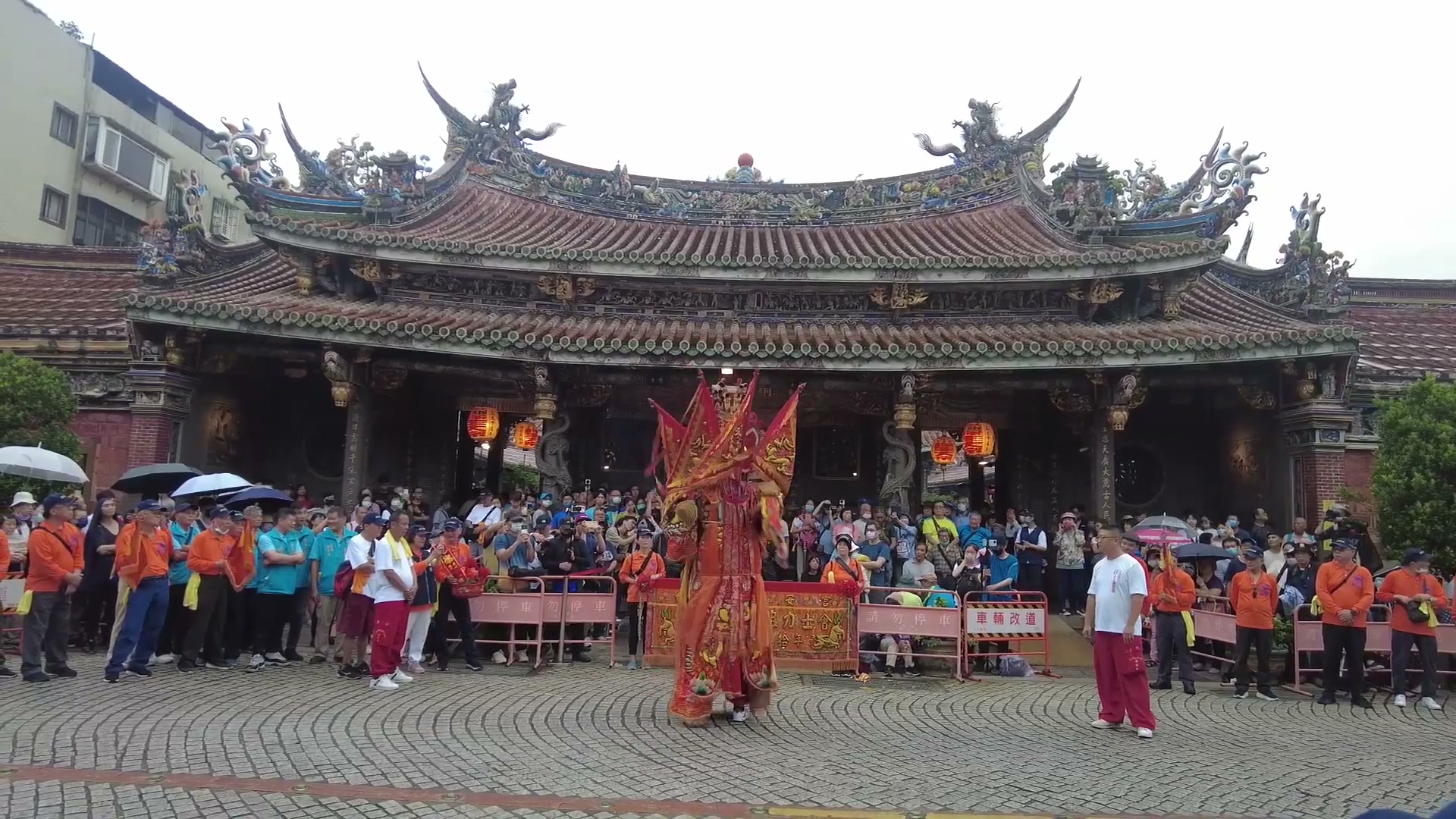
Look beneath the towering figures
When towering ceremonial figures enter the square, their headpieces and robes draw the eye first. Look lower and the movement becomes clearer: steps, turns and small changes of distance carry the whole figure forward. The film keeps the full figures and the surrounding space visible, so the performers’ work can be understood within the procession. The tradition lives both in the crafted object and in the practised movements that bring it into the forecourt.
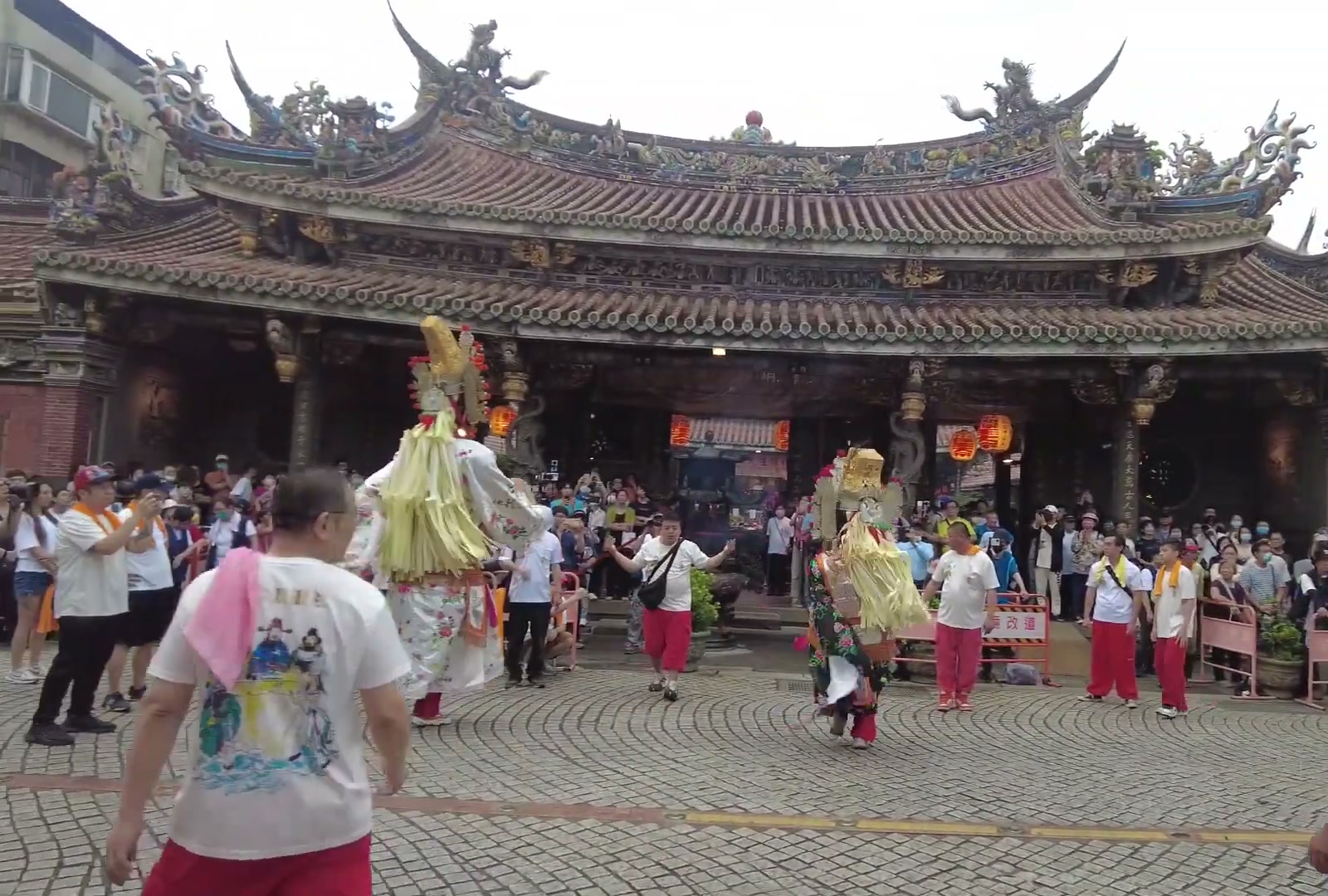
Many roles share one route
Wheels roll past, musicians carry their instruments forward and people leave a little more room when a performer turns. These small adjustments reveal how a procession works. Decorated vehicles and performing groups use the same square in sequence; each group must attend to its own movement and to the people ahead and behind. The film uses the separate instrumental track “Across the Sea.” The instruments and formations are real scenes from the event; the soundtrack was added in editing.
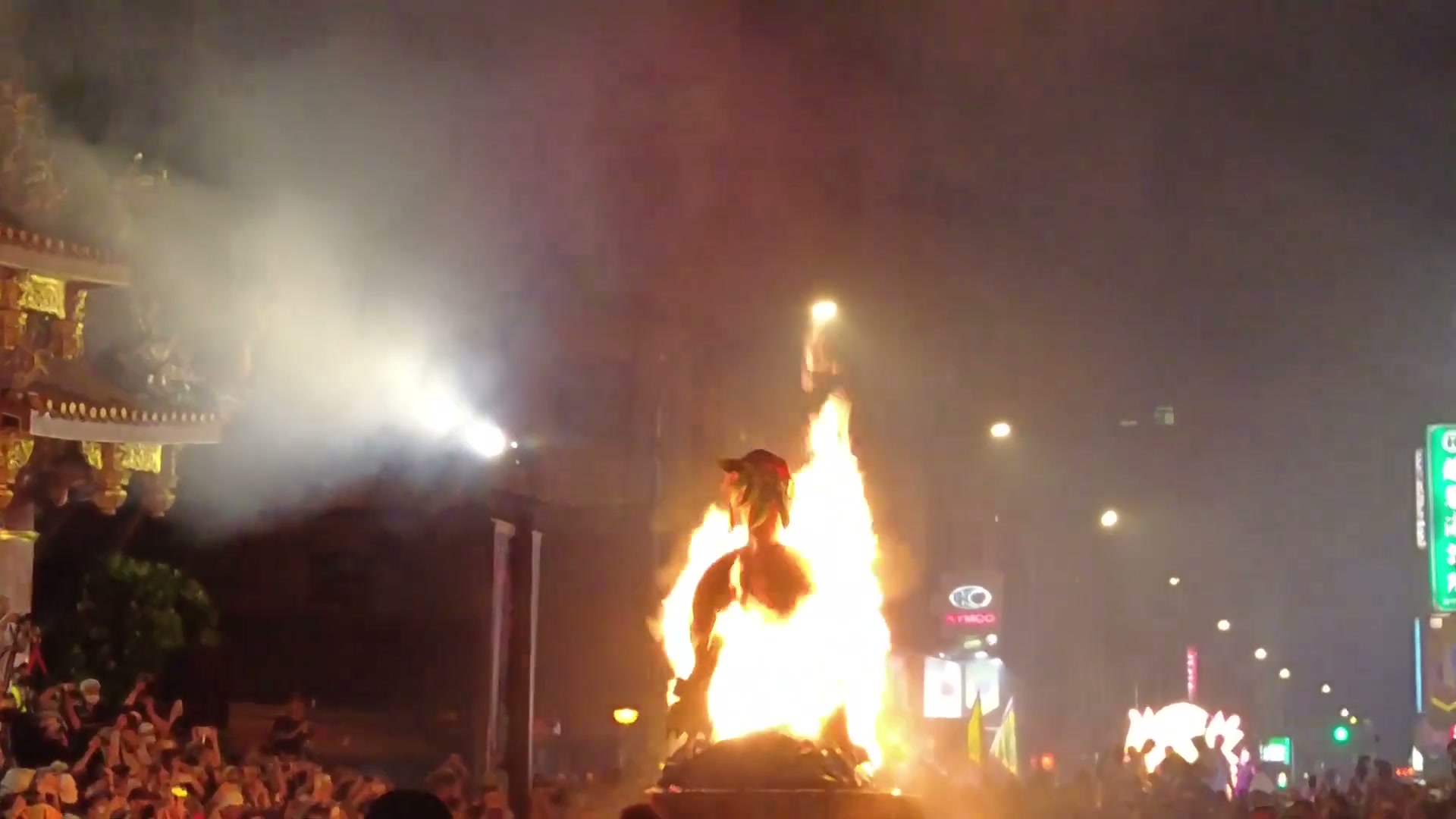
From a paper lion to firelight
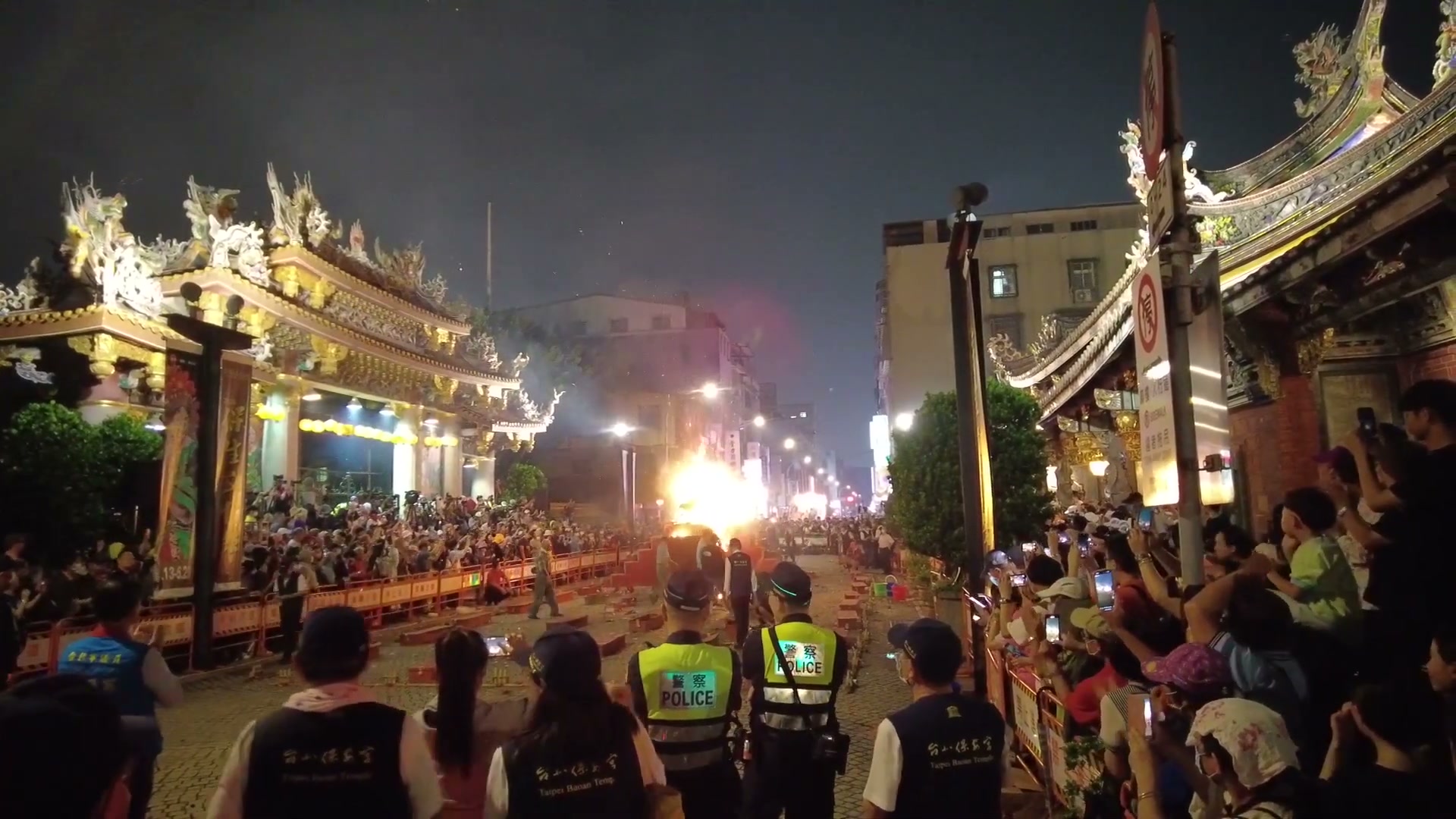
After dark, a paper-crafted lion stands on a red platform in the forecourt, separated from the watching crowd. The film shows its complete unlit form before the first sparks, fireworks above the roofs and the lion’s body burning. These are selected moments from the same edition, edited into a short sequence rather than a continuous 90-second record. Bao’an Temple’s 2024 programme placed performances, the procession and the fire-lion ceremony on 22 April. During a visit, remain in the designated audience area and follow the guidance on site.
Leave room for another visit
The festival includes more than one event. Family-sponsored opera, performing groups and rituals each have their own place in the programme; this short film visits the forecourt on one day in 2024. That edition has ended. Check Bao’an Temple’s latest announcement for future dates, performances and visiting arrangements. Outside the festival, the temple at 61 Hami Street, Datong District, Taipei, offers another starting point: notice the forecourt and rooflines, then explore the surrounding Dalongdong streets. A place can also be understood beyond its busiest moment.
Film, article and image sources
Re-edited archival coverage identified by the creator as 22 April 2024 and corroborated by the temple’s 2024 programme. This is not a live 2026 report or an announcement of future dates.
- 【2024大龍峒保生文化祭】三年一次保生大帝聖誕遶境微記錄
- 【2024大龍峒保生文化祭】壓軸高潮「放火獅」~~蜂炮煙火狂炸16分鐘超震撼!無冷場!
- 保安宮官方:2024保生文化祭日程表
- 保安宮官方:2024保生文化祭回顧
- 大龍峒保安宮官方網站
1. 零肆貳拾捌 / 0428 · 2024
2. 零肆貳拾捌 / 0428 · 2024
3. 零肆貳拾捌 / 0428 · 2024
4. 零肆貳拾捌 / 0428 · 2024
5. 零肆貳拾捌 / 0428 · 2024
Music: 跨海的一段路 (AI-generated instrumental).
Look closer
Compare the two sides of the main hall, then listen for the relationship between singing and instrumental cues on stage.
During fire-lion events, remain in the designated audience area; keep ritual passages and performance entrances clear.
Visiting information
- When
- Birthday: lunar March 15. The 2026 festival ran April 19–June 16; family opera was scheduled April 19–May 14, with evening programmes around 19:00–21:30. The listed 2026 festival programme has ended.
- Place and opening
- Dalongdong Baoan Temple, No. 61, Hami Street, Datong District, Taipei; ordinary temple visiting hours 06:30–22:00.
- Getting there
- From Yuanshan MRT Exit 2, follow Kulun Street and turn right into Dalong Street; the temple describes the walk as about 15 minutes.
- Return
- After an evening performance, walk back to Yuanshan along the same streets; leave time for your final MRT transfer.